This website uses cookies to enhance your browsing experience and ensure the functionality of our site. For more detailed information about the types of cookies we use and how we protect your privacy, please visit our Privacy Information page.
×
Cookie Settings
This website uses different types of cookies to enhance your experience. Please select your preferences below:
Valenciennea puellaris, Maiden goby : fisheries, aquarium
> Gobiiformes (Gobies) > Gobiidae (Gobies) > Gobiinae
Etymology: Valenciennea:From Achille Valenciennes 1794-1865; he worked with Duméril, Cuvier and Lacepède since 1815; malacologist, author of a "Histoire naturelle des poissons" (Ref. 45335). Eponymy: Achille Valenciennes (1794–1865) was a French zoologist; primarily an ichthyologist and conchologist. [...] (Ref. 128868), visit book page.
Môi trường: môi trường / vùng khí hậu / Mức độ sâu / phạm vi phân phối Sinh thái học
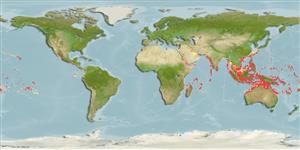
biển cùng sống ở rạn san hô; không di cư (Ref. 52884); mức độ sâu 2 - 84 m (Ref. 86942), usually 10 - 30 m (Ref. 8527). Tropical; 22°C - 26°C (Ref. 27115); 32°N - 24°S
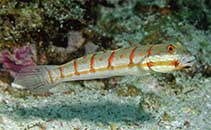
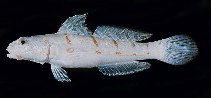
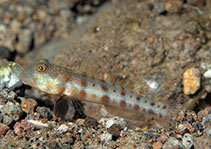
Các tia vây lưng cứng (tổng cộng) : 7; Các vây lưng mềm (tổng cộng) : 11 - 12; Tia cứng vây hậu môn: 1; Tia mềm vây hậu môn: 11 - 12. Characterized by pale grey body color for Pacific fish with row of large orange spots on side, a series of dash-like markings below, smaller orange spots on back and blue to whitish streaks or spots on head; Indian Ocean fish with pale blue-grey body color with orange stripe across lower head, cheeks with blue markings and orange bars on side connected to pale orange stripe on lower half; third dorsal spine, longest, filamentous in juveniles under 40 mm SL; rounded caudal fin, 3.0-4.2 in SL; longitudinal scale series 79-91; ctenoid body scales, becoming cycloid anteriorly before first dorsal fin, on lower side, and midline of abdomen; head or midline of nape without scales; side of nape with scales extending forward to above middle of operculum; scaleless pectoral fin base; partly to fully scaled prepelvic area; depth of body 4.8-6.0 in SL (Ref. 90102). Body shape (shape guide): fusiform / normal.
Adults inhabit sandy areas of clear lagoon and seaward reefs (Ref. 9710, 48637). They occur in pairs and use burrows as refuge. Monogamous (Ref. 52884). The burrow is shallow, only a few cm, and made under large pieces of rubble. May be found on dark volcanic sand such as those in the Philippines, Indonesia, and the northern Mariana Is. Also Ref. 58652.
Vòng đời và hành vi giao phối Chín muồi sinh dục | Sự tái sinh sản | Đẻ trứng | Các trứng | Sự sinh sản | Ấu trùng
Monogamous mating is observed as both obligate and social (Ref. 52884).
Hoese, D.F. and H.K. Larson, 1994. Revision of the Indo-Pacific gobiid fish genus Valenciennea, with descriptions of seven new species. Indo-Pac. Fish. (23):71 p. (Ref. 8527)
Tình trạng Sách đỏ IUCN (Ref. 130435: Version 2025-2 (Global))
Vòng đời Sự tái sinh sản Chín muồi sinh dục Độ trưởng thành/Mang liên quan Sự sinh sản Đẻ trứng Tập hợp sinh sản Các trứng Sự phát triển của trứng Ấu trùng Sự biến động ấu trùng
Nhiệt độ ưa thích (Tài liệu tham khảo 123201): 25.5 - 29, mean 28 °C (based on 842 cells).
Chỉ số đa dạng phát sinh loài (Tài liệu tham khảo 82804): PD50 = 0.5000 [Uniqueness, from 0.5 = low to 2.0 = high].
Bayesian length-weight: a=0.01023 (0.00477 - 0.02194), b=3.01 (2.83 - 3.19), in cm total length, based on LWR estimates for this (Sub)family-body shape (Ref. 93245).
Mức dinh dưỡng (Tài liệu tham khảo 69278): 3.2 ±0.3 se; based on size and trophs of closest relatives
Thích nghi nhanh (Tài liệu tham khảo 120179): Trung bình, thời gian nhân đôi của chủng quần tối thiểu là 1.4 - 4.4 năm (Preliminary K or Fecundity.).
Sự dễ bị tổn thương của nghề đánh cá (Ref. 59153): Low vulnerability (14 of 100). 🛈