>
Myctophiformes (Lanternfishes) >
Myctophidae (Lanternfishes) > Myctophinae
Etymology: Benthosema: Greek, benthos = depth of the sea + Greek, sema, sematos = signal, flag (Ref. 45335).
More on authors: Gilbert & Cramer.
Environment: milieu / climate zone / intervalo de profundidade / distribution range
Ecologia
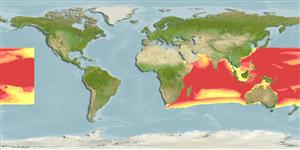
marinhas batipelágico; oceanódromo (Ref. 51243); intervalo de profundidade 0 - 2000 m (Ref. 26165). Deep-water; 33°N - 42°S, 19°E - 139°W
Indian Ocean: 18°N-20°S, to 42°S in the Agulhas Current. Pacific Ocean: 21°N-10°S.
Length at first maturity / Tamanho / Peso / Idade
Maturidade: Lm ?, range 4 - ? cm
Max length : 10.0 cm TL macho/indeterminado; (Ref. 9835)
Espinhos dorsais (total) : 0; Raios dorsais moles (total) : 12 - 14; Espinhos anais: 0; Raios anais moles: 18 - 20; Vértebras: 31 - 32. Anal organs 10-11; mature males have large 3 to 5 translucent supracaudal gland and smaller infracaudal gland; mature females have small supracaudal gland and much smaller infracaudal patches (Ref. 39633).
Body shape (shape guide): fusiform / normal.
Benthopelagic and mesopelagic in slope and oceanic waters, but usually not high-oceanic. Occurs in the upper 200 m at night (Ref. 4066). Epipelagic in nearshore areas at 0-856 m (Ref. 58302). Occasionally seen during dark nights on slopes that are near very deep water. Attracted by light like moths, becoming disoriented and darting frantically in all directions (Ref. 48635).
Life cycle and mating behavior
Maturidade | Reprodução | Desova | Ovos | Fecundidade | Larvas
Paxton, J.R. and P.A. Hulley, 1999. Myctophidae. Lanternfishes. p. 1957-1964. In K.E. Carpenter and V.H. Niem (eds.) FAO species identification guide for fishery purposes. The living marine resources of the WCP. Vol. 3. Batoid fishes, chimaeras and bony fishes part 1 (Elopidae to Linophrynidae). FAO, Rome. (Ref. 9835)
Categoria na Lista Vermelha da IUCN (Ref. 130435: Version 2025-1)
Ameaça para o homem
Harmless
Utilização humana
Pescarias: de interesse potencial
Ferramentas
Relatórios especiais
Descarregue XML
Fontes da internet
Estimates based on models
Preferred temperature (Ref.
123201): 5.6 - 14.4, mean 8.9 °C (based on 788 cells).
Phylogenetic diversity index (Ref.
82804): PD
50 = 0.5312 [Uniqueness, from 0.5 = low to 2.0 = high].
Bayesian length-weight: a=0.00851 (0.00371 - 0.01953), b=3.08 (2.89 - 3.27), in cm total length, based on LWR estimates for this (Sub)family-body shape (Ref.
93245).
Nível Trófico (Ref.
69278): 3.2 ±0.33 se; based on food items.
Resiliência (Ref.
120179): Elevada, tempo mínimo de duplicação da população menor que 15 meses (K=5.62; tmax=1).
Fishing Vulnerability (Ref.
59153): Low vulnerability (10 of 100).
🛈
Nutrients (Ref.
124155): Calcium = 291 [71, 933] mg/100g; Iron = 1.67 [0.55, 4.95] mg/100g; Protein = 18 [15, 20] %; Omega3 = 0.517 [0.218, 1.219] g/100g; Selenium = 63.2 [19.8, 210.1] μg/100g; VitaminA = 22.9 [3.2, 118.3] μg/100g; Zinc = 1.25 [0.60, 2.69] mg/100g (wet weight); based on
nutrient studies.