>
Scombriformes (Mackerels) >
Trichiuridae (Cutlassfishes) > Lepidopodinae
Etymology: Evoxymetopon: Greek, eu = good + Greek, oxys = sharpen + Greek, metopon = brow (Ref. 45335).
More on author: Gill.
Environment: milieu / climate zone / intervalo de profundidade / distribution range
Ecologia
marinhas bentopelágico; intervalo de profundidade ? - 200 m (Ref. 13628), usually 100 - 200 m (Ref. 13628). Deep-water; 35°N - 29°S, 126°E - 39°W (Ref. 6181)
Western Atlantic: Bahamas, Caribbean Sea, and off southern Brazil (specimens found at the Institut für Seefischerei, Universität Hamburg collected from 24°40'S, 44°35'W). Northwest Pacific: Cheju Do Island, south of Korean Peninsula.
Tamanho / Peso / Idade
Maturidade: Lm ? range ? - ? cm
Max length : 200 cm SL macho/indeterminado; (Ref. 6181); common length : 155 cm SL macho/indeterminado; (Ref. 6181); peso máx. Publicado: 1.7 kg (Ref. 5217)
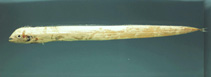
Raios dorsais moles (total) : 81 - 90; Espinhos anais: 0; Raios anais moles: 60. Lateral line fairly straight, running mid laterally or slightly nearer the ventral contour than the dorsal contour. First anal fin ray scale-like, others ordinal and short. Pelvic fins reduced to a scale-like process spine. Body silvery white with slight red-brownish on dorsal part; several longitudinal pale yellow stripes on body.
Body shape (shape guide): elongated; Cross section: compressed.
Occurs on the continental slope and sometimes the continental shelf.
Life cycle and mating behavior
Maturidade | Reprodução | Desova | Ovos | Fecundidade | Larvas
Nakamura, I. and N.V. Parin, 1993. FAO Species Catalogue. Vol. 15. Snake mackerels and cutlassfishes of the world (families Gempylidae and Trichiuridae). An annotated and illustrated catalogue of the snake mackerels, snoeks, escolars, gemfishes, sackfishes, domine, oilfish, cutlassfishes,. scabbardfishes, hairtails, and frostfishes known to date. FAO Fish. Synop. 125(15):136 p. (Ref. 6181)
Categoria na Lista Vermelha da IUCN (Ref. 130435: Version 2025-1)
Ameaça para o homem
Harmless
Utilização humana
Pescarias: pescarias de subsistência; peixe desportivo: sim
Ferramentas
Relatórios especiais
Descarregue XML
Fontes da internet
Estimates based on models
Preferred temperature (Ref.
123201): 16.1 - 23.6, mean 19.5 °C (based on 75 cells).
Phylogenetic diversity index (Ref.
82804): PD
50 = 0.5625 [Uniqueness, from 0.5 = low to 2.0 = high].
Bayesian length-weight: a=0.00219 (0.00097 - 0.00493), b=2.99 (2.78 - 3.20), in cm total length, based on LWR estimates for this species & (Sub)family-body (Ref.
93245).
Nível Trófico (Ref.
69278): 4.5 ±0.7 se; based on size and trophs of closest relatives
Resiliência (Ref.
120179): Baixo, tempo mínimo de duplicação da população 4,5 - 14 anos (Preliminary K or Fecundity.).
Fishing Vulnerability (Ref.
59153): Very high vulnerability (90 of 100).
🛈