


Scleropages jardinii (Saville-Kent, 1892)
Australian bonytongue
Uploaden van uw Foto's en video's
Afbeeldingen | Google afbeelding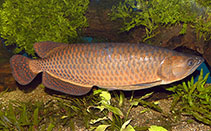 Scleropages jardinii
Afbeelding van Muséum-Aquarium de Nancy/B. Alenda
Afbeeldingen | Google afbeelding
Afbeelding van Muséum-Aquarium de Nancy/B. Alenda
Classificatie / Namen Lokale namen | Synoniemen | Catalog of Fishes(Genus, Soort(en)) | ITIS | CoL | WoRMS | Cloffa
> Osteoglossiformes (Bony tongues) > Osteoglossidae (Arowanas)
Etymology: Scleropages: Greek, skleros = hard + Greek, page, -es = knot (Ref. 45335).
Eponymy: Francis Lascelles ‘Frank’ Jardine (1841–1919) was a pastoralist and pioneer associated with the exploration and settlement of the Cape York Peninsula in Queensland, where the Jardine River is named after him. [...] (Ref. 128868), visit book page.
More on author: Saville-Kent.
Etymology: Scleropages: Greek, skleros = hard + Greek, page, -es = knot (Ref. 45335).
Eponymy: Francis Lascelles ‘Frank’ Jardine (1841–1919) was a pastoralist and pioneer associated with the exploration and settlement of the Cape York Peninsula in Queensland, where the Jardine River is named after him. [...] (Ref. 128868), visit book page.
More on author: Saville-Kent.
Milieu: milieu / Klimaatzone / Diepte / verspreidingsgebied Ecologie
; zoet water pelagisch. Tropical; ? - 15°C (Ref. 44894); 6°S - 14°S
Verspreiding Gebieden | FAO regio's | Ecosystemen | Voorkomen | Verspreidingskaart | Introducties | Faunafri
Asia and Oceania: northern Australia and central-southern New Guinea (Ref. 58511).
Lengte bij maturiteit / Grootte / Gewicht / Leeftijd
Maturiteit: Lm 45.0 range ? - ? cm
Max length : 100.0 cm SL mannelijk / geslacht onbekend; (Ref. 44894); common length : 55.0 cm SL mannelijk / geslacht onbekend; (Ref. 44894)
Max length : 100.0 cm SL mannelijk / geslacht onbekend; (Ref. 44894); common length : 55.0 cm SL mannelijk / geslacht onbekend; (Ref. 44894)
Korte beschrijving Determinatiesleutels | Morfologie | Morfometrie
Dorsale stekels (totaal) : 0; Dorsale zachte stralen (totaal) : 20 - 24; Anale stekels: 0; Anale zachte stralen: 28 - 32.
Body shape (shape guide): fusiform / normal.
Body shape (shape guide): fusiform / normal.
Adults occur in still waters of streams and swamps where it is usually seen near the surface or close to shore among aquatic vegetation (Ref. 2847, 44894). Solitary, territorial and spawn prior to the wet season when surface water temperatures approach 30°C (Ref. 44894). Young feed primarily on microcrustaceans (Ref. 2847). Primarily a surface feeder, feeding on a variety of terrestrial and aquatic insects, small fishes, frogs, crustaceans, and some plant material (Ref. 44894). Mouthbrooders (Ref. 56180). Maximum weight reported in Ref. 5259 may be 12.27 kg (W. Lau, pers. Comm. 07/05). Important food fish (Ref. 58511) and a valuable aquarium fish (Ref. 83518).
Levenscyclus en paargedrag Maturiteit | Voortplanting | Paaien | Eieren | Fecunditeit | Larven
Fertilized eggs are carried in the mouth of the female. Eggs hatch in 1-2 weeks. Larvae, with their enlarged yolk sac, are kept in or close to the mouth for another 4 or 5 weeks. Young fish commence feeding, primarily on microcrustaceans, at a size of 2-3 cm, well before the yolk sac is entirely resorbed. Become independent at a length of 3.5-4.0 cm.
Hoofdreferentie
Upload uw referenties | Referenties | Coördinator | Medewerkers
Allen, G.R., 1991. Field guide to the freshwater fishes of New Guinea. Publication, no. 9. 268 p. Christensen Research Institute, Madang, Papua New Guinea. (Ref. 2847)
Status op de Rode Lijst van het IUCN (Ref. 130435: Version 2025-2 (Global))
Niet bedreigd (LC) ; Date assessed: 14 February 2019
CITES
Not Evaluated
Gevaar voor de mens
Harmless
Gebruik door de mens
Visserij: van geen belang; Aquacultuur: commercieel; sportvis: ja; Aquarium: Commercieel
FAO - Publication: search | FishSource |
Meer informatie
Trofische ecologie
Voedsel (prooien)
Dieetsamenstelling
Voedselconsumptie
Voedselrantsoenen
Predatoren
Voedsel (prooien)
Dieetsamenstelling
Voedselconsumptie
Voedselrantsoenen
Predatoren
Populatiedynamica
Groeiparameters
Max. leeftijden / maten
Lengte-gewicht rel.
Lengte-lengte rel.
Lengtefrequenties
Massaconversie
Rekrutering
Abundantie
Groeiparameters
Max. leeftijden / maten
Lengte-gewicht rel.
Lengte-lengte rel.
Lengtefrequenties
Massaconversie
Rekrutering
Abundantie
Levenscyclus
Voortplanting
Maturiteit
Rijpheid/kieuwen rel.
Fecunditeit
Paaien
Paaibestanden
Eieren
Ontwikkeling van de eieren
Larven
Larvale populatiedynamiek
Voortplanting
Maturiteit
Rijpheid/kieuwen rel.
Fecunditeit
Paaien
Paaibestanden
Eieren
Ontwikkeling van de eieren
Larven
Larvale populatiedynamiek
Fysiologie
Lichaamssamenstelling
Voedingsstoffen
Zuurstofverbruik
Type zwemmen
Zwemsnelheid
Visuele pigmenten
Vis geluid
Ziekten en parasieten
Toxiciteit (LC50)
Lichaamssamenstelling
Voedingsstoffen
Zuurstofverbruik
Type zwemmen
Zwemsnelheid
Visuele pigmenten
Vis geluid
Ziekten en parasieten
Toxiciteit (LC50)
Genetica
genoom
Genetica
Heterozygositeit
Erfelijkheid
Genetische diversiteit
genoom
Genetica
Heterozygositeit
Erfelijkheid
Genetische diversiteit
Menselijk gerelateerd
Aquacultuursystemen
Aquacultuurprofielen
Kweeklijnen
Ciguatera gevallen
Postzegels, munten, diversen.
Aquacultuursystemen
Aquacultuurprofielen
Kweeklijnen
Ciguatera gevallen
Postzegels, munten, diversen.
Tools
Biologische quiz | E-boek | Veldgids | Lengtefrequentie Tool | Levenscyclus tool | Verspreidingskaart |
Vangst-MSY |
Speciale rapporten
Bekijk gegevens voor het houden in een aquarium | Bekijk Fact Sheets voor de soort | Bekijk Aquacultuur Fact Sheets
Download XML
Internetbronnen
AFORO (otoliths) | Exoten/Invasieve soorten database | Aquatic Commons | BHL | Cloffa | Websites from users | Bekijk FishWatcher | CISTI | Catalog of Fishes: Genus, Soort(en) | DiscoverLife | ECOTOX | FAO - Publication: search | Faunafri | Fishipedia | Fishtrace | GloBI | Google Books | Google Scholar | Google | IGFA World Record | OneZoom | Open Tree of Life | Otolith Atlas of Taiwan Fishes | Publieke aquaria | PubMed | Reef Life Survey | Socotra Atlas | TreeBase | Tree of Life | Wikipedia: ga naar, zoek | World Records Freshwater Fishing | Zoological Record
Schattingen op basis van modellen
Fylogenetische diversiteitsindex (Ref. 82804): PD50 = 0.5781 [Uniqueness, from 0.5 = low to 2.0 = high].
Bayesian length-weight: a=0.01122 (0.00514 - 0.02450), b=3.04 (2.87 - 3.21), in cm total length, based on all LWR estimates for this body shape (Ref. 93245).
Trofisch niveau (Ref. 69278): 2.8 ±0.1 se; based on diet studies.
Weerstandsvermogen (Ref. 120179): laag, minimale populatieverdubbelingstijd 4,5-14 jaar (tm=4-5; Fec=30-130).