


Scleropages leichardti Günther, 1864
Southern saratoga
Uploaden van uw Foto's en video's
Afbeeldingen | Google afbeelding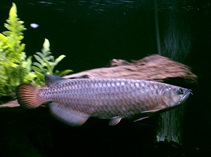 Scleropages leichardti
Afbeelding van Poole, S.
Afbeeldingen | Google afbeelding
Afbeelding van Poole, S.
Classificatie / Namen Lokale namen | Synoniemen | Catalog of Fishes(Genus, Soort(en)) | ITIS | CoL | WoRMS | Cloffa
> Osteoglossiformes (Bony tongues) > Osteoglossidae (Arowanas)
Etymology: Scleropages: Greek, skleros = hard + Greek, page, -es = knot (Ref. 45335).
Eponymy: Friedrich Wilhelm Ludwig Leichhardt (1813–1848) was a Prussian naturalist and explorer noted for having made a three-thousand-mile journey across Australia. [...] (Ref. 128868), visit book page.
More on author: Günther.
Etymology: Scleropages: Greek, skleros = hard + Greek, page, -es = knot (Ref. 45335).
Eponymy: Friedrich Wilhelm Ludwig Leichhardt (1813–1848) was a Prussian naturalist and explorer noted for having made a three-thousand-mile journey across Australia. [...] (Ref. 128868), visit book page.
More on author: Günther.
Taxonomic Remarks
Doubt about this species' source and geographic origin of type material and provenance of the original descriptions all strongly suggest that Günther based his description on material collected from within the range of the more widespread taxon S. jardinii. A revision of the Australian species within the genus Scleropages is needed (Ref. 131545). Please send us reference(s) regarding further studies of this species (or species under this genus).
Milieu: milieu / Klimaatzone / Diepte / verspreidingsgebied Ecologie
; zoet water pelagisch. Tropical; 24°C - 40°C (Ref. 40276)
Verspreiding Gebieden | FAO regio's | Ecosystemen | Voorkomen | Verspreidingskaart | Introducties | Faunafri
Oceania: Fitzroy River system of central-eastern Queensland, Australia. Introduced to a few other systems in southeastern Queensland. Protected in Indonesia, where it does not occur, probably as a misidentification of Scleropages jardinii (Ref. 12217).
Grootte / Gewicht / Leeftijd
Maturiteit: Lm ? range ? - ? cm
Max length : 100.0 cm SL mannelijk / geslacht onbekend; (Ref. 44894); common length : 55.0 cm SL mannelijk / geslacht onbekend; (Ref. 44894)
Max length : 100.0 cm SL mannelijk / geslacht onbekend; (Ref. 44894); common length : 55.0 cm SL mannelijk / geslacht onbekend; (Ref. 44894)
Live in still waters and slow-flowing sections of streams. They are usually seen near the surface or near shore among aquatic vegetation (Ref. 39857, 44894). Territorial and aggressive towards other fishes, particularly conspecifics. Scratches and wounds resulting from fighting arre frequently exhibited by adults captured in the wild (Ref. 44894). Feed on aquatic and terrestrial insects, fishes, frogs and crayfish. Mouthbrooders (Ref. 39857, 44894). Breeding occurs prior to the wet season at temperatures between 20°C and 23°C. A renowned angling species (Ref. 44894).
Levenscyclus en paargedrag Maturiteit | Voortplanting | Paaien | Eieren | Fecunditeit | Larven
"Spawning is by direct pairing. For several days prior to the estimated egg-laying time, the pairs were in continuous close company, swimming near the surface. Courting activities include close following, intermittent angled swimming (head down), vent nudging and lifting by the male. Individual males are capable of participating in at least two spawnings per season. A male will repair with a new available female within several weeks of an initial mating.
Females carrying unhatched eggs or larvae in the mouth are distinguished by a conspicuous white chin during the incubation period. Incubating females spend more time at the surface, exhibit no aggression to other non-carrying individuals and show no interest in food. Occasionally two incubating females will briefly act aggressively towards each other. During the latter stages of incubation the females concerned continually circle and inspect shallow shore areas.
Temporary release and recall of developing larvae occurs during daylight hours. The female comes into the littoral shallows, releases the full brood and continues swimming slowly parallel to the bank. Larvae maintain station around the head of the adult with individuals making brief excursions to the pond edge. The released juveniles are observed closely by the female. A sudden kinking movement of her body is followed by the rapid return of young to her mouth" (Ref. 39857).
Hoofdreferentie
Upload uw referenties | Referenties | Coördinator | Medewerkers
Allen, G.R., 1989. Freshwater fishes of Australia. T.F.H. Publications, Inc., Neptune City, New Jersey. (Ref. 5259)
Status op de Rode Lijst van het IUCN (Ref. 130435: Version 2025-2 (Global))
Gevoelig (NT) (B2b(iv)); Date assessed: 14 February 2019
CITES
Not Evaluated
Gevaar voor de mens
Harmless
Gebruik door de mens
Visserij: commercieel; Aquacultuur: commercieel; sportvis: ja; Aquarium: Publieke aquaria
FAO - Publication: search | FishSource |
Meer informatie
Trofische ecologie
Voedsel (prooien)
Dieetsamenstelling
Voedselconsumptie
Voedselrantsoenen
Predatoren
Voedsel (prooien)
Dieetsamenstelling
Voedselconsumptie
Voedselrantsoenen
Predatoren
Populatiedynamica
Groeiparameters
Max. leeftijden / maten
Lengte-gewicht rel.
Lengte-lengte rel.
Lengtefrequenties
Massaconversie
Rekrutering
Abundantie
Groeiparameters
Max. leeftijden / maten
Lengte-gewicht rel.
Lengte-lengte rel.
Lengtefrequenties
Massaconversie
Rekrutering
Abundantie
Levenscyclus
Voortplanting
Maturiteit
Rijpheid/kieuwen rel.
Fecunditeit
Paaien
Paaibestanden
Eieren
Ontwikkeling van de eieren
Larven
Larvale populatiedynamiek
Voortplanting
Maturiteit
Rijpheid/kieuwen rel.
Fecunditeit
Paaien
Paaibestanden
Eieren
Ontwikkeling van de eieren
Larven
Larvale populatiedynamiek
Anatomie
Kieuwoppervlak
Hersenen
Otoliet
Kieuwoppervlak
Hersenen
Otoliet
Fysiologie
Lichaamssamenstelling
Voedingsstoffen
Zuurstofverbruik
Type zwemmen
Zwemsnelheid
Visuele pigmenten
Vis geluid
Ziekten en parasieten
Toxiciteit (LC50)
Lichaamssamenstelling
Voedingsstoffen
Zuurstofverbruik
Type zwemmen
Zwemsnelheid
Visuele pigmenten
Vis geluid
Ziekten en parasieten
Toxiciteit (LC50)
Genetica
genoom
Genetica
Heterozygositeit
Erfelijkheid
Genetische diversiteit
genoom
Genetica
Heterozygositeit
Erfelijkheid
Genetische diversiteit
Menselijk gerelateerd
Aquacultuursystemen
Aquacultuurprofielen
Kweeklijnen
Ciguatera gevallen
Postzegels, munten, diversen.
Aquacultuursystemen
Aquacultuurprofielen
Kweeklijnen
Ciguatera gevallen
Postzegels, munten, diversen.
Tools
Biologische quiz | E-boek | Veldgids | Lengtefrequentie Tool | Levenscyclus tool | Verspreidingskaart |
Vangst-MSY |
Speciale rapporten
Bekijk gegevens voor het houden in een aquarium | Bekijk Fact Sheets voor de soort | Bekijk Aquacultuur Fact Sheets
Download XML
Internetbronnen
AFORO (otoliths) | Exoten/Invasieve soorten database | Aquatic Commons | BHL | Cloffa | Websites from users | Bekijk FishWatcher | CISTI | Catalog of Fishes: Genus, Soort(en) | DiscoverLife | ECOTOX | FAO - Publication: search | Faunafri | Fishipedia | Fishtrace | GloBI | Google Books | Google Scholar | Google | IGFA World Record | OneZoom | Open Tree of Life | Otolith Atlas of Taiwan Fishes | Publieke aquaria | PubMed | Reef Life Survey | Socotra Atlas | TreeBase | Tree of Life | Wikipedia: ga naar, zoek | World Records Freshwater Fishing | Zoobank | Zoological Record
Schattingen op basis van modellen
Fylogenetische diversiteitsindex (Ref. 82804): PD50 = 0.5781 [Uniqueness, from 0.5 = low to 2.0 = high].
Bayesian length-weight: a=0.00417 (0.00174 - 0.01001), b=3.10 (2.89 - 3.31), in cm total length, based on LWR estimates for this (Sub)family-body shape (Ref. 93245).
Trofisch niveau (Ref. 69278): 3.9 ±0.61 se; based on food items.
Weerstandsvermogen (Ref. 120179): laag, minimale populatieverdubbelingstijd 4,5-14 jaar (Assuming fec < 100).