>
Anguilliformes (Eels and morays) >
Muraenidae (Moray eels) > Muraeninae
Etymology: Gymnothorax: Greek, gymnos = naked + Greek, thorax, -akos = breast (Ref. 45335).
Environment: milieu / climate zone / profondeur / distribution range
Écologie
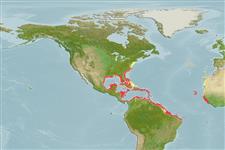
marin récifal; profondeur 1 - 50 m (Ref. 58047), usually 5 - 30 m (Ref. 26938). Tropical; 42°N - 30°S, 99°W - 13°W (Ref. 55256)
Western Atlantic: New Jersey (USA), Bermuda, and northern Gulf of Mexico to Brazil. Recorded once from Nova Scotia, Canada. Eastern Atlantic and eastern Pacific (Ref. 26340).
Taille / Poids / Âge
Maturité: Lm ? range ? - ? cm
Max length : 250 cm TL mâle / non sexé; (Ref. 7251); common length : 150 cm TL mâle / non sexé; (Ref. 5217); poids max. publié: 29.0 kg (Ref. 9710)
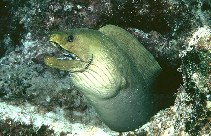
Very large brown moray, uniformly dark green to brown (Ref. 26938).
Body shape (shape guide): eel-like.
A benthic and solitary species (Ref. 26340) occurring along rocky shorelines, reefs, and mangroves (Ref. 3255).Usually found shallower than 30 m (Ref. 26938). Due to its large size and aggressiveness, the bites of this moray are particularly dangerous (Ref. 3255). Feeds mainly at night on fish and crustaceans (Ref. 42064). Marketed fresh and salted (Ref. 3255). Large individuals are ciguatoxic (Ref. 3255).
Life cycle and mating behavior
Maturité | Reproduction | Frai | Œufs | Fécondité | Larves
Spawning migrations and leptocephalus larvae (ref. 42064).
Robins, C.R. and G.C. Ray, 1986. A field guide to Atlantic coast fishes of North America. Houghton Mifflin Company, Boston, U.S.A. 354 p. (Ref. 7251)
Statut dans la liste rouge de l'IUCN (Ref. 130435: Version 2025-1)
Menace pour l'homme
Traumatogenic (Ref. 3255)
Utilisations par l'homme
Pêcheries: intérêt commercial mineur; Aquarium: Aquariums publics
Outils
Articles particuliers
Télécharger en XML
Sources Internet
Estimates based on models
Preferred temperature (Réf.
123201): 23.3 - 28, mean 26 °C (based on 476 cells).
Phylogenetic diversity index (Réf.
82804): PD
50 = 0.5000 [Uniqueness, from 0.5 = low to 2.0 = high].
Bayesian length-weight: a=0.00062 (0.00041 - 0.00093), b=3.27 (3.15 - 3.39), in cm total length, based on LWR estimates for this species & Genus-body shape (Ref.
93245).
Niveau trophique (Réf.
69278): 4.0 ±0.71 se; based on food items.
Résilience (Réf.
120179): Très faible, temps minimum de doublement de population supérieur à 14 ans (Preliminary K or Fecundity.).
Fishing Vulnerability (Ref.
59153): Very high vulnerability (90 of 100).
🛈
Nutrients (Ref.
124155): Calcium = 16 [8, 25] mg/100g; Iron = 0.4 [0.2, 0.8] mg/100g; Protein = 18.7 [16.4, 21.3] %; Omega3 = 0.0823 [, ] g/100g; Selenium = 60.6 [27.2, 130.1] μg/100g; VitaminA = 56.2 [13.7, 218.4] μg/100g; Zinc = 0.72 [0.49, 1.05] mg/100g (wet weight);