


Tripterygion delaisi Cadenat & Blache, 1970
Black-faced blenny
अपना अवलोकन जोड़ें Fish Watcher
| Native range | All suitable habitat | Point map | Year 2050 |
|
| This map was computer-generated and has not yet been reviewed. |
| Tripterygion delaisi AquaMaps Data sources: GBIF OBIS |
अपना अपलोड करें तस्वीरें और वीडियो
तस्वीरे | Google image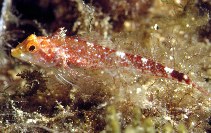 Tripterygion delaisi
Female चित्र स्रोत: AP Patzner, R.
तस्वीरे | Google image
Female चित्र स्रोत: AP Patzner, R.
वर्गीकरण / नाम आम नाम | उपशब्द | Catalog of Fishes(वर्ग, प्रजाति) | ITIS | CoL | WoRMS | Cloffa
> Blenniiformes (Blennies) > Tripterygiidae (Triplefin blennies) > Tripterygiinae
Etymology: Tripterygion: Greek, tres tria = three + Greek, pteron = wing, fin; diminutive (Ref. 45335).
Eponymy: Michel Delais worked at the Institute Française d’Afrique Noire at Gorée in Senegal under Dr J Cadenat. He captured virtually all the specimens that the authors studied, including the blenny holotype off Senegal (1950). (Ref. 128868), visit book page.
Etymology: Tripterygion: Greek, tres tria = three + Greek, pteron = wing, fin; diminutive (Ref. 45335).
Eponymy: Michel Delais worked at the Institute Française d’Afrique Noire at Gorée in Senegal under Dr J Cadenat. He captured virtually all the specimens that the authors studied, including the blenny holotype off Senegal (1950). (Ref. 128868), visit book page.
Taxonomic Remarks
Tripterygion xanthosoma is considered valid in Patzner et al. 2009:449 (Ref. 93609).
पर्यावरण: पर्यावरण / जलवायु क्षेत्र / गहराई सीमा / वितरण सीमा पारिस्थितिकी
समुद्री ड़िमरसल; गहराई सीमा 0 - 40 m (Ref. 4785), usually 6 - 12 m (Ref. 4785). Subtropical; 52°N - 12°N, 19°W - 36°E
वितरण प्रदेशों | ऐफ ऐ ओ क्षेत्र | पारिस्थितिकी प्रणालियों | संयोग | बिन्दु नक्शा | भूमिका | Faunafri
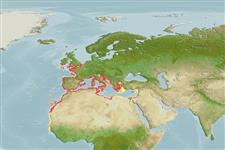
Eastern Atlantic and Mediterranean Sea: English Channel southwards and along the coast of west Africa, including Madeira and the Canary Islands (Ref. 4785), south to Senegal.
आकार / वज़न / आयु
परिपक्व अवधि: Lm ? range ? - ? cm
Max length : 8.9 cm TL पुल्लिंग / अलिंग; (Ref. 5294); common length : 6.0 cm TL पुल्लिंग / अलिंग; (Ref. 5294)
Max length : 8.9 cm TL पुल्लिंग / अलिंग; (Ref. 5294); common length : 6.0 cm TL पुल्लिंग / अलिंग; (Ref. 5294)
Adults inhabit shallow coastal waters with rocky substrate. They are found under overhanging rocks, entrances of caves and other biotopes with reduced light. In the Atlantic, they occur in shallow, light-exposed biotopes. They feed on benthic invertebrates, also on harpacticoids (Ref. 4785), amphipods and other copepods (Ref. 94105). Males court by figure-8-swimming (Ref. 4785). Eggs are hemispherical and covered with numerous sticky threads that anchor them in the algae on the nesting sites (Ref. 240). Larvae are planktonic which occur primarily in shallow, nearshore waters (Ref. 94114).
जीवन चक्र और संभोग व्यवहार परिपक्व अवधि | पुनरुत्पत्ति | मछलीऔ का अंडे देना | अंडे | उपजाऊपन | लार्वा
मुख्य संदर्भ
अपने संदर्भ अपलोड करें | संदर्भ | संयोजक : Fricke, Ronald | सहयोगीयो
Wirtz, P., 1990. Tripterygiidae. p. 916-917. In J.C. Quero, J.C. Hureau, C. Karrer, A. Post and L. Saldanha (eds.) Check-list of the fishes of the eastern tropical Atlantic (CLOFETA). JNICT, Lisbon; SEI, Paris; and UNESCO, Paris. Vol. 2. (Ref. 5294)
आईयूसीएन रेड लिस्ट स्थिति (Ref. 130435: Version 2025-2 (Global))
Least Concern (LC) ; Date assessed: 16 November 2007
CITES
Not Evaluated
मनुष्यों के लिए ख़तरा
Harmless
मानव उपयोग
मात्स्यिकी: बाबत संभावित दिलचस्पी; जलजीवालय: संभावित
FAO - Publication: search | FishSource |
अधिक जानकारी
जनसंख्या गतिशीलता
विकास मापदंड
अधिकतम आयु/आकार
लंबाई-वजन संबंध
लंबाई-लंबाई संबंध
लंबाई-आवृत्तियाँ
सामूहिक रूपांतरण
भर्ती
बहुतायत
विकास मापदंड
अधिकतम आयु/आकार
लंबाई-वजन संबंध
लंबाई-लंबाई संबंध
लंबाई-आवृत्तियाँ
सामूहिक रूपांतरण
भर्ती
बहुतायत
शरीर रचना
गिल क्षेत्र
दिमाग
ओटोलिथ
गिल क्षेत्र
दिमाग
ओटोलिथ
फिजियोलॉजी
शारीरिक संरचना
पोषक तत्व
प्राणवायु की खपत
तैराकी का प्रकार
तैराकी की गति
दृश्य वर्णक
मछली की आवाज
रोग एवं परजीवी
विषाक्तता (LC50s)
शारीरिक संरचना
पोषक तत्व
प्राणवायु की खपत
तैराकी का प्रकार
तैराकी की गति
दृश्य वर्णक
मछली की आवाज
रोग एवं परजीवी
विषाक्तता (LC50s)
आनुवंशिकी
जीनोम
आनुवंशिकी
विषमयुग्मजी
हैरेटिबिलटी
आनुवंशिक विविधता
जीनोम
आनुवंशिकी
विषमयुग्मजी
हैरेटिबिलटी
आनुवंशिक विविधता
साधन
बायो क्विज़ | ई-पुस्तक | कार्यक्षेत्र पथप्रदर्शक | पहचान कुंजी | लंबाई आवृति इंद्रजालिक | जीवन-इतिहास उपकरण | बिन्दु नक्शा |
कैच-एमएसवाई |
विशेष रिपोर्ट
एक्वेरियम के रखरखाव की जांच करें | प्रजातियों के तथ्य पत्रक की जाँच करें | जलीय कृषि तथ्य पत्रक की जाँच करें
XML डाउनलोड करें
सारांश पृष्ठ | बिंदु डेटा | आम नाम | तस्वीरें
इंटरनेट स्रोत
AFORO (otoliths) | Aquatic Commons | BHL | Cloffa | Websites from users | Check FishWatcher | CISTI | Catalog of Fishes: वर्ग, प्रजाति | DiscoverLife | DORIS | ECOTOX | FAO - Publication: search | Faunafri | Fishipedia | Fishtrace | GloBI | Google Books | Google Scholar | Google | IGFA World Record | राष्ट्रीय आंकड़ासंचय | OneZoom | Open Tree of Life | Otolith Atlas of Taiwan Fishes | सार्वजनिक लजीवालय | PubMed | Reef Life Survey | Socotra Atlas | TreeBase | Tree of Life | Wikipedia: Go, खोज | World Records Freshwater Fishing | Zoobank | प्राणीशास्त्रीय अभिलेख
मॉडल पर आधारित अनुमान
पसंदीदा तापमान (संदर्भ 123201): 12.5 - 21, mean 18.7 °C (based on 609 cells).
जातिवृति विविधता सूचकांक (संदर्भ 82804): PD50 = 0.5625 [Uniqueness, from 0.5 = low to 2.0 = high].
Bayesian length-weight: a=0.00617 (0.00290 - 0.01310), b=3.04 (2.86 - 3.22), in cm total length, based on LWR estimates for this (Sub)family-body shape (Ref. 93245).
ट्रॉफिक स्तर (संदर्भ 69278): 3.4 ±0.44 se; based on food items.
लौटाव (संदर्भ 120179): ऊंचा, न्यूनतम जनसंख्या दुगनी समय अवलागत 15 महीने। (Preliminary K or Fecundity.).
पोषक तत्व (Ref. 124155): Calcium = 360 [191, 886] mg/100g; Iron = 2.16 [1.12, 4.22] mg/100g; Protein = 18.4 [17.3, 19.5] %; Omega3 = 0.264 [0.123, 0.562] g/100g; Selenium = 30.7 [11.3, 72.4] μg/100g; VitaminA = 11.1 [2.9, 41.2] μg/100g; Zinc = 1.65 [1.01, 2.57] mg/100g (wet weight);