


Istiophorus platypterus (Shaw, 1792)
Indo-Pacific sailfish
Adicionar sua observação em Fish Watcher
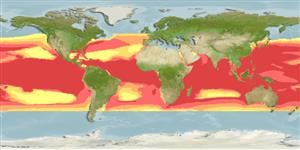
| Native range | All suitable habitat | Point map | Year 2050 |
|
| This map was computer-generated and has not yet been reviewed. |
| Istiophorus platypterus AquaMaps Data sources: GBIF OBIS |
Carregue seu(sua) Fotos e vídeos
Fotos | Selos, moedas, diversos. | Imagem do Google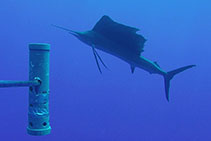 Istiophorus platypterus
Foto de University of Western Australia (UWA)
Fotos | Selos, moedas, diversos. | Imagem do Google
Foto de University of Western Australia (UWA)
Classificação / Nomes Nomes comuns | Sinônimos | Catalog of Fishes(Gênero, Espécies) | ITIS | CoL | WoRMS | Cloffa
> Carangiformes (Jacks) > Istiophoridae (Billfishes)
Etymology: Istiophorus: Greek, istios = sail + Greek, pherein = to carry (Ref. 45335).
More on author: Shaw.
Etymology: Istiophorus: Greek, istios = sail + Greek, pherein = to carry (Ref. 45335).
More on author: Shaw.
Meio ambiente: milieu / Zona climática / intervalo de profundidade / faixa de distribuição Ecologia
marinhas pelagic-oceanic; oceanódromo (Ref. 71039); intervalo de profundidade 0 - 200 m (Ref. 54238), usually 30 - ? m (Ref. 9688). Subtropical; 50°N - 43°S, 180°W - 180°E (Ref. 43)
Distribuição Territórios | Áreas da FAO | Ecossistemas | Ocorrências | Mapa de pontos | Introduções | Faunafri
Indo-Pacific: tropical and temperate waters approximately 45°- 50°N and 40°-35°S in the western Pacific, 35°N and 35°S in the eastern Pacific; 45°S in western Indian Ocean and 35°S in eastern Indian Ocean. Entered Mediterranean Sea from Red sea via Suez Canal. Highly migratory species. Some authors recognize a single worldwide species, Istiophorus platypterus (Shaw & Nodder 1792) but we follow Nakamura 1990 (Ref. 10820) retaining the usage of Istiophorus platypterus for the Indo-Pacific sailfish and Istiophorus albicans for the Atlantic sailfish in recognition of the differences between them.
Tamanho / Peso / Idade
Maturidade: Lm ? range ? - 150 cm
Max length : 348 cm FL macho/indeterminado; (Ref. 40637); common length : 270 cm TL macho/indeterminado; (Ref. 9308); peso máx. publicado: 100.2 kg (Ref. 40637); idade máx. registrada: 13 anos (Ref. 53742)
Max length : 348 cm FL macho/indeterminado; (Ref. 40637); common length : 270 cm TL macho/indeterminado; (Ref. 9308); peso máx. publicado: 100.2 kg (Ref. 40637); idade máx. registrada: 13 anos (Ref. 53742)
Descrição suscinta Chaves de identificação | Morfologia | Morfometria
Espinhos dorsais (total) : 0; Raios dorsais (total) : 47 - 53; Espinhos anais: 2; Raios anais : 12 - 15. This species is distinguished by the following characters: slender elongate and fairly compressed with a high, sail-like first dorsal fin; upper jaw prolonged into a very long beak, slender and round in cross-section; jaws and palatines with villiform teeth; no gill rakers; two dorsal fins, the first very large (42-49 rays) the second small (6-7 rays); pectoral fins 18-20 rays; pelvic fins I, 2 soft rays fused together, very long and narrow, depressible into a groove; caudal peduncle with double keels on each side; body covered with small, embedded scales with 1 or 2 blunt points. Colour of back dark with about 20 bluish vertical bars; belly pale silver; membrane of first dorsal fin blue- black with numerous dark spots; bases of first and second anal fins often tinged with silvery white; remaining fins blackish brown or dark blue (Ref. 43, 26938).
Body shape (shape guide): elongated; Cross section: compressed.
Body shape (shape guide): elongated; Cross section: compressed.
Oceanic and epipelagic species usually found above the thermocline. Most densely distributed in waters close to coasts and islands (Ref. 9688). Most likely schools by size. Undergoes spawning migrations in the Pacific. Feeds mainly on fishes, crustaceans and cephalopods. Caught mainly with longlines, set nets, and sometimes by trolling and harpooning from boats (Ref. 43). Utilized fresh, smoked and frozen; also used for sashimi and sushi; eaten broiled and baked (Ref. 9987).
Ciclo de vida ou comportamento de acasalamento Maturidade | Reprodução | Desova | Ovos | Fecundidade | Larvas
Seems to spawn throughout the year in tropical and subtropical waters of the Pacific with peak spawning occurring in the respective local summer seasons. Spawning occurs with males and females swimming in pairs or with two or three males chasing a single female (probably a mating behavior). The ripe ovarian eggs are about 0.85 mm in diameter and have a single oil globule; there are no structures on the vitalize membrane and the egg is transparent. Eggs shed from captured female in the Indian Ocean averaged 1.304 mm in diameter.
Referência principal
Carregar suas referências | Referências | Coordenador | Colaboradores
Nakamura, I., 1985. FAO species catalogue. Vol. 5. Billfishes of the world. An annotated and illustrated catalogue of marlins, sailfishes, spearfishes and swordfishes known to date. FAO Fish. Synop. 125(5):65p. Rome: FAO. (Ref. 43)
Status na Lista Vermelha da UICN (Ref. 130435: Version 2025-2 (Global))
Vulnerável (VU) (A2bd); Date assessed: 01 May 2021
CITES
Not Evaluated
Ameaça para os humanos
Harmless
Uso pelos humanos
Pescarias: espécies comerciais; peixe esportivo: sim
FAO - pescarias: desembarques, perfil da espécie; Publication: search | FishSource | Sea Around Us
Mais informação
Ecologia Trófica
Itens alimentares (presas)
Composição da dieta
Consumo alimentar
Rações alimentares
Predadores
Itens alimentares (presas)
Composição da dieta
Consumo alimentar
Rações alimentares
Predadores
Dinâmica populacional
Parâmetros de crescimento
Idade máxima / tamanhos
Relação comprimento-peso.
Relação comprimento-comprimento.
Frequências de comprimento
Conversão de massa
Recrutamento
Abundância
Parâmetros de crescimento
Idade máxima / tamanhos
Relação comprimento-peso.
Relação comprimento-comprimento.
Frequências de comprimento
Conversão de massa
Recrutamento
Abundância
Ciclo de vida
Reprodução
Maturidade
Maturidade/Rel. das guelras
Fecundidade
Desova
Agregações de desova
Ovos
Desenvolvimento dos ovos
Larvas
Dinâmica larval
Reprodução
Maturidade
Maturidade/Rel. das guelras
Fecundidade
Desova
Agregações de desova
Ovos
Desenvolvimento dos ovos
Larvas
Dinâmica larval
Fisiologia
Composição corporal
Nutrientes
Consumo de oxigênio
Tipo de natação
Velocidade de natação
Pigmentos visuais
Som de peixe
Doenças e Parasitas
Toxicidade (LC50s)
Composição corporal
Nutrientes
Consumo de oxigênio
Tipo de natação
Velocidade de natação
Pigmentos visuais
Som de peixe
Doenças e Parasitas
Toxicidade (LC50s)
Relacionado a humanos
Sistemas de aquicultura
Perfis para aquacultura
Estirpes
Casos de Ciguatera
Selos, moedas, diversos.
Sistemas de aquicultura
Perfis para aquacultura
Estirpes
Casos de Ciguatera
Selos, moedas, diversos.
Ferramentas
Livro eletrônico | Guia de campo | Chaves de identificação | Ferramenta auxiliar de frequências de comprimento | Ferramenta sobre a história de vida | Mapa de pontos |
Catch-MSY |
Relatórios especiais
Checar Manutenção em Aquário | Checar Planilhas de Fatos sobre as Espécies | Checar Planilhas de Fatos sobre Aquicultura
Baixar XML
Fontes da internet
AFORO (otoliths) | Aquatic Commons | BHL | Cloffa | Websites from users | Checar Observador de Peixes (FishWatcher) | CISTI | Catalog of Fishes: Gênero, Espécies | DiscoverLife | ECOTOX | FAO - pescarias: desembarques, perfil da espécie; Publication: search | Faunafri | Fishipedia | Fishtrace | GloBI | GoMexSI (interaction data) | Google Books | Google Scholar | Google | IGFA World Record | Bases de dados nacionais | OneZoom | Open Tree of Life | Otolith Atlas of Taiwan Fishes | PubMed | Reef Life Survey | Socotra Atlas | TreeBase | Árvore da vida | Wikipedia: Ir para, procura | World Records Freshwater Fishing | Registro zoológico
Estimativas baseadas em modelos
Temperatura preferida (Ref. 123201): 18.2 - 27.7, mean 25.6 °C (based on 513 cells).
Índice de diversidade filogenética (Ref. 82804): PD50 = 0.7505 [Uniqueness, from 0.5 = low to 2.0 = high].
Bayesian length-weight: a=0.00589 (0.00275 - 0.01263), b=3.14 (2.94 - 3.34), in cm total length, based on LWR estimates for this species & (Sub)family-body (Ref. 93245).
Nível Trófico (Ref. 69278): 4.5 ±0.3 se; based on diet studies.
Resiliência (Ref. 120179): Baixo, tempo mínimo de duplicação da população 4,5 - 14 anos (rm=0.11; K=0.1-0.8; tmax=13; Fec=>2M).
Prior r = 0.38, 95% CL = 0.25 - 0.57, Based on 1 full stock assessment.
Nutrientes (Ref. 124155): Calcium = 26.2 [12.9, 42.4] mg/100g; Iron = 0.856 [0.511, 1.406] mg/100g; Protein = 19.6 [18.4, 20.6] %; Omega3 = 0.209 [0.114, 0.374] g/100g; Selenium = 44.7 [23.7, 83.1] μg/100g; VitaminA = 6.44 [2.15, 18.92] μg/100g; Zinc = 0.364 [0.257, 0.521] mg/100g (wet weight);