>
Syngnathiformes (Pipefishes and seahorses) >
Syngnathidae (Pipefishes and seahorses) > Syngnathinae
Etymology: Halicampus: Greek, als, alis = salt + Greek, kampe = bend (Ref. 45335).
Eponymy: John Edward Gray (1800–1875) was a British ornithologist and entomologist. [...] (Ref. 128868), visit book page.
More on author: Kaup.
Environment: milieu / climate zone / Tiefenbereich / distribution range
Ökologie
seewasser; brackwasser riff-verbunden; tiefenbereich ? - 100 m (Ref. 48635). Tropical
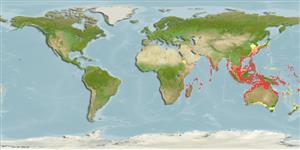
Indo-West Pacific: Gulf of Aden, off Sri Lanka, and from the Gulf of Thailand and Australia to Kyûshû Islands, Japan.
Size / Gewicht / Alter
Geschlechtsreife: Lm ? range ? - ? cm
Max length : 20.0 cm SL Männchen/unbestimmt; (Ref. 5316)
Kurzbeschreibung
Bestimmungsschlüssel | Morphologie | Morphometrie
Rückenflossenweichstrahlen (insgesamt) : 19 - 22; Afterflossenweichstrahlen: 4. Short-snouted species with large eyes (Ref. 48635).
Body shape (shape guide): eel-like.
Adults live in muddy habitats, often covered with silt and extremely well-camouflaged (Ref. 48635). Planktonic specimens taken in the upper 0 to 100 m over depths to at least 2980 m while the demersal fish have been taken in SCUBA and trawl collections from 9 to 91.4 m. Ovoviviparous (Ref. 205). Males exhibit parental care by incubating and guarding the eggs in their brood pouch (Ref. 43081).
Life cycle and mating behavior
Geschlechtsreife | Fortpflanzung | Ablaichen | Eier | Fecundity | Larven
Males carry the eggs in the brood pouch (Ref. 205).
Dawson, C.E., 1985. Indo-Pacific pipefishes (Red Sea to the Americas). The Gulf Coast Research Laboratory Ocean Springs, Mississippi, USA. (Ref. 5316)
IUCN Rote Liste Status (Ref. 130435: Version 2025-1)
Bedrohung für Menschen
Harmless
Nutzung durch Menschen
Tools
Zusatzinformationen
Download XML
Internet Quellen
Estimates based on models
Preferred temperature (Ref.
123201): 24.3 - 29, mean 27.8 °C (based on 1194 cells).
Phylogenetic diversity index (Ref.
82804): PD
50 = 0.5002 [Uniqueness, from 0.5 = low to 2.0 = high].
Bayesian length-weight: a=0.00037 (0.00016 - 0.00085), b=3.18 (2.99 - 3.37), in cm total length, based on LWR estimates for this (Sub)family-body shape (Ref.
93245).
Trophic level (Ref.
69278): 3.3 ±0.44 se; based on food items.
Widerstandsfähigkeit (Ref.
120179): hoch, Verdopplung der Population dauert weniger als 15 Monate. (Preliminary K or Fecundity.).
Fishing Vulnerability (Ref.
59153): Low vulnerability (14 of 100).
🛈
Nutrients (Ref.
124155): Calcium = 84.8 [48.1, 169.2] mg/100g; Iron = 0.726 [0.429, 1.210] mg/100g; Protein = 18.1 [17.0, 19.3] %; Omega3 = 0.137 [0.081, 0.247] g/100g; Selenium = 37.9 [19.4, 89.4] μg/100g; VitaminA = 74 [25, 221] μg/100g; Zinc = 1.71 [1.17, 2.39] mg/100g (wet weight);