Elasmobranchii (tubarões e raias) (sharks and rays) >
Rajiformes (Skates and rays) >
Rajidae (Skates)
Etymology: Dipturus: Greek, di = two + Greek, pteryx = fin (Ref. 45335).
Eponymy: Stewart ‘Stew’ Springer (1906–1991) was a field naturalist who dropped out of Butler College (1929) but was awarded a baccalaureate by George Washington University (1964), by which time he was world-renowned as an expert on both the taxonomy and [...] (Ref. 128868), visit book page.
Environment: milieu / Zona climática / intervalo de profundidade / distribution range
Ecologia
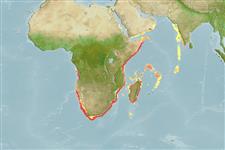
marinhas batidemersal; intervalo de profundidade 88 - 740 m (Ref. 11284), usually 400 - 500 m (Ref. 5578). Deep-water; 21°N - 37°S, 11°E - 77°E (Ref. 114953)
Southeast Atlantic and Western Indian Ocean: in scattered localities from Lüderitz, Namibia round the Cape (South Africa) to central Mozambique; also off Madagascar and Kenya; also found off India and Oman (Ref. 114953).
Tamanho / Peso / Idade
Maturidade: Lm ? range ? - ? cm
Max length : 192 cm TL macho/indeterminado; (Ref. 114953)
Descrição suscinta
Chaves de identificação | Morfologia | Morfometria
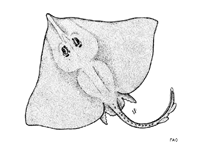
An all-dark longnose skate with its underside uniformly roughened by small denticles; snout acutely pointed and greatly elongated, and tail moderately stout and not conspicuously swollen; pectoral disc angular and broader than in other longnose skates in the area; no nape thorn (Ref. 5578). Dark grey to blackish above and below, ventral mucous pores black (Ref. 5578).
Body shape (shape guide): other.
Inhabits the outer shelf and upper slope (Ref. 5578). Rarely caught, probably inhabits hard bottoms that are seldom trawled (Ref. 114953). Feeds on bony fish, crabs and squid (Ref. 5578, Ref. 114953). Oviparous (Ref. 50449). Eggs have horn-like projections on the shell (Ref. 205). Males reaches maturity at 125-135 cm TL, females at 170-190 cm TL. Smallest known specimen at 27 cm TL (Ref. 114953) Probably caught by hake trawlers (Ref. 5578).
Ciclo de vida ou comportamento de acasalamento
Maturidade | Reprodução | Desova | Ovos | Fecundidade | Larvas
Oviparous, paired eggs are laid. Embryos feed solely on yolk (Ref. 50449). Eggs have horn-like projections on the shell (Ref. 205).
McEachran, J.D. and K.A. Dunn, 1998. Phylogenetic analysis of skates, a morphologically conservative clade of elasmobranchs (Chondrichthyes: Rajidae). Copeia 1998(2):271-290. (Ref. 27314)
Status na Lista Vermelha da UICN (Ref. 130435: Version 2025-1)
Ameaça para os humanos
Harmless
Uso pelos humanos
Pescarias: sem interesse
Ferramentas
Relatórios especiais
Baixar XML
Fontes da internet
Estimates based on models
Preferred temperature (Ref.
123201): 6.4 - 12.5, mean 10.4 °C (based on 32 cells).
Índice de diversidade filogenética (Ref.
82804): PD
50 = 0.5000 [Uniqueness, from 0.5 = low to 2.0 = high].
Bayesian length-weight: a=0.00275 (0.00175 - 0.00433), b=3.20 (3.07 - 3.33), in cm total length, based on LWR estimates for this species & Genus-body shape (Ref.
93245).
Nível Trófico (Ref.
69278): 4.3 ±0.69 se; based on food items.
Resiliência (Ref.
120179): Baixo, tempo mínimo de duplicação da população 4,5 - 14 anos (Fec assumed to be <100).
Fishing Vulnerability (Ref.
59153): Very high vulnerability (90 of 100).
🛈