Élasmobranches (requins et raies) (sharks and rays) >
Carcharhiniformes (Ground sharks) >
Scyliorhinidae (Cat sharks) > Scyliorhininae
Etymology: Cephaloscyllium: cephalus, from kephale (Gr.), head, referring to its very broad and depressed head; skylion, Greek for dogfish or small shark (See ETYFish); laticeps: latus (L.), wide or broad; ceps (New Latin), head, referring to its broad, parabola-shaped head (See ETYFish).
More on author: Duméril.
Environment: milieu / climate zone / profondeur / distribution range
Écologie
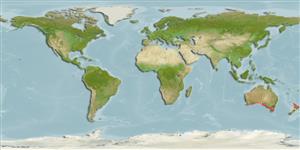
marin démersal; profondeur 1 - 220 m. Temperate; 32°S - 44°S
Eastern Indian Ocean: southern Australia, from Western Australia to New South Wales.
Length at first maturity / Taille / Poids / Âge
Maturité: Lm ?, range 82 - ? cm
Max length : 150 cm TL mâle / non sexé; (Ref. 6871)
Description synthétique
Clés d'identification | Morphologie | Morphométrie
Vertèbres: 129 - 138. Head short and very broad. Body robust with inflatable stomach; with dark, mottled and blotched color pattern, and mostly with a dark median stripe on the belly. Labial furrows absent. Denticles large and widely spaced.
Body shape (shape guide): elongated; Cross section: flattened.
Found on the continental shelf from close inshore in shallow to deeper water. Oviparous, hatching at about 14 cm (Ref. 6871). Can expand itself with air or water. Caught by commercial bottom trawlers but of no use to fisheries at present.
Life cycle and mating behavior
Maturité | Reproduction | Frai | Œufs | Fécondité | Larves
Oviparous, paired eggs are laid. Embryos feed solely on yolk (Ref. 50449).
Compagno, L.J.V., 1984. FAO Species Catalogue. Vol. 4. Sharks of the world. An annotated and illustrated catalogue of shark species known to date. Part 2 - Carcharhiniformes. FAO Fish. Synop. 125(4/2):251-655. Rome: FAO. (Ref. 244)
Statut dans la liste rouge de l'IUCN (Ref. 130435: Version 2025-1)
Utilisations par l'homme
Pêcheries: sans intérêt
Outils
Articles particuliers
Télécharger en XML
Sources Internet
Estimates based on models
Preferred temperature (Réf.
123201): 14 - 18.2, mean 16 °C (based on 175 cells).
Phylogenetic diversity index (Réf.
82804): PD
50 = 0.5000 [Uniqueness, from 0.5 = low to 2.0 = high].
Bayesian length-weight: a=0.00263 (0.00138 - 0.00502), b=3.21 (3.04 - 3.38), in cm total length, based on LWR estimates for this (Sub)family-body shape (Ref.
93245).
Niveau trophique (Réf.
69278): 4.3 ±0.5 se; based on size and trophs of closest relatives
Résilience (Réf.
120179): Faible, temps minimum de doublement de population : 4,5 à 14 années (Fec assumed to be <100).
Fishing Vulnerability (Ref.
59153): Very high vulnerability (90 of 100).
🛈
Nutrients (Ref.
124155): Calcium = 7.44 [1.43, 39.12] mg/100g; Iron = 0.236 [0.062, 0.719] mg/100g; Protein = 18 [15, 21] %; Omega3 = 0.301 [0.127, 0.682] g/100g; Selenium = 13.3 [4.4, 37.3] μg/100g; VitaminA = 12.8 [4.0, 41.2] μg/100g; Zinc = 0.335 [0.164, 0.605] mg/100g (wet weight);