


Pisodonophis boro (Hamilton, 1822)
Rice-paddy eel
Waarneming toevoegen in Fish Watcher
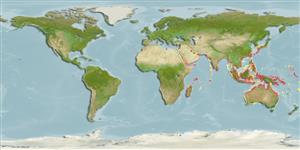
| Native range | All suitable habitat | Point map | Year 2050 |
|
| This map was computer-generated and has not yet been reviewed. |
| Pisodonophis boro AquaMaps Data sources: GBIF OBIS |
Uploaden van uw Foto's en video's
Afbeeldingen | Google afbeelding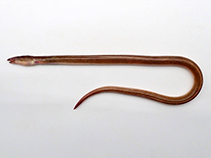 Pisodonophis boro
Afbeelding van Lai, N.-W.
Afbeeldingen | Google afbeelding
Afbeelding van Lai, N.-W.
Classificatie / Namen Lokale namen | Synoniemen | Catalog of Fishes(Genus, Soort(en)) | ITIS | CoL | WoRMS | Cloffa
> Anguilliformes (Eels and morays) > Ophichthidae (Snake eels) > Ophichthinae
Etymology: Pisodonophis: Greek, piso, pipisko = to drink + Greek, odous = teeth + Greek, ophis = serpent.
More on author: Hamilton.
Etymology: Pisodonophis: Greek, piso, pipisko = to drink + Greek, odous = teeth + Greek, ophis = serpent.
More on author: Hamilton.
Milieu: milieu / Klimaatzone / Diepte / verspreidingsgebied Ecologie
marien; zoet water; brak water demersaal; anadroom (Ref. 51243); diepte 0 - 10 m (Ref. 86942). Tropical
Verspreiding Gebieden | FAO regio's | Ecosystemen | Voorkomen | Verspreidingskaart | Introducties | Faunafri
Indo-West Pacific: Somalia (Ref. 30573) and Tanzania south to Knysna, South Africa (Ref. 3972), including the Seychelles (Ref. 7245); also southern India and Sri Lanka (Ref. 7245). Widespread elsewhere from the east Indian coast throughout Indonesia to Polynesia (Ref. 7245).
Grootte / Gewicht / Leeftijd
Maturiteit: Lm ? range ? - ? cm
Max length : 100.0 cm TL mannelijk / geslacht onbekend; (Ref. 3972); common length : 70.0 cm TL mannelijk / geslacht onbekend; (Ref. 7245)
Max length : 100.0 cm TL mannelijk / geslacht onbekend; (Ref. 3972); common length : 70.0 cm TL mannelijk / geslacht onbekend; (Ref. 7245)
Korte beschrijving Determinatiesleutels | Morfologie | Morfometrie
Dorsale stekels (totaal) : 0; Anale stekels: 0; Wervels: 171 - 180. Diagnosis: Body snake-like, cylindrical, compressed only along extreme tail tip; anterior nostril tubular, posterior along lower edge of lip; teeth granular to molariform, multiserial bands on jaws and vomer, but sharper on jaws and more pointed in young individuals; median fins not continuous posteriorly; extreme tip of tail stiff and finless; dorsal fin origin about a pectoral fin length behind tips of pectoral fins; lateral line inconspicuous (Ref. 4832).
Body shape (shape guide): eel-like.
Body shape (shape guide): eel-like.
Found in lagoons and estuaries, entering freshwater and paddy fields (Ref. 7245, 30573). Common in tidal reaches and nearby upstream areas of coastal rivers (Ref. 12693). Lives in holes in the river bottom and bank and actively forages for small fishes at night (Ref. 12693). Reported to spawn in rice-paddies during the rainy season (Ref. 12693). Caught in bag nets and similar gear. Marketed fresh.
Levenscyclus en paargedrag Maturiteit | Voortplanting | Paaien | Eieren | Fecunditeit | Larven
Hoofdreferentie
Upload uw referenties | Referenties | Coördinator : McCosker, John E. | Medewerkers
Castle, P.H.J., 1984. Ophichthidae. p. 38-39. In J. Daget, J.-P. Gosse and D.F.E. Thys van den Audenaerde (eds.) Check-list of the freshwater fishes of Africa (CLOFFA). ORSTOM, Paris and MRAC, Tervuren. Vol. 1. (Ref. 3508)
Status op de Rode Lijst van het IUCN (Ref. 130435: Version 2025-2 (Global))
Niet bedreigd (LC) ; Date assessed: 12 October 2009
CITES
Not Evaluated
Gevaar voor de mens
Harmless
Gebruik door de mens
Visserij: van minder commercieel belang; aas: usually
FAO - Aquacultuursystemen: productie; ; Publication: search | FishSource |
Meer informatie
Trofische ecologie
Voedsel (prooien)
Dieetsamenstelling
Voedselconsumptie
Voedselrantsoenen
Predatoren
Voedsel (prooien)
Dieetsamenstelling
Voedselconsumptie
Voedselrantsoenen
Predatoren
Populatiedynamica
Groeiparameters
Max. leeftijden / maten
Lengte-gewicht rel.
Lengte-lengte rel.
Lengtefrequenties
Massaconversie
Rekrutering
Abundantie
Groeiparameters
Max. leeftijden / maten
Lengte-gewicht rel.
Lengte-lengte rel.
Lengtefrequenties
Massaconversie
Rekrutering
Abundantie
Levenscyclus
Voortplanting
Maturiteit
Rijpheid/kieuwen rel.
Fecunditeit
Paaien
Paaibestanden
Eieren
Ontwikkeling van de eieren
Larven
Larvale populatiedynamiek
Voortplanting
Maturiteit
Rijpheid/kieuwen rel.
Fecunditeit
Paaien
Paaibestanden
Eieren
Ontwikkeling van de eieren
Larven
Larvale populatiedynamiek
Anatomie
Kieuwoppervlak
Hersenen
Otoliet
Kieuwoppervlak
Hersenen
Otoliet
Fysiologie
Lichaamssamenstelling
Voedingsstoffen
Zuurstofverbruik
Type zwemmen
Zwemsnelheid
Visuele pigmenten
Vis geluid
Ziekten en parasieten
Toxiciteit (LC50)
Lichaamssamenstelling
Voedingsstoffen
Zuurstofverbruik
Type zwemmen
Zwemsnelheid
Visuele pigmenten
Vis geluid
Ziekten en parasieten
Toxiciteit (LC50)
Menselijk gerelateerd
Aquacultuursystemen
Aquacultuurprofielen
Kweeklijnen
Ciguatera gevallen
Postzegels, munten, diversen.
Aquacultuursystemen
Aquacultuurprofielen
Kweeklijnen
Ciguatera gevallen
Postzegels, munten, diversen.
Tools
Speciale rapporten
Bekijk gegevens voor het houden in een aquarium | Bekijk Fact Sheets voor de soort | Bekijk Aquacultuur Fact Sheets
Download XML
Internetbronnen
AFORO (otoliths) | Aquatic Commons | BHL | Cloffa | Websites from users | Bekijk FishWatcher | CISTI | Catalog of Fishes: Genus, Soort(en) | DiscoverLife | ECOTOX | FAO - Aquacultuursystemen: productie; ; Publication: search | Faunafri | Fishipedia | Fishtrace | GloBI | Google Books | Google Scholar | Google | IGFA World Record | Nationale databanken | OneZoom | Open Tree of Life | Otolith Atlas of Taiwan Fishes | PubMed | Reef Life Survey | Socotra Atlas | TreeBase | Tree of Life | Wikipedia: ga naar, zoek | World Records Freshwater Fishing | Zoological Record
Schattingen op basis van modellen
Gewenste temperatuur (Ref. 123201): 24.6 - 29.2, mean 28.5 °C (based on 2626 cells).
Fylogenetische diversiteitsindex (Ref. 82804): PD50 = 0.5078 [Uniqueness, from 0.5 = low to 2.0 = high].
Bayesian length-weight: a=0.00095 (0.00049 - 0.00185), b=2.97 (2.80 - 3.14), in cm total length, based on LWR estimates for this species & (Sub)family-body (Ref. 93245).
Trofisch niveau (Ref. 69278): 4.0 ±0.71 se; based on food items.
Weerstandsvermogen (Ref. 120179): Gemiddeld, minimale populatieverdubbelingstijd 1,4-4,4 jaar (Preliminary K or Fecundity.).