Issue
Type locality: Monsembe (Haut Congo).
Environment: milieu / climate zone / rango de profundidad / distribution range
Ecología
; agua dulce demersal. Tropical; 26°C - 28°C (Ref. 1672)
Africa: Congo River basin in Cameroon, Democratic Republic of the Congo (Ref. 3188, Angola (Ref. 3188, 120641) and Republic of Congo (Ref. 45477). Also reported from the Lake Rukwa drainage (Ref. 27292) and Lake Tanganyika basin (Ref. 4537, 36901, 54847).
Tamaño / Peso / Age
Madurez: Lm ? range ? - ? cm
Max length : 60.0 cm TL macho / no sexado; (Ref. 3188)
Short description
Claves de identificación | Morfología | Morfometría
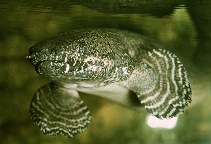
Espinas dorsales (total) : 9 - 11; Espinas anales: 14 - 15. Subcylindrical body (Ref. 27292, Ref. 36901). Upper and lower jaw of equal length (Ref. 36901, Ref. 42907). Number of dorsal finlets: 9-11 (Ref. 42908, Ref. 51884). Dorsal fin origin well behind pectoral fin (Ref. 4967, Ref. 42873). Ganoid scales (Ref. 27292, Ref. 42904): 58-65 lateral line scales, 38-44 scales around body, 22-27 predorsal scales (Ref. 2970, Ref. 11970, Ref. 42907, Ref. 42908). Dorsal side grey-brown colored, marbled with clear whitish spots (Ref. 11970), the belly is white to yellowish (Ref. 27292). Head finely reticulated (Ref. 42873, Ref. 42901). Fins with white spots alternating with dark spots, forming a continuous bar (Ref. 11970).
Body shape (shape guide): elongated; Cross section: circular.
Facultative air-breathing (Ref. 126274); Inhabits calm waters of swamps and rivers (Ref. 11970). It feeds on worms and insect larvae when young, but takes larger food, mainly fish, when adult (Ref. 27292). It mainly hunts at night (Ref. 27292). In general they are more or less solitary fish and do not form schools (Ref. 27292).
Life cycle and mating behavior
Madurez | Reproducción | Puesta | Huevos | Fecundidad | Larva
Male starts with the courtship and is the active partner (Ref. 1672). The male makes from the anal fin a sort of cup and the female lays the eggs in this cup (Ref. 1672). The male then spreads the eggs so that they attach, e.g., to plants.
Gosse, J.-P., 1984. Polypteridae. p. 18-29. In J. Daget, J.-P. Gosse and D.F.E. Thys van den Audenaerde (eds.) Check-list of the freshwater fishes of Africa (CLOFFA). Volume I. ORSTOM, Paris and MRAC, Tervuren. 410 p. (Ref. 3188)
IUCN Red List Status (Ref. 130435: Version 2025-1)
Threat to humans
Harmless
Human uses
Pesquerías: sin interés; Acuario: Acuarios públicos
Herramientas
Special reports
Download XML
Fuentes de Internet
Estimates based on models
Phylogenetic diversity index (Referencia
82804): PD
50 = 0.5003 [Uniqueness, from 0.5 = low to 2.0 = high].
Bayesian length-weight: a=0.00457 (0.00197 - 0.01063), b=3.05 (2.85 - 3.25), in cm total length, based on LWR estimates for this (Sub)family-body shape (Ref.
93245).
Nivel trófico (Referencia
69278): 3.7 ±0.60 se; based on food items.
Resiliencia (Referencia
120179): Bajo, población duplicada en un tiempo mínimo de 4.5-14 años (Fec=200-300; tmax likely >= 20).
Fishing Vulnerability (Ref.
59153): Moderate vulnerability (44 of 100).
🛈