>
Ovalentaria/misc (Various families in series Ovalentaria) >
Pomacentridae (Damselfishes) > Chrominae
Etymology: Azurina: Latin, azurinus = blue, pale blue; the name of Leuciscus caeruleus, blue Roach; 1600 (Ref. 45335).
More on author: Gill.
Environment: milieu / Klimaatzone / Diepte / distribution range
Ecologie
marien rifbewoner; standvastig; diepte 6 - 80 m (Ref. 9334), usually 6 - 20 m (Ref. 6852). Tropical; 33°N - 18°S
Eastern Pacific: northern Gulf of California to northern Peru, including the Galapagos and Cocos islands.
Grootte / Gewicht / Leeftijd
Maturiteit: Lm ? range ? - ? cm
Max length : 13.4 cm TL mannelijk / geslacht onbekend; (Ref. 59088)
Korte beschrijving
Determinatiesleutels | Morfologie | Morfometrie
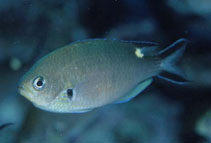
Dorsale stekels (totaal) : 12; Dorsale zachte stralen (totaal) : 12 - 13; Anale stekels: 2; Anale zachte stralen: 10 - 12. Brown with a prominent black spot on the base of the pectoral fin. Fins with thin light blue or white margin.
Body shape (shape guide): fusiform / normal; Cross section: compressed.
Adults inhabit coral or rocky reefs (Ref. 9334). They aggregate in large numbers in open water above reefs and feed on zooplankton. Not strongly territorial as other damselfishes in the area. They become almost invisible in the darkness of deep water except for its brilliant post-dorsal white spot which gives the illusion of glowing in the dark. Oviparous, distinct pairing during breeding (Ref. 205). Eggs are demersal and adhere to the substrate (Ref. 205). Males guard and aerate the eggs (Ref. 205).
Levenscyclus en paargedrag
Maturiteit | Voortplanting | Paaien | Eieren | Fecunditeit | Larven
Oviparous, distinct pairing during breeding (Ref. 205). Eggs are demersal and adhere to the substrate (Ref. 205). Males guard and aerate the eggs (Ref. 205).
Allen, G.R., 1991. Damselfishes of the world. Mergus Publishers, Melle, Germany. 271 p. (Ref. 7247)
Status op de Rode Lijst van het IUCN (Ref. 130435: Version 2025-1)
Gevaar voor de mens
Harmless
Gebruik door de mens
Tools
Speciale rapporten
Download XML
Internetbronnen
Estimates based on models
Preferred temperature (Ref.
123201): 21.2 - 28.5, mean 25.9 °C (based on 40 cells).
Fylogenetische diversiteitsindex (Ref.
82804): PD
50 = 0.5010 [Uniqueness, from 0.5 = low to 2.0 = high].
Bayesian length-weight: a=0.01288 (0.00716 - 0.02316), b=3.10 (2.94 - 3.26), in cm total length, based on LWR estimates for this species & (Sub)family-body (Ref.
93245).
Trofisch niveau (Ref.
69278): 3.4 ±0.45 se; based on food items.
Weerstandsvermogen (Ref.
120179): Hoog, minimale populatieverdubbelingstijd minder dan 15 maanden (Preliminary K or Fecundity.).
Fishing Vulnerability (Ref.
59153): Low vulnerability (10 of 100).
🛈
Nutrients (Ref.
124155): Calcium = 88.8 [53.6, 148.6] mg/100g; Iron = 0.813 [0.525, 1.261] mg/100g; Protein = 18.7 [17.6, 19.6] %; Omega3 = 0.169 [0.108, 0.262] g/100g; Selenium = 26.7 [15.3, 48.6] μg/100g; VitaminA = 213 [79, 552] μg/100g; Zinc = 1.53 [1.07, 2.08] mg/100g (wet weight);