Classification / Noms
Noms communs | Synonymes | Catalog of Fishes(Genre, Espèce) | ITIS | CoL | WoRMS | Cloffa
>
Cichliformes (Cichlids, convict blennies) >
Cichlidae (Cichlids) > Pseudocrenilabrinae
Etymology: Cynotilapia: Greek, kyon = dog + Bechuana, African native thiape = fish (Ref. 45335).
Environnement : milieu / zone climatique / profondeur / gamme de distribution
Écologie
; eau douce benthopélagique. Tropical; 11°S - 13°S
Africa: circum-lacustrine distribution in Lake Malawi (Ref. 5664, 88848).
Taille / Poids / Âge
Maturité: Lm ? range ? - ? cm
Max length : 9.3 cm SL mâle / non sexé; (Ref. 88848)
Description synthétique
Clés d'identification | Morphologie | Morphométrie
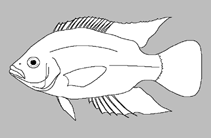
Épines dorsales (Total) : 17 - 18; Rayons mous dorsaux (Total) : 7 - 10; Épines anales: 3; Rayons mous anaux: 6 - 9. Diagnosis: This species of Microchromis is characterized by a blue pattern with dark vertical bars on body, enhanced in dominant specimens, and usually extending onto the dorsal fin; similar to Maylandia zebra and other species in that complex with which it shares the same overall colouration, namely blue ground colour with strengthening melanic pattern in dominant males, extending onto the head, but it differs from these mainly by dentition: teeth on outer rows short and conical, regularly decreasing in size from symphysis to corner, vs. bicuspid in Maylandia (Ref. 88848). It differs from Microchromis aurifrons by its less heavily black pattern and vertical stripes on head, joining on brow (Ref. 88848).
Body shape (shape guide): fusiform / normal.
Found in all rocky habitats of Lake Malawi (Ref. 88848).
Cycle de vie et comportement reproducteur
Maturité | Reproduction | Frai | Œufs | Fécondité | Larves
Li, S., A.F. Konings and J.R. Stauffer Jr., 2016. A revision of the Pseudotropheus elongatus species group (Teleostei: Cichlidae) with description of a new genus and seven new species. Zootaxa 4168(2):353-381. (Ref. 119465)
Statut dans la liste rouge de l'IUCN (Ref. 130435: Version 2025-2)
Menace pour l'homme
Harmless
Utilisations par l'homme
Pêcheries: sans intérêt
Outils
Articles particuliers
Télécharger en XML
Sources Internet
Estimations basées sur des modèles
Indice de diversité phylogénétique (Réf.
82804): PD
50 = 0.5312 [Uniqueness, from 0.5 = low to 2.0 = high].
Bayesian length-weight: a=0.01000 (0.00244 - 0.04107), b=3.04 (2.81 - 3.27), in cm total length, based on all LWR estimates for this body shape (Ref.
93245).
Niveau trophique (Réf.
69278): 3.4 ±0.4 se; based on size and trophs of closest relatives
Résilience (Réf.
120179): Haut, temps minimum de doublement de population inférieur à 15 mois (Preliminary K or Fecundity.).
Vulnérabilité de la pêche (Ref.
59153): Low vulnerability (10 of 100).
🛈