>
Scombriformes (Mackerels) >
Gempylidae (Snake mackerels)
Etymology: Paradiplospinus: Greek, para = the side of + Greek, diploos = double + Latin, spina, pinna = thron (Ref. 45335).
More on author: Andriashev.
Issue
Validity of species questionnable for some authors, but no recent publications.
Environment: milieu / climate zone / distribuzione batimetrica / distribution range
Ecologia
marino batipelagico; distribuzione batimetrica 0 - 2830 m (Ref. 6181). Deep-water; 31°S - 79°S, 180°W - 180°E (Ref. 6181)
Southern Ocean: circumpolar. In the belief that there was only a single species of Paradiplospinus, many authors used the name Paradiplospinus gracilis as including Paradiplospinus antarcticus.
Size / Peso / Age
Maturità: Lm ? range ? - ? cm
Max length : 52.0 cm SL maschio/sesso non determinato; (Ref. 6181); common length : 35.0 cm SL maschio/sesso non determinato; (Ref. 6181)
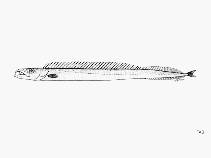
Spine dorsali (totale) : 36 - 39; Raggi dorsali molli (totale) : 24 - 34; Spine anali: 2; Raggi anali molli: 25 - 31; Vertebre: 64 - 67. Body is extremely elongate. Mouth with fang-like teeth, 3-6 fangs anteriorly in upper jaw and 1 fang on each side of the lower jaw. Pyloric caeca 6. Color is silvery white without any conspicuous marks except 40 - 50 narrow longitudinal lines of pale melanophores; the dorsal-fin base, opercular region and caudal-fin origin dark brownish.
Body shape (shape guide): elongated; Cross section: compressed.
Adults and subadults epipelagic to mesopelagic, or mesobenthopelagic at shelves and slopes from surface to 830 m (temp. 0° to 4°C). Larvae and juveniles, probably mesopelagic to bathypelagic, down to 2,830 m depth (Ref. 5084). Feeds on krill, squid and fishes (predominantly myctophids). Larval and juvenile specimens mostly obtained between southern land masses and the Antarctic continent.
Life cycle and mating behavior
Maturità | Riproduzione | Deposizione | Uova | Fecundity | Larve
Nakamura, I. and N.V. Parin, 1993. FAO Species Catalogue. Vol. 15. Snake mackerels and cutlassfishes of the world (families Gempylidae and Trichiuridae). An annotated and illustrated catalogue of the snake mackerels, snoeks, escolars, gemfishes, sackfishes, domine, oilfish, cutlassfishes,. scabbardfishes, hairtails, and frostfishes known to date. FAO Fish. Synop. 125(15):136 p. (Ref. 6181)
IUCN Red List Status (Ref. 130435: Version 2025-1)
Threat to humans
Harmless
Human uses
Pesca: di nessun interesse
Strumenti
Special reports
Download XML
Fonti Internet
Estimates based on models
Preferred temperature (Fonte Biblio.
123201): 0.8 - 7.8, mean 3.5 °C (based on 694 cells).
Phylogenetic diversity index (Fonte Biblio.
82804): PD
50 = 0.7500 [Uniqueness, from 0.5 = low to 2.0 = high].
Bayesian length-weight: a=0.00372 (0.00167 - 0.00826), b=3.10 (2.91 - 3.29), in cm total length, based on LWR estimates for this (Sub)family-body shape (Ref.
93245).
Trophic level (Fonte Biblio.
69278): 4.1 ±0.53 se; based on food items.
Resilienza (Fonte Biblio.
120179): Medio, tempo minimo di raddoppiamento della popolazione 1.4 - 4.4 anni (Preliminary K or Fecundity.).
Fishing Vulnerability (Ref.
59153): Moderate to high vulnerability (45 of 100).
🛈