This website uses cookies to enhance your browsing experience and ensure the functionality of our site. For more detailed information about the types of cookies we use and how we protect your privacy, please visit our Privacy Information page.
×
Cookie Settings
This website uses different types of cookies to enhance your experience. Please select your preferences below:
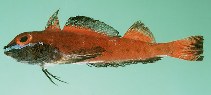
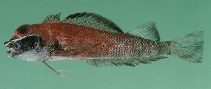
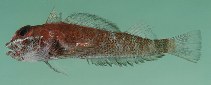
Espinas dorsales (total) : 16 - 18; Radios blandos dorsales (total) : 10 - 12; Espinas anales: 1; Radios blandos anales: 19 - 21; Vértebra: 36 - 38. Diagnosis: Dorsal fin III + XIV+ 11, 1st fin 4/5 height of 2nd fin, 1 free pterygiophore between 2nd and 3rd fin; anal fin I + 21; pectoral rays 17 (1+9+7); pelvic fin I, 2, spine short and hidden, segmented rays simple, partially united by membrane. Vertebrae 10 + 27. LL total lateral scales 39-40; tubed 22-30 scales, ends below anterior half of 3rd dorsal fin; nape, 1st and 2nd dorsal fin and anal-fin base scaleless, caudal fin base with 1 row of scales. Mandibular pores 5-8+1-2+5-8. Orbital cirrus simple. Head length 3.4 in SL; eye 2.9, maxilla 2.1 in HL. Male head with blue stripe below eye from mouth to pectoral-fin base and masked with black on ventral half; body pinkish orange with scattered dusky rosettes denser ventrally; larger ones with 5-6 light grey blotches and dusky triangular marks; median fins generally uniformly dark to black. Female paler version of male but not masked (Ref. 75031). Body shape (shape guide): elongated.
Adults live on rock surfaces and under ledges; common at depths less than 10 m (Ref. 6211). Eggs are hemispherical and covered with numerous sticky threads that anchor them in the algae on the nesting sites (Ref. 240). Larvae are planktonic which occur primarily in shallow, nearshore waters (Ref. 94114).
Ciclo vital y comportamiento de apareamiento Madurez | Reproducción | Puesta | Huevos | Fecundidad | Larva
Hansen, P.E.H., 1986. Revision of the tripterygiid fish genus Helcogramma, including descriptions of four new species. Bull. Mar. Sci. 38(2):313-354. (Ref. 6211)
Situación en la Lista Roja de la UICN (Ref. 130435: Version 2025-2 (Global))
Ecología Trófica Alimentos (presas) Composición de la dieta consumo de alimento Raciones de comida Despredadores
Ecología Ecología
Dinámica de la población Coeficiente del crecimiento para Edades / tallas máximas Longitud-peso rel. Longitud-longitud rel. Longitud-frecuencias Conversión de masas Reclutamiento Abundancia
Ciclo de vida Reproducción Madurez Madurez/Gills rel. Fecundidad Puesta Agregaciones de desove Huevos Desarrollo de los huevos Larva Dinámica larvaria
Fisiología Composición corporal Nutrientes Consumo del oxígeno Tipo de natación Velocidad de natación Pigmentos visuales Sonido de peces Enfermedades y parásitos Toxicidad (CL50)
Temperatura preferida (Referencia 123201): 24.7 - 29.3, mean 28 °C (based on 1759 cells).
Índice de diversidad filogenética (Referencia 82804): PD50 = 0.5000 [Uniqueness, from 0.5 = low to 2.0 = high].
Bayesian length-weight: a=0.00617 (0.00290 - 0.01310), b=3.04 (2.86 - 3.22), in cm total length, based on LWR estimates for this (Sub)family-body shape (Ref. 93245).
Nivel trófico (Referencia 69278): 3.1 ±0.3 se; based on size and trophs of closest relatives
Resiliencia (Referencia 120179): Alto, población duplicada en un tiempo mínimo inferior a 15 meses (Preliminary K or Fecundity.).
Vulnerabilidad pesquera (Ref. 59153): Low vulnerability (10 of 100). 🛈