>
Cichliformes (Cichlids, convict blennies) >
Cichlidae (Cichlids) > Pseudocrenilabrinae
Etymology: Eretmodus: Greek, eretmos, -ou = with oars + Greek, odous = teeth (Ref. 45335).
More on author: Boulenger.
Ambiente: milieu / zona climatica / distribuzione batimetrica / gamma di distribuzione
Ecologia
; acqua dolce benthopelagico; pH range: 8.0 - 9.0; dH range: 9 - 19. Tropical; 24°C - 26°C (Ref. 1672); 3°S - 9°S
Africa: endemic to Lake Tanganyika, occurs in the southern part of the Lake, from Kipili (Tanzania) to Moliro (Democratic Republic of the Congo) (Ref. 46829).
Dimensione / Peso / Età
Maturità: Lm ? range ? - ? cm
Max length : 9.0 cm TL maschio/sesso non determinato; (Ref. 5633)
Breve descrizione
Chiavi di identificazione | Morfologia | Morfometria
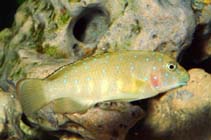
Spine dorsali (totale) : 23 - 24; Raggi dorsali molli (totale) : 4 - 5; Spine anali: 3; Raggi anali molli: 6 - 7. Diagnosis: Eretmodus cyanostictus is characterized by a terminal mouth and a number of bright blue spots on the head and upper half of the body (Ref. 92306). About 5 light bars are present on the side of the body but evident only on the lower half of the body and none crossing the posterior en of the body or caudal peduncle (Ref. 92306).
Body shape (shape guide): short and / or deep.
Occurs in rocky areas (Ref. 53528). Adults occur in the turbulent, highly oxygenated shallow waters of the surf zone; found in the shallows of a gradually sloping rocky coast where some sand is found between the rocks; solitary and to some extent, territorial; heavy body and small swim bladder result in negative buoyancy (Ref. 6770). Feeds on algae which are scraped from the rocks (Ref. 6770, 46829). Both parents brood their young in the mouth (Ref. 52921, 86760).
Ciclo vitale e comportamento di accoppiamento
Maturità | Riproduzione | Deposizione | Uova | Fecondità | Larve
Eggs from the cleavage phase and larvae of up to 1.09 cm TL are mouthbrooded by male and female parents ranging from 4.7 to 6.2 cm SL (Ref. 86760).
Konings, A., 1998. Tanganyika cichlids in their natural habitat. Cichlid Press. 272 p. (Ref. 46829)
Stato della Lista Rossa IUCN (Ref. 130435: Version 2025-2)
Minaccia per l'uomo
Harmless
Usi umani
Acquario: Commerciale
Strumenti
Rapporti speciali
Scarica XML
Fonti Internet
Stime basate su modelli
Indice di diversità filogenetica (Fonte Biblio.
82804): PD
50 = 0.7500 [Uniqueness, from 0.5 = low to 2.0 = high].
Bayesian length-weight: a=0.01862 (0.00830 - 0.04177), b=3.01 (2.82 - 3.20), in cm total length, based on LWR estimates for this (Sub)family-body shape (Ref.
93245).
Livello trofico (Fonte Biblio.
69278): 2.1 ±0.1 se; based on diet studies.
Resilienza (Fonte Biblio.
120179): Basso, tempo minimo di raddoppiamento della popolazione 4.5 - 14 anni (tm<1 (?); Fec=20-25 (aquarium observation)).
Vulnerabilità della pesca (Ref.
59153): Low vulnerability (10 of 100).
🛈