Ikan bertulang rawan (sharks and rays) >
Carcharhiniformes (Ground sharks) >
Carcharhinidae (Requiem sharks)
Etymology: Carcharhinus: karcharos (Gr.), sharp or jagged; rhinus, an ancient name for sharks, from rhine (Gr.), rasp, both words alluding to a shark's jagged, rasp-like skin (See ETYFish); borneensis: -ensis, Latin suffix denoting place: Borneo, Indonesia, where type locality (off Singkawang, West Kalimantan) is situated (See ETYFish).
More on author: Bleeker.
Environment: milieu / climate zone / kisaran kedalaman / distribution range
Ekologi
laut dasar (demersal). Tropical; 21°N - 4°S
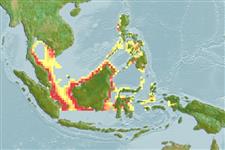
Western Pacific: Borneo and China. Questionably occurring in Java, Indonesia and the Philippines. Due to its very restricted and very small area of occurrence (Borneo), conservation measures are urgently needed (Ref. 84280).
Size / Weight / umur
Kematangan: Lm ? range ? - ? cm
Max length : 70.0 cm TL jantan/; (Ref. 244)
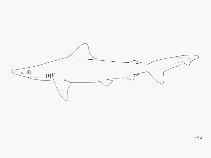
This small species is characterized by the following: snout long and pointed; slender body and tail; alongside each mouth corner is a row of enlarged hyomandibular pores (5-12); upper anterior teeth finely serrated with a single narrow, oblique cusp; distal edge deeply notched and with several cusplets; lower anterior teeth with narrower, similarly oblique cusps; no lateral cusplets; total tooth row counts 23-26/23-25, or 46-50; second dorsal-fin origin well posterior of anal-fin origin, about opposite or just anterior to anal-fin midbase while second dorsal-fin
origin to anal-fin origin 2.2-4.1% TL, 0.4-0.9 times second dorsal-fin base; interdorsal space 20.7-22.7% TL; pelvic fins small, anterior margins 4.4-5.8% TL and 35-42% of pectoral anterior margin; first dorsal fin triangular, with nearly straight posterior margin, free rear tip about opposite pelvic-fin origins, length 14.5-17.6% TL, 1.8-2.4 times height, inner margin 1.9-2.8 in base; second dorsal fin much smaller than first and slightly smaller than anal fin, length 7.5-10.2% TL, base 2.0-3.1 times height; height 21-29% of first dorsal fin height; anal fin height 1.1-1.6 times second dorsal height, base 1.1-1.5 times second dorsal-fin base; total vertebral counts 117-121, monospondylous precaudal counts 33-36, diplospondylous precaudal counts 21-26, diplospondylous caudal counts 56-60, precaudal counts 57-63; colour slate-grey dorsally, whitish ventrally with waterline clearly demarcated along head and body, fins no distinct black markings, pectoral fins and lower caudal lobe with whitish margins (Ref. 84280).
Body shape (shape guide): fusiform / normal.
A rare species found inshore in coastal areas (Ref. 244). Viviparous (Ref. 50449). Specimens range in length from 23.7-61.8 cm TL. Two specimens collected in the 1800s had fresh umbilical scars at 23.7 and 27.4 cm, indicating that the size at birth is close to these sizes; four specimens of 34.1-37.3 cm had well healed, but still obvious umbilical scars. Five males with lengths of 54.8-57.6 cm were found mature (additional material of mature males with lengths of 59.0-62.0 cm and several pregnant females with lengths of 61.0-65.0 cm). Litter size of pregnant females was 6 (Ref. 84280). Undoubtedly taken in local fisheries (Ref. 244).
Life cycle and mating behavior
Kematangan | Reproduksi, perkembang biakan | Pemijahan | telur-telur | Fecundity | Larva
Viviparous, placental (Ref. 50449). Distinct pairing with embrace (Ref. 205).
Compagno, L.J.V., 1984. FAO Species Catalogue. Vol. 4. Sharks of the world. An annotated and illustrated catalogue of shark species known to date. Part 2 - Carcharhiniformes. FAO Fish. Synop. 125(4/2):251-655. Rome: FAO. (Ref. 244)
Status IUCN Red List (Ref. 130435: Version 2025-1)
ancaman kepada manusia
Harmless
penggunaan manusia
Perikanan: perikanan swasembada
Alat, peralatan
laporan khas
muat turun XML
Sumber internet
Estimates based on models
Preferred temperature (Acuan
123201): 23.7 - 28.3, mean 27.5 °C (based on 219 cells).
Phylogenetic diversity index (Acuan
82804): PD
50 = 0.5000 [Uniqueness, from 0.5 = low to 2.0 = high].
Bayesian length-weight: a=0.00513 (0.00236 - 0.01115), b=3.08 (2.91 - 3.25), in cm total length, based on LWR estimates for this Genus-body shape (Ref.
93245).
Trophic level (Acuan
69278): 3.9 ±0.6 se; based on size and trophs of closest relatives
Daya lenting (Acuan
120179): sangat rendah, Waktu penggandaan populasi minimum lebih dari 14 tahun (Fec assumed to be <10).
Fishing Vulnerability (Ref.
59153): Moderate to high vulnerability (48 of 100).
🛈