>
Osteoglossiformes (Bony tongues) >
Mormyridae (Elephantfishes)
Etymology: Heteromormyrus: Greek, heteros = other + Greek mormyros = a kind of fish similar to Boops sp. (Ref. 45335).
Eponymy: Dr William John Ansorge (1850–1913) was an English explorer and collector who was active in Africa in the second half of the 19th century. [...] (Ref. 128868), visit book page.
More on author: Boulenger.
Environment: milieu / climate zone / rango de profundidad / distribution range
Ecología
; agua dulce demersal. Tropical; 11°S - 21°S
Africa: Cuanza River in Angola (Ref. 52193, 128501), also Cunene, Okavango, upper Zambezi, Buzi and Pungwe rivers, and an isolated population occurs in the Ruo River (lower Zambezi system) in Malawi (Ref. 52193). In the Congo basin known from the Kwango in Angola (Ref. 11970). Possibly also in the Inkisi River (lower Congo) (Ref. 12818, 120641), Lufira and Luwombwa rivers (upper Congo basin) (Ref. 12818) but these need confirmation.
Tamaño / Peso / Age
Madurez: Lm ? range ? - ? cm
Max length : 15.0 cm SL macho / no sexado; (Ref. 52193)
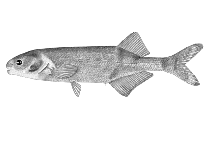
Espinas dorsales (total) : 0; Radios blandos dorsales (total) : 18 - 19; Espinas anales: 0; Radios blandos anales: 24 - 26. Diagnosis: dorsal fin origin nearer caudal fin base than tip of snout; origin of dorsal fin behind origin of anal fin; dorsal fin shorter than anal fin; chin (mental swelling) present but feebly developed; dorsal fin with 19 rays, anal fin with 24-26 rays (Ref. 52193).
Found in rocky habitats in flowing waters (Ref. 7248, 52193). Feeds on small aquatic invertebrates (Ref. 7248, 52193) such as insect larvae (Ref. 7248).
Life cycle and mating behavior
Madurez | Reproducción | Puesta | Huevos | Fecundidad | Larva
Sullivan, J.P.: Hopkins, C.D., S. Pirro, R. Peterson, A. Chakona, T.I. Mutizwa, C. Mukweze Mulelenu, F.H. Alqahtani, E. Vreven and C.B. Dillman, 2022. Mitogenome recovered from a 19th century holotype by shotgun sequencing supplies a generic name for an orphaned clade of African weakly electric fishes (Osteoglossomorpha, Mormyridae). ZooKeys 1129:163-196. (Ref. 128501)
IUCN Red List Status (Ref. 130435: Version 2025-1)
Threat to humans
Harmless
Human uses
Herramientas
Special reports
Download XML
Fuentes de Internet
Estimates based on models
Phylogenetic diversity index (Referencia
82804): PD
50 = 0.5156 [Uniqueness, from 0.5 = low to 2.0 = high].
Bayesian length-weight: a=0.00562 (0.00244 - 0.01296), b=3.05 (2.85 - 3.25), in cm total length, based on LWR estimates for this (Sub)family-body shape (Ref.
93245).
Nivel trófico (Referencia
69278): 3.2 ±0.40 se; based on food items.
Resiliencia (Referencia
120179): Alto, población duplicada en un tiempo mínimo inferior a 15 meses (Preliminary K or Fecundity.).
Fishing Vulnerability (Ref.
59153): Low vulnerability (10 of 100).
🛈