


Paretroplus kieneri Arnoult, 1960
Red-nosed Madagascar cichlid
Envoyez vos Photos et vidéos
Images | Images Google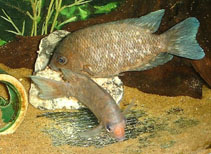 Paretroplus kieneri
Photo de Tourle, D.
Images | Images Google
Photo de Tourle, D.
Classification / Noms Noms communs | Synonymes | Catalog of Fishes(Genre, Espèce) | ITIS | CoL | WoRMS | Cloffa
> Cichliformes (Cichlids, convict blennies) > Cichlidae (Cichlids) > Etroplinae
Etymology: Paretroplus: Name from the Greek 'para' meaning 'on the side of'; in taxonomy it is commonly used in generic names to express similarity or relatedness; in the present case it would mean 'next to Etroplus' (S.Kullander, pers.comm. 3/11).
Eponymy: André Kiener was a French fisheries researcher who conducted numerous studies in Madagascar (1950s & 1960s). He wrote: Poissons, pêche et pisciculture à Madagascar (1963). (Ref. 128868), visit book page.
Etymology: Paretroplus: Name from the Greek 'para' meaning 'on the side of'; in taxonomy it is commonly used in generic names to express similarity or relatedness; in the present case it would mean 'next to Etroplus' (S.Kullander, pers.comm. 3/11).
Eponymy: André Kiener was a French fisheries researcher who conducted numerous studies in Madagascar (1950s & 1960s). He wrote: Poissons, pêche et pisciculture à Madagascar (1963). (Ref. 128868), visit book page.
Environnement : milieu / zone climatique / profondeur / gamme de distribution Écologie
; eau douce démersal. Tropical; 24°C - 28°C (Ref. 13614); 13°S - 20°S
Distribution Territoires | Zones FAO | Écosystèmes | Occurrences | Carte par point | Introductions | Faunafri
Africa: northwestern Madagascar (Ref. 78623).
Taille / Poids / Âge
Description synthétique Clés d'identification | Morphologie | Morphométrie
Épines dorsales (Total) : 18 - 20; Rayons mous dorsaux (Total) : 13 - 15; Épines anales: 9 - 11; Rayons mous anaux: 11 - 12. Diagnosis: A shallow-bodied Paretroplus distinguished from all congeners except P. gymnopreopercularis by the presence of a blotchy, mottled, and irregular pigmentation pattern, the absence of vertical bars on the flanks, and by a fleshy snout that extends rostral to the lips and also ventrally to cover a portion of the upper lip (Ref. 78623). Paretroplus kieneri is distinguished from its sister taxon, P. gymnopreopercularis, by the presence of a more or less fully scaled preopercle, except along the ventral margin, vs. completely asquamate; a pointed and mildly convex predorsal profile, vs. blunt and strongly convex; and a second lacrimal plate that forms a part, albeit small, of the orbit margin, vs. second lacrimal plate excluded from orbit margin; the pigmentation pattern of P. kieneri is conspicuously blotchy, mottled, and irregular, whereas P. gymnopreopercularis is characterized by a weakly mottled and especially uniform chain-link lateral pigmentation pattern, owing to darkly pigmented scale margins (Ref. 78623).
Body shape (shape guide): fusiform / normal.
Body shape (shape guide): fusiform / normal.
Cycle de vie et comportement reproducteur Maturité | Reproduction | Frai | Œufs | Fécondité | Larves
Référence principale
Téléchargez vos références | Références | Coordinateur : Kullander, Sven O. | Collaborateurs
Sparks, J.S., 2008. Phylogeny of the cichlid subfamily Etroplinae and taxonomic revision of the Malagasy cichlid genus Paretroplus (Teleostei: Cichlidae). Bull. Am. Mus. Nat. Hist. 314:1-151. (Ref. 78623)
Statut dans la liste rouge de l'IUCN (Ref. 130435: Version 2025-2 (Global))
Vulnérable (VU) (B1ab(i,ii,iii,iv)); Date assessed: 02 July 2016
CITES
Not Evaluated
Menace pour l'homme
Harmless
Utilisations par l'homme
FAO - Publication: search | FishSource |
Plus d'informations
Écologie trophique
Aliments (proies)
Composition du régime alimentaire
Consommation alimentaire
Rations alimentaires
Prédateurs
Aliments (proies)
Composition du régime alimentaire
Consommation alimentaire
Rations alimentaires
Prédateurs
Écologie
Écologie
Écologie
Dynamique des populations
Paramètres de croissance
Âges / tailles maximales
Longueur-poids rel.
Rel. longueur-longueur.
Fréquences de longueurs
Conversion de masse
Recrutement
Abondance
Paramètres de croissance
Âges / tailles maximales
Longueur-poids rel.
Rel. longueur-longueur.
Fréquences de longueurs
Conversion de masse
Recrutement
Abondance
Cycle de vie
Reproduction
Maturité
Maturité/épines rel.
Fécondité
Frai
Agrégats de frai
Œufs
Développement de l'œuf
Larves
Dynamique des populations larvaires
Reproduction
Maturité
Maturité/épines rel.
Fécondité
Frai
Agrégats de frai
Œufs
Développement de l'œuf
Larves
Dynamique des populations larvaires
Anatomie
Surface branchiale
Cerveau
Otolithe
Surface branchiale
Cerveau
Otolithe
Physiologie
Composition corporelle
Nutriments
Consommation d'oxygène
Type de natation
Vitesse de nage
Pigments visuels
Son de poisson
Maladies et parasites
Toxicité (CL50)
Composition corporelle
Nutriments
Consommation d'oxygène
Type de natation
Vitesse de nage
Pigments visuels
Son de poisson
Maladies et parasites
Toxicité (CL50)
Génétique
génôme
Génétique
Hétérozygotie
Héritabilité
Diversité génétique
génôme
Génétique
Hétérozygotie
Héritabilité
Diversité génétique
Liées à l'homme
Systèmes d'aquaculture
Profils d'aquaculture
Souches
Cas de ciguatera
Timbres, pièces de monnaie, divers
Systèmes d'aquaculture
Profils d'aquaculture
Souches
Cas de ciguatera
Timbres, pièces de monnaie, divers
Outils
E-book | Guide de terrain | Générateur de fréquences de longueur | Outil de dynamique de population | Carte par point |
Capture-MSY |
Articles particuliers
Télécharger en XML
Sources Internet
AFORO (otoliths) | Aquatic Commons | BHL | Cloffa | Websites from users | FishWatcher | CISTI | Catalog of Fishes: Genre, Espèce | DiscoverLife | ECOTOX | FAO - Publication: search | Faunafri | Fishipedia | Fishtrace | GloBI | Google Books | Google Scholar | Google | IGFA World Record | OneZoom | Open Tree of Life | Otolith Atlas of Taiwan Fishes | PubMed | Reef Life Survey | Socotra Atlas | TreeBase | Arbre de Vie | Wikipedia: aller à, chercher | World Records Freshwater Fishing | Zoobank | Zoological Record
Estimations basées sur des modèles
Indice de diversité phylogénétique (Réf. 82804): PD50 = 0.5001 [Uniqueness, from 0.5 = low to 2.0 = high].
Bayesian length-weight: a=0.01660 (0.00670 - 0.04111), b=2.95 (2.74 - 3.16), in cm total length, based on LWR estimates for this (Sub)family-body shape (Ref. 93245).
Niveau trophique (Réf. 69278): 2.8 ±0.3 se; based on size and trophs of closest relatives
Résilience (Réf. 120179): Haut, temps minimum de doublement de population inférieur à 15 mois (Preliminary K or Fecundity.).