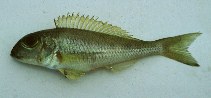
>
Cichliformes (Cichlids, convict blennies) >
Cichlidae (Cichlids) > Pseudocrenilabrinae
Etymology: Xenotilapia: Greek, xenos = strange + Bechuana, African native thiape = fish (Ref. 45335).
Eponymy: George Albert Boulenger (1858–1937) was a Belgian-British zoologist at the British Museum, London. [...] (Ref. 128868), visit book page.
More on author: Poll.
Entorno: milieu / zona climática / rango de profundidad / gama de distribución
Ecología
; agua dulce bentopelágico; pH range: 7.5 - 8.5; dH range: 20 - ?. Tropical; 23°C - 26°C (Ref. 2060); 3°S - 9°S
Africa: Endemic to Lake Tanganyika.
Tamaño / Peso / Edad
Madurez: Lm ? range ? - ? cm
Max length : 15.3 cm TL macho / no sexado; (Ref. 5717)
Adults are found over sandy bottoms often in pairs. Form schools. Feed on copepods and small shrimps (Ref. 6770). Exhibit biparental mouthbrooding of the young (Ref. 86760).
Ciclo vital y comportamiento de apareamiento
Madurez | Reproducción | Puesta | Huevos | Fecundidad | Larva
After the male has fertilized the eggs the female mouthbroods them for 12 days after which they are transferred to the male for an additional 18-20 days of mouthbrooding (Ref. 2060). In one study, larvae of up to 0.99 cm TL are mouthbrooded by female parents 6.8 to 7.5 cm SL in size (Ref. 86760).
Maréchal, C. and M. Poll, 1991. Xenotilapia. p. 537-543. In J. Daget, J.-P. Gosse, G.G. Teugels and D.F.E. Thys van den Audenaerde (eds.) Check-list of the freshwater fishes of Africa (CLOFFA). ISNB, Brussels; MRAC, Tervuren; and ORSTOM, Paris. Vol. 4. (Ref. 5717)
Situación en la Lista Roja de la UICN (Ref. 130435: Version 2025-2)
Amenaza para el ser humano
Harmless
Usos humanos
Pesquerías: comercial; Acuario: Comercial
Herramientas
Informes especiales
Descargar XML
Fuentes de Internet
Estimaciones basadas en modelos
Índice de diversidad filogenética (Referencia
82804): PD
50 = 0.5000 [Uniqueness, from 0.5 = low to 2.0 = high].
Bayesian length-weight: a=0.01445 (0.00674 - 0.03099), b=2.99 (2.82 - 3.16), in cm total length, based on LWR estimates for this (Sub)family-body shape (Ref.
93245).
Nivel trófico (Referencia
69278): 3.3 ±0.38 se; based on food items.
Resiliencia (Referencia
120179): Alto, población duplicada en un tiempo mínimo inferior a 15 meses (Fec=20).
Vulnerabilidad pesquera (Ref.
59153): Low vulnerability (10 of 100).
🛈