Centropyge acanthops, Orangeback angelfish : aquarium

You can sponsor this page

Centropyge acanthops (Norman, 1922)

Orangeback angelfish
Adicionar sua observação em Fish Watcher
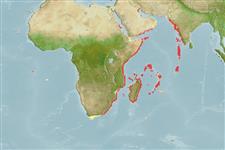
Native range | All suitable habitat | Point map | Year 2050
This map was computer-generated and has not yet been reviewed.
Centropyge acanthops   AquaMaps   Data sources: GBIF OBIS
Carregue seu(sua) Fotos e vídeos
Fotos | Imagem do Google
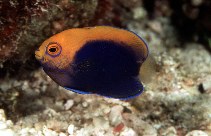
Image of Centropyge acanthops (Orangeback angelfish)
Centropyge acanthops
Juvenile Foto de Randall, J.E.

Classificação / Nomes Nomes comuns | Sinônimos | Catalog of Fishes(Gênero, Espécies) | ITIS | CoL | WoRMS | Cloffa

> Acanthuriformes (Surgeonfishes) > Pomacanthidae (Angelfishes)
Etymology: Centropyge: Greek, kentron = sting + Greek, pyge = tail (Ref. 45335).
More on author: Norman.

Environment: milieu / Zona climática / intervalo de profundidade / distribution range Ecologia

marinhas associadas(os) a recifes; não migratória; intervalo de profundidade 6 - 40 m (Ref. 9710). Tropical

Distribuição Países | Áreas da FAO | Ecossistemas | Ocorrências | Mapa de pontos | Introduções | Faunafri

Western Indian Ocean: Somalia to East London, South Africa. Also around oceanic islands. Common off East Africa (Ref. 9710).

Tamanho / Peso / Idade

Maturidade: Lm ?  range ? - ? cm
Max length : 8.0 cm TL macho/indeterminado; (Ref. 5953)

Descrição suscinta Chaves de identificação | Morfologia | Morfometria

Head, upper sides, dorsal, and caudal fins golden yellow; lower two-thirds of the body and the anal fin black with numerous close-set purple spots.
Body shape (shape guide): short and / or deep; Cross section: compressed.

Biologia     Glossário (p.ex. epibenthic)

Inhabits areas with coral rubble and frequently occurs in small groups of up to about 10 individuals. Feeds on small invertebrates and algae (Ref. 5503). Spawns at sunset; male stimulating the emission of eggs with biting motions on female's abdomen; eggs released and abandoned in open water without any particular parental care (Ref. 5503). Popular aquarium fish in Natal. Occasionally exported from Kenya.

Ciclo de vida ou comportamento de acasalamento Maturidade | Reprodução | Desova | Ovos | Fecundidade | Larvas

Bi-directional sex change has been confirmed for this species (Ref. 103751).

Referência principal Carregar suas referências | Referências | Coordenador | Colaboradores

Allen, G.R., 1985. Butterfly and angelfishes of the world. Vol. 2. 3rd edit. in English. Mergus Publishers, Melle, Germany. (Ref. 4858)

Status na Lista Vermelha da UICN (Ref. 130435: Version 2025-1)

  Segura ou pouco preocupante (LC) ; Date assessed: 26 January 2009

CITES

Not Evaluated

CMS (Ref. 116361)

Not Evaluated

Ameaça para os humanos

  Harmless


Uso pelos humanos

Pescarias: sem interesse; Aquário: Espécies comerciais
FAO - Publication: search | FishSource |

Mais informação

Ecologia Trófica
Food items (preys)
Composição da dieta
Consumo alimentar
Food rations
Predadores
Ecologia
Ecologia
Home ranges
Population dynamics
Parâmetros de crescimento
Max. ages / sizes
Length-weight rel.
Length-length rel.
Frequências de comprimento
Conversão de massa
Recrutamento
Abundância
Life cycle
Reprodução
Maturidade
Maturity/Gills rel.
Fecundidade
Desova
Spawning aggregations
Ovos
Desenvolvimento dos ovos
Larvas
Dinâmica larval
Distribuição
Países
Áreas da FAO
Ecossistemas
Ocorrências
Introduções
BRUVS - Videos
Anatomy
Área branquial
Brain
Otolith
Physiology
Body composition
Nutrients
Consumo de oxigênio
Tipo de natação
Velocidade de natação
Visual pigments
Fish sound
Diseases & Parasites
Toxicity (LC50s)
Genética
genoma
Genética
Heterozygosity
Hereditariedade
Human related
Aquaculture systems
Perfis para aquacultura
Estirpes
Ciguatera cases
Stamps, coins, misc.
Outreach
Colaboradores
Referências
Referências

Ferramentas

Relatórios especiais

Baixar XML

Fontes da internet

AFORO (otoliths) | Aquatic Commons | BHL | Cloffa | Websites from users | Checar Observador de Peixes (FishWatcher) | CISTI | Catalog of Fishes: Gênero, Espécies | DiscoverLife | ECOTOX | FAO - Publication: search | Faunafri | Fishipedia | Fishtrace | GloBI | Google Books | Google Scholar | Google | IGFA World Record | OneZoom | Open Tree of Life | Otolith Atlas of Taiwan Fishes | Aquários públicos | PubMed | Reef Life Survey | Socotra Atlas | TreeBase | Árvore da vida | Wikipedia: Ir para, procura | World Records Freshwater Fishing | Registro zoológico

Estimates based on models

Preferred temperature (Ref. 123201): 24.6 - 27.8, mean 26.8 °C (based on 84 cells).
Índice de diversidade filogenética (Ref. 82804):  PD50 = 0.5000   [Uniqueness, from 0.5 = low to 2.0 = high].
Bayesian length-weight: a=0.03090 (0.01378 - 0.06932), b=2.88 (2.69 - 3.07), in cm total length, based on LWR estimates for this (Sub)family-body shape (Ref. 93245).
Nível Trófico (Ref. 69278):  2.9   ±0.32 se; based on food items.
Resiliência (Ref. 120179):  Elevada, tempo mínimo de duplicação da população menor que 15 meses (Preliminary K or Fecundity.).
Fishing Vulnerability (Ref. 59153):  Low vulnerability (10 of 100). 🛈
Nutrients (Ref. 124155):  Calcium = 125 [61, 193] mg/100g; Iron = 0.772 [0.462, 1.296] mg/100g; Protein = 18.1 [16.9, 19.3] %; Omega3 = 0.126 [0.074, 0.209] g/100g; Selenium = 23.6 [12.5, 44.2] μg/100g; VitaminA = 114 [32, 393] μg/100g; Zinc = 1.86 [1.26, 2.70] mg/100g (wet weight);