>
Eupercaria/misc (Various families in series Eupercaria) >
Caesionidae (Fusiliers) > Caesioninae
Etymology: Caesio: Latin, caesius, bluish-grey, 1835; it is the same name given to the silvery metal (Cs) (Ref. 45335).
More on author: Seale.
Environment: milieu / climate zone / rango de profundidad / distribution range
Ecología
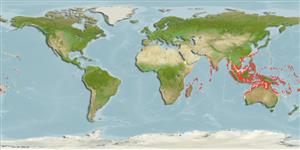
marino asociado a arrecife; no migratorio; rango de profundidad 5 - 60 m (Ref. 30874). Tropical; 30°N - 34°S, 28°E - 157°W (Ref. 402)
Indo-West Pacific: East Africa to the Line Islands. Not occurring in the Red Sea or the Arabian (Persian) Gulf.
Tamaño / Peso / Age
Madurez: Lm ? range ? - ? cm
Max length : 40.0 cm TL macho / no sexado; (Ref. 11228); common length : 26.6 cm SL macho / no sexado; (Ref. 37816)
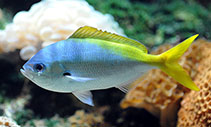
Espinas dorsales (total) : 10; Radios blandos dorsales (total) : 14 - 16; Espinas anales: 3; Radios blandos anales: 12 - 13. This species is distinguished by the following characters: D X14-16, usually 15; A III,12-13, usually 12; pectoral-fin rays 18-23, usually 20-21; lateral line scales 51-61, usually 55; scales above lateral line to dorsal origin 7-10, modally 8, and below to anal-fin origin 16-20; predorsal scales 20-28; a single postmaxillary process; supratemporal band of scales interrupted at dorsal midline by a narrow scaleless zone; body colour blue with bright yellow on caudal fin, caudal peduncle, and body from just anterior to dorsal-fin origin to ventral origin of caudal peduncle, except in large individuals particularly in the western Pacific where the yellow does not extend as far anteriorly (Ref. 68703, 90102).
Body shape (shape guide): fusiform / normal; Cross section: compressed.
Adults are found primarily around coral reefs, with a preference for coralline lagoons. They feed on zooplankton in large midwater groups and form schools with other caesionids. Mature adults migrate to select areas around the reef to spawn near the surface in the entrances of deep channels during outgoing tides on a lunar cycle. They are oviparous, with numerous, small pelagic eggs (Ref. 402). Are caught with drive-in nets. Maximum depth reported taken from Ref. 128797.
Life cycle and mating behavior
Madurez | Reproducción | Puesta | Huevos | Fecundidad | Larva
Mass spawning of this species observed to occur only around sunset at or near full moon.
Carpenter, K.E., 1987. Revision of the Indo-Pacific fish family Caesionidae (Lutjanoidea), with descriptions of five new species. Indo-Pac. Fish. (15):56 p. (Ref. 1723)
IUCN Red List Status (Ref. 130435: Version 2025-1)
Threat to humans
Harmless
Human uses
Pesquerías: escaso valor comercial
Herramientas
Special reports
Download XML
Fuentes de Internet
Estimates based on models
Preferred temperature (Referencia
123201): 24.9 - 29.1, mean 28.2 °C (based on 988 cells).
Phylogenetic diversity index (Referencia
82804): PD
50 = 0.5010 [Uniqueness, from 0.5 = low to 2.0 = high].
Bayesian length-weight: a=0.01202 (0.00696 - 0.02076), b=3.10 (2.95 - 3.25), in cm total length, based on LWR estimates for this species & (Sub)family-body (Ref.
93245).
Nivel trófico (Referencia
69278): 3.4 ±0.45 se; based on food items.
Resiliencia (Referencia
120179): Alto, población duplicada en un tiempo mínimo inferior a 15 meses (Preliminary K or Fecundity.).
Fishing Vulnerability (Ref.
59153): Low to moderate vulnerability (30 of 100).
🛈
Nutrients (Ref.
124155): Calcium = 53.2 [35.4, 76.6] mg/100g; Iron = 0.708 [0.466, 1.023] mg/100g; Protein = 19 [18, 20] %; Omega3 = 0.138 [0.096, 0.196] g/100g; Selenium = 33.1 [21.1, 55.5] μg/100g; VitaminA = 99.1 [41.3, 244.0] μg/100g; Zinc = 1.1 [0.8, 1.5] mg/100g (wet weight);