


Nothobranchius taeniopygus Hilgendorf, 1891
Striped nothobranch
Uploaden van uw Foto's en video's
Afbeeldingen | Postzegels, munten, diversen. | Google afbeelding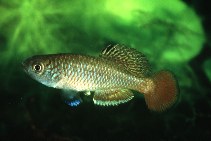 Nothobranchius taeniopygus
Male Afbeelding van Seegers, L.
Afbeeldingen | Postzegels, munten, diversen. | Google afbeelding
Male Afbeelding van Seegers, L.
Classificatie / Namen Lokale namen | Synoniemen | Catalog of Fishes(Genus, Soort(en)) | ITIS | CoL | WoRMS | Cloffa
> Cyprinodontiformes (Rivulines, killifishes and live bearers) > Nothobranchiidae (African rivulines)
Etymology: Nothobranchius: Greek, nothos = false + Greek, brangchia = gill (Ref. 45335).
More on author: Hilgendorf.
Etymology: Nothobranchius: Greek, nothos = false + Greek, brangchia = gill (Ref. 45335).
More on author: Hilgendorf.
Milieu: milieu / Klimaatzone / Diepte / verspreidingsgebied Ecologie
; zoet water benthopelagisch; pH range: 8.2 - ? ; dH range: 6 - ?; standvastig. Tropical; 18°C - 24°C (Ref. 2059)
Verspreiding Gebieden | FAO regio's | Ecosystemen | Voorkomen | Verspreidingskaart | Introducties | Faunafri
Africa: seasonal pools of Wembere River system in central Tanzania (Ref. 122068). Also reported from Malagarazi River, Lake Rukwa and Lake Victoria drainages in Tanzania (Ref. 27139, 59344), but these reports might refer to other species (Ref. 122098). Reports from Bubu River (Ref. 26713, 106076) refer to Nothobranchius angelae (Ref. 122068). Probably introduced for mosquito control in several localities in Uganda, Kenya, Tanzania and Zambia (Ref. 3788, 59344, 106076).
Grootte / Gewicht / Leeftijd
Maturiteit: Lm ? range ? - ? cm
Max length : 3.6 cm SL mannelijk / geslacht onbekend; (Ref. 122068); 3.1 cm SL (female)
Max length : 3.6 cm SL mannelijk / geslacht onbekend; (Ref. 122068); 3.1 cm SL (female)
Korte beschrijving Determinatiesleutels | Morfologie | Morfometrie
Dorsale stekels (totaal) : 0; Dorsale zachte stralen (totaal) : 15 - 17; Anale stekels: 0; Anale zachte stralen: 16 - 18. Diagnosis: Nothobranchius taeniopygus is distinguished from all other species of the genus by the following combination of characters in males: body colouration light blue with red-brown scale margins; anal fin light blue-grey to yellow-grey with irregular brown spots, narrow brown submedial band, slender cream to yellow medial band, narrow yellow to white subdistal band and a broad black distal band; caudal fin light yellow-grey with brown stripes proximally, followed by a narrow brown medial band, a slender white subdistal band and a broad black distal band; pelvic fins brown, with slender cream to yellow medial band and narrow black distal band (Ref. 122068). Furthermore, it differs from the other members of the Nothobranchius taeniopygus species group in central and western Tanzania by a postorbital length of 43-46% of head length vs. 46-63%; and snout to eye end length 54-57% of head length vs. 37-54% (Ref. 122068).
Body shape (shape guide): fusiform / normal; Cross section: compressed.
Body shape (shape guide): fusiform / normal; Cross section: compressed.
Seasonal fish with very short life span, typical species of steppe and savannah which need long dry season (Ref. 27292). Occurs in swamps and restwater pools of river floodplains (Ref. 79882), in ditches and despressions in floodplains (Ref. 59344). Bottom spawner (Ref. 79882). Incubation of eggs in captivity is 3-6 months and young fish reach maturity in 6-7 weeks (Ref. 59344). Specimens from central Tanzania introduced in various localities in Tanzania, Uganda, Kenya and other countries, for mosquito control (Ref. 59344).
Levenscyclus en paargedrag Maturiteit | Voortplanting | Paaien | Eieren | Fecunditeit | Larven
Hoofdreferentie
Upload uw referenties | Referenties | Coördinator | Medewerkers
Watters, B.R., B. Nagy, P.D.W. van der Merwe, F.P.D. Cotteril and D.U. Bellstedt, 2019. Review of the Nothobranchius taeniopygus species group from central and western Tanzania with descriptions of five new species and redescription of Nothobranchius taeniopygus (Teleostei: Nothobranchiidae). Ichthyol. Explor. Freshwat. 29(3):239-278. (Ref. 122068)
Status op de Rode Lijst van het IUCN (Ref. 130435: Version 2025-2 (Global))
Kwetsbaar (VU) (B1ab(iii)+2ab(iii)); Date assessed: 02 September 2019
CITES
Not Evaluated
Gevaar voor de mens
Harmless
Gebruik door de mens
Aquarium: Commercieel
FAO - Publication: search | FishSource |
Meer informatie
Trofische ecologie
Voedsel (prooien)
Dieetsamenstelling
Voedselconsumptie
Voedselrantsoenen
Predatoren
Voedsel (prooien)
Dieetsamenstelling
Voedselconsumptie
Voedselrantsoenen
Predatoren
Ecologie
Ecologie
Ecologie
Populatiedynamica
Groeiparameters
Max. leeftijden / maten
Lengte-gewicht rel.
Lengte-lengte rel.
Lengtefrequenties
Massaconversie
Rekrutering
Abundantie
Groeiparameters
Max. leeftijden / maten
Lengte-gewicht rel.
Lengte-lengte rel.
Lengtefrequenties
Massaconversie
Rekrutering
Abundantie
Levenscyclus
Voortplanting
Maturiteit
Rijpheid/kieuwen rel.
Fecunditeit
Paaien
Paaibestanden
Eieren
Ontwikkeling van de eieren
Larven
Larvale populatiedynamiek
Voortplanting
Maturiteit
Rijpheid/kieuwen rel.
Fecunditeit
Paaien
Paaibestanden
Eieren
Ontwikkeling van de eieren
Larven
Larvale populatiedynamiek
Anatomie
Kieuwoppervlak
Hersenen
Otoliet
Kieuwoppervlak
Hersenen
Otoliet
Fysiologie
Lichaamssamenstelling
Voedingsstoffen
Zuurstofverbruik
Type zwemmen
Zwemsnelheid
Visuele pigmenten
Vis geluid
Ziekten en parasieten
Toxiciteit (LC50)
Lichaamssamenstelling
Voedingsstoffen
Zuurstofverbruik
Type zwemmen
Zwemsnelheid
Visuele pigmenten
Vis geluid
Ziekten en parasieten
Toxiciteit (LC50)
Genetica
genoom
Genetica
Heterozygositeit
Erfelijkheid
Genetische diversiteit
genoom
Genetica
Heterozygositeit
Erfelijkheid
Genetische diversiteit
Menselijk gerelateerd
Aquacultuursystemen
Aquacultuurprofielen
Kweeklijnen
Ciguatera gevallen
Postzegels, munten, diversen.
Aquacultuursystemen
Aquacultuurprofielen
Kweeklijnen
Ciguatera gevallen
Postzegels, munten, diversen.
Tools
Speciale rapporten
Bekijk gegevens voor het houden in een aquarium | Bekijk Fact Sheets voor de soort | Bekijk Aquacultuur Fact Sheets
Download XML
Internetbronnen
AFORO (otoliths) | Aquatic Commons | BHL | Cloffa | Websites from users | Bekijk FishWatcher | CISTI | Catalog of Fishes: Genus, Soort(en) | DiscoverLife | ECOTOX | FAO - Publication: search | Faunafri | Fishipedia | Fishtrace | GloBI | Google Books | Google Scholar | Google | IGFA World Record | OneZoom | Open Tree of Life | Otolith Atlas of Taiwan Fishes | PubMed | Reef Life Survey | Socotra Atlas | TreeBase | Tree of Life | Wikipedia: ga naar, zoek | World Records Freshwater Fishing | Zoobank | Zoological Record
Schattingen op basis van modellen
Fylogenetische diversiteitsindex (Ref. 82804): PD50 = 0.5000 [Uniqueness, from 0.5 = low to 2.0 = high].
Bayesian length-weight: a=0.01096 (0.00461 - 0.02608), b=2.94 (2.74 - 3.14), in cm total length, based on LWR estimates for this (Sub)family-body shape (Ref. 93245).
Trofisch niveau (Ref. 69278): 3.2 ±0.4 se; based on size and trophs of closest relatives