>
Eupercaria/misc (Various families in series Eupercaria) >
Priacanthidae (Bigeyes or catalufas)
Etymology: Priacanthus: Greek, prion = saw + Greek, akantha = thorn (Ref. 45335).
Environment: milieu / climate zone / profondeur / distribution range
Écologie
marin démersal; profondeur ? - 350 m (Ref. 100719). Tropical
Indo-West Pacific: Red Sea and Reunion to Japan, northern Australia and Samoa. Mediterranean (Ref. 96612).
Taille / Poids / Âge
Maturité: Lm ? range ? - ? cm
Max length : 35.0 cm SL mâle / non sexé; (Ref. 48635)
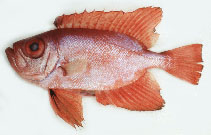
Épines dorsales (Total) : 10; Rayons mous dorsaux (Total) : 13 - 14; Épines anales: 3; Rayons mous anaux: 13 - 15. Medium-sized fish. The body is oval; dorsal fin continuous; eyes very large; mouth large and oblique; preopercular spine short and broad. The head and body reddish silvery or, alternately, pale yellowish with gray mottling; the iris of the eye pink to bright red. The dorsal, anal, and caudal fins pink with reddish-brown spots in the membranes, or yellowish with dusky spots. This species resembles P. blochii, but differs from it by having pointed soft dorsal and anal fins, and black membrane between the first and the second dorsal spine.
Body shape (shape guide): fusiform / normal; Cross section: oval.
In sheltered reefs in moderate depths, usually in caves or under coral plates (Ref. 48635); may also be found in rocky and open areas. Solitary (Ref 90102).
Life cycle and mating behavior
Maturité | Reproduction | Frai | Œufs | Fécondité | Larves
Starnes, W.C., 1988. Revision, phylogeny and biogeographic comments on the circumtropical marine percoid fish family Priacanthidae. Bull. Mar. Sci. 43(2):117-203. (Ref. 5403)
Statut dans la liste rouge de l'IUCN (Ref. 130435: Version 2025-1)
Menace pour l'homme
Harmless
Utilisations par l'homme
Pêcheries: intérêt commercial mineur
Outils
Articles particuliers
Télécharger en XML
Sources Internet
Estimates based on models
Phylogenetic diversity index (Réf.
82804): PD
50 = 0.5002 [Uniqueness, from 0.5 = low to 2.0 = high].
Bayesian length-weight: a=0.01698 (0.00734 - 0.03932), b=2.91 (2.72 - 3.10), in cm total length, based on LWR estimates for this (Sub)family-body shape (Ref.
93245).
Niveau trophique (Réf.
69278): 4.5 ±0.80 se; based on food items.
Résilience (Réf.
120179): Haut, temps minimum de doublement de population inférieur à 15 mois (Preliminary K or Fecundity.).
Fishing Vulnerability (Ref.
59153): Low to moderate vulnerability (33 of 100).
🛈