>
Blenniiformes (Blennies) >
Blenniidae (Combtooth blennies) > Salariinae
Etymology: Hypleurochilus: Greek, hypo = under + Greek, pleura = in the side of + Greek, cheilos = lip.
Eponymy: Herbert Otto Henry Lang (1879–1957) was born in Germany and trained as a taxidermist. [...] (Ref. 128868), visit book page.
More on author: Fowler.
Environment: milieu / climate zone / djupintervall / distribution range
Ekologi
marina; brackvatten bottenlevande. Tropical
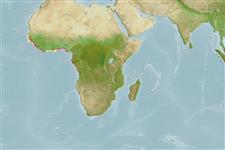
Eastern Atlantic: northern Senegal to the mouth of the Congo (Ref. 4342, 81288). Also reported from Annobon Island (Ref. 5298).
Size / Vikt / Age
Könsmognad: Lm ? range ? - ? cm
Max length : 8.3 cm TL hane/ej könsbestämd; (Ref. 81288)
Short description
Bestämningsnycklar | Morfologi | Morfometri
Taggstrålar i ryggfenan (totalt) : 12; Mjukstrålar i ryggfenan (totalt) : 14 - 17; Taggstrålar i analfenan: 2; Mjukstrålar i analfenan: 16 - 19. Diagnosis: length of supraorbital tentacles varies from approximately 2/3 of eye diameter to 2 times this diameter; longest tentacles occur in male specimens; shape of supraorbital tentacles varies from a single finger-like appendage bearing 2-4 filaments at the rear base to 4 appendages of almost equal length; anterior nostril forms a small tube which bears up to 4 cirri on posterior rim, only 1 in most cases; only one ring of cephalic sensory pores in infraorbital and preopercular series; lateral line does not reach beyond level of 8th-10th spine of dorsal fin; both males and females with a thin crest on head, but crest in females not as high as in males; dorsal fin with 12 spines and 14-17, generally 15-16, soft rays, last spine shorter than soft rays; anal fin with 2 spines and 16-19, generally 17-18, soft rays; caudal fin rounded (Ref. 81288).
Coloration: in alcohol, uniformly clear brown, lower part of head and throat clearer; some individuals with a black spot on membrane between 1st and 3rd dorsal spines; sometimes flanks bearing vertical stripes darker (Ref. 81288).
Body shape (shape guide): elongated.
Euryhaline, entering mouth of large rivers and mangroves, but always in brackish water (Ref. 81288). Oviparous. Eggs are demersal and adhesive (Ref. 205), and are attached to the substrate via a filamentous, adhesive pad or pedestal (Ref. 94114). Larvae are planktonic, often found in shallow, coastal waters (Ref. 94114). Maximum SL recorded was 7.0 cm (Ref. 4342).
Life cycle and mating behavior
Könsmognad | Reproduktion | Lek | Ägg | Fecundity | Larver
Oviparous, distinct pairing (Ref. 205).
Bath, H., 1986. Blenniidae. p. 355-357. In J. Daget, J.-P. Gosse and D.F.E. Thys van den Audenaerde (eds.) Check-list of the freshwater fishes of Africa (CLOFFA). ISNB, Brussels, MRAC, Tervuren; and ORSTOM, Paris. Vol. 2. (Ref. 4342)
IUCN Red List Status (Ref. 130435: Version 2025-1)
Threat to humans
Harmless
Human uses
Fiskeri: saknar intresse
Verktyg
Special reports
Download XML
Internet-källor
Estimates based on models
Preferred temperature (Ref.
123201): 25.2 - 28, mean 27.3 °C (based on 164 cells).
Phylogenetic diversity index (Ref.
82804): PD
50 = 0.5005 [Uniqueness, from 0.5 = low to 2.0 = high].
Bayesian length-weight: a=0.00776 (0.00356 - 0.01695), b=3.00 (2.81 - 3.19), in cm total length, based on LWR estimates for this (Sub)family-body shape (Ref.
93245).
Trofisk nivå (Ref.
69278): 3.2 ±0.3 se; based on size and trophs of closest relatives
Resiliens (Ref.
120179): Hög, lägsta populationsfördubblingstid mindre än 15 månader (Preliminary K or Fecundity.).
Fishing Vulnerability (Ref.
59153): Low vulnerability (10 of 100).
🛈