>
Carangiformes (Jacks) >
Carangidae (Jacks and pompanos) > Caranginae
Etymology: Decapterus: Greek, deka = ten + Greek, pteron = wing, fin (Ref. 45335).
Environment: milieu / climate zone / intervalo de profundidade / distribution range
Ecologia
marinhas demersal; intervalo de profundidade 7 - 550 m (Ref. 47377), usually 150 - 220 m (Ref. 5217). Subtropical; 45°N - 55°S, 102°E - 41°E
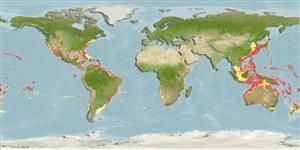
Pacific Ocean: Japan, Indonesia (Ref. 3197), Australia and the Hawaiian Islands Western Atlantic: Canada (Ref. 5951) to North Carolina, USA to Venezuela (Ref. 7251). Also found in Brazil (Ref. 47377) and in Argentina (Ref. 2806). Eastern Atlantic: St. Helena Island (Ref. 7097). Indian Ocean: off Kenya (Ref. 3287) to off East London, South Africa (Ref. 11228).
Length at first maturity / Tamanho / Peso / Idade
Maturidade: Lm 30.0 range ? - ? cm
Max length : 50.0 cm TL macho/indeterminado; (Ref. 3197); common length : 25.0 cm TL macho/indeterminado; (Ref. 5217); peso máx. Publicado: 560.00 g (Ref. 3277)
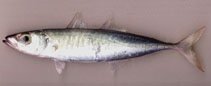
Espinhos dorsais (total) : 9; Raios dorsais moles (total) : 30 - 34; Espinhos anais: 3; Raios anais moles: 24 - 26; Vértebras: 24. This species is distinguished by the following: posterodorsal margin of opercular membrane minutely serrated in adults; oral valve (membrane) at symphysis of upper jaw dusky or transparent; posterior end of upper jaw straight above, slightly concave and not strongly slanted anteroventrally; shoulder girdle (cleithrum) margin with 2 small papillae, the lower papilla larger; terminal dorsal- and anal-fin rays each consisting of a widely detached finlet; lateral line scales, in curved part 61-73, no scutes and straight part 4-12, followed by 30-40 scutes; total scales and scutes in lateral line (excluding scales on caudal fin) 103-118. Colour in life metallic blue to greenish above, silvery below; small black blotch on margin of opercle near upper edge; caudal fin bright red and tips of soft dorsal-fin rays tinged with red (Ref. 9894, 11228).
Body shape (shape guide): fusiform / normal; Cross section: oval.
Adults occur in mid-water or near the bottom; also near the surface (Ref. 5217). They feed on smaller planktonic invertebrates, primarily copepods. Maximum depth recorded from Ref. 57551. Marketed fresh (Ref. 5217).
Paxton, J.R., D.F. Hoese, G.R. Allen and J.E. Hanley, 1989. Pisces. Petromyzontidae to Carangidae. Zoological Catalogue of Australia, Vol. 7. Australian Government Publishing Service, Canberra, 665 p. (Ref. 7300)
Categoria na Lista Vermelha da IUCN (Ref. 130435: Version 2025-1)
Ameaça para o homem
Harmless
Utilização humana
Pescarias: pouco comercial; isco: usually
Ferramentas
Relatórios especiais
Descarregue XML
Fontes da internet
Estimates based on models
Preferred temperature (Ref.
123201): 12.1 - 22.4, mean 16.6 °C (based on 271 cells).
Phylogenetic diversity index (Ref.
82804): PD
50 = 0.5005 [Uniqueness, from 0.5 = low to 2.0 = high].
Bayesian length-weight: a=0.01230 (0.00838 - 0.01806), b=3.01 (2.89 - 3.13), in cm total length, based on LWR estimates for this species & Genus-body shape (Ref.
93245).
Nível Trófico (Ref.
69278): 3.2 ±0.32 se; based on food items.
Resiliência (Ref.
120179): Elevada, tempo mínimo de duplicação da população menor que 15 meses (Fec=20,000-150,000).
Fishing Vulnerability (Ref.
59153): Moderate vulnerability (40 of 100).
🛈