This website uses cookies to enhance your browsing experience and ensure the functionality of our site. For more detailed information about the types of cookies we use and how we protect your privacy, please visit our Privacy Information page.
×
Cookie Settings
This website uses different types of cookies to enhance your experience. Please select your preferences below:
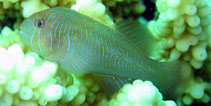
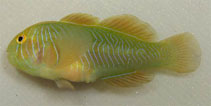
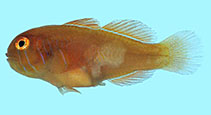
Rückenflossenstacheln (insgesamt) : 7; Rückenflossenweichstrahlen (insgesamt) : 10 - 11; Afterflossenstacheln: 1; Afterflossenweichstrahlen: 8 - 9. Characterized by red face with vertical blue lines; uniformly dark brown to light brown or bright green with a longitudinal thin red stripe; red stripe at the base of dorsal fins; absence of scales; complete pelvic fin frenum and basal membrane; depth of body at level of pelvic fins 2.6-3.0 in SL (Ref. 90102). Body shape (shape guide): short and / or deep; Cross section: compressed.
Facultative air-breathing in the genus (Ref. 126274); Marine species usually living on coral reefs but also recorded from pools, freshwater streams or lagoon mouths (Ref. 4343). They are found on tabletop Acropora corals (Ref. 1602); a coral-commensal species (Ref. 72446). Adults prey on copepods (Ref. 92840). Monogamous (Ref. 52884). The male takes care of eggs deposited on a coral branch (Ref. 32163). Has the ability to change sex in both directions to favor reproductive success (Ref. 32163).
The male takes care of eggs deposited on a coral branch (Ref. 32163). Has the ability to change sex in both directions to favor reproductive success (Ref. 32163). Monogamous mating is observed as both obligate and social (Ref. 52884).
Bevorzugte Temperatur (Ref. 123201): 24.8 - 29, mean 28 °C (based on 1316 cells).
Phylogenetischer Diversitätsindex (Ref. 82804): PD50 = 0.5000 [Uniqueness, from 0.5 = low to 2.0 = high].
Bayesian length-weight: a=0.01995 (0.00906 - 0.04395), b=3.01 (2.83 - 3.19), in cm total length, based on all LWR estimates for this body shape (Ref. 93245).
Trophische Ebene (Ref. 69278): 3.5 ±0.5 se; based on size and trophs of closest relatives
Widerstandsfähigkeit (Ref. 120179): hoch, Verdopplung der Population dauert weniger als 15 Monate. (Preliminary K or Fecundity.).
Anfälligkeit der Fischerei (Ref. 59153): Low vulnerability (10 of 100). 🛈