Issue
Some information are attached to E. jacksoniensis Macleay, 1878, a synonym of Etrumeus (Ref. 93002).
Environment: milieu / Zona climática / intervalo de profundidade / distribution range
Ecologia
marinhas pelagic-neritic; oceanódromo (Ref. 51243); intervalo de profundidade 0 - 125 m (Ref. 96339). Subtropical
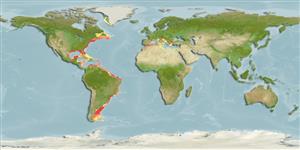
Restricted to the northwestern Atlantic: from the Bay of Fundy to the Gulf of Mexico.
Comprimento de primeira maturação / Tamanho / Peso / Idade
Maturidade: Lm 17.0 range ? - ? cm
Max length : 33.0 cm TL macho/indeterminado; (Ref. 56557); common length : 25.0 cm TL macho/indeterminado; (Ref. 56557)
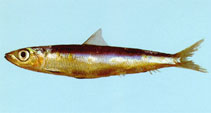
Espinhos dorsais (total) : 0; Raios dorsais (total) : 15 - 18; Espinhos anais: 0; Raios anais : 10 - 13. Some variation in body depth and certain meristic characters; without pre- and post-pelvic scutes; W-shaped pelvic scute; pelvic fins less advanced. Distinguished from E. whiteheadi of southern African waters by having fewer anal fin rays and the pelvic fin base about 1/3 eye diameter. Isthmus with lateral flanges or shoulders (Ref. 188). Silvery with an olive green back. Scales deciduous (Ref. 7251). Also Ref. 3259.
Body shape (shape guide): elongated; Cross section: circular.
Mainly inshore but has been occasionally taken 120 km from the Ecuador coast (Ref. 9291); also occur on shelf edge or surface (Ref. 11230), and between 50-150m (Ref. 028016). Usually occur in large schools (Ref. 2850). Epipelagic (Ref. 58302). Feed mainly on euphausiids and copepods (Ref. 9291). Oviparous, with planktonic eggs and larvae (Ref. 35601). Marketed fresh, salted and canned. Also processed into fishmeal (Ref. 9291).
DiBattista, J.D., J.E. Randall and B.W. Bowen, 2012. Review of the round herrings of the genus Etrumeus (Clupeidae: Dussumieriinae) of Africa, with descriptions of two new species. Cybium 36(3):447-460. (Ref. 91762)
Status na Lista Vermelha da UICN (Ref. 130435: Version 2025-1)
Ameaça para os humanos
Harmless
Uso pelos humanos
Pescarias: altamente comercial
Ferramentas
Relatórios especiais
Baixar XML
Fontes da internet
Estimates based on models
Preferred temperature (Ref.
123201): 7.3 - 26.7, mean 20.3 °C (based on 800 cells).
Índice de diversidade filogenética (Ref.
82804): PD
50 = 0.5078 [Uniqueness, from 0.5 = low to 2.0 = high].
Bayesian length-weight: a=0.00646 (0.00482 - 0.00866), b=3.08 (2.99 - 3.17), in cm total length, based on LWR estimates for this species (Ref.
93245).
Nível Trófico (Ref.
69278): 3.6 ±0.2 se; based on diet studies.
Resiliência (Ref.
120179): médio(a), tempo mínimo de duplicação da população 1,4 - 4,4 anos (K=0.13-0.8; tm=1.7; tmax=5).
Fishing Vulnerability (Ref.
59153): Low vulnerability (16 of 100).
🛈
Climate Vulnerability (Ref.
125649): Low vulnerability (6 of 100).
🛈
Nutrients (Ref.
124155): Calcium = 197 [87, 399] mg/100g; Iron = 2.18 [1.02, 4.56] mg/100g; Protein = 20.9 [19.7, 22.2] %; Omega3 = 0.341 [0.132, 0.740] g/100g; Selenium = 42.7 [19.3, 103.1] μg/100g; VitaminA = 6.52 [1.49, 24.08] μg/100g; Zinc = 0.979 [0.621, 1.540] mg/100g (wet weight); based on
nutrient studies.