


Satanoperca jurupari (Heckel, 1840)
Demon eartheater
Envoyez vos Photos et vidéos
Images | Images Google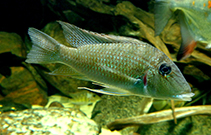 Satanoperca jurupari
Photo de Irtz, P.
Images | Images Google
Photo de Irtz, P.
Classification / Noms Noms communs | Synonymes | Catalog of Fishes(Genre, Espèce) | ITIS | CoL | WoRMS | Cloffa
> Cichliformes (Cichlids, convict blennies) > Cichlidae (Cichlids) > Geophaginae
Etymology: Satanoperca: Taken from the prince of darkness. Hube liked to name cave fishes with diabolic names based on the idea of hell being underground + Greek, perke = perch (Ref. 45335).
Eponymy: Named after the devil, and referring in the case of the blindcat to the species’ underground habitat. Günther’s use of a name meaning ‘Satan perch’ for the cichlids was probably inspired by Heckel (q.v.) having named a species as ‘Geophagus daemon’. (Ref. 128868), visit book page.
More on author: Heckel.
Etymology: Satanoperca: Taken from the prince of darkness. Hube liked to name cave fishes with diabolic names based on the idea of hell being underground + Greek, perke = perch (Ref. 45335).
Eponymy: Named after the devil, and referring in the case of the blindcat to the species’ underground habitat. Günther’s use of a name meaning ‘Satan perch’ for the cichlids was probably inspired by Heckel (q.v.) having named a species as ‘Geophagus daemon’. (Ref. 128868), visit book page.
More on author: Heckel.
Taxonomic Remarks
Redescription, based on Peruvian material, in Kullander (1986:147), with bibliography, diagnosis, description, distribution and illustration.
Environnement : milieu / zone climatique / profondeur / gamme de distribution Écologie
; eau douce benthopélagique; pH range: 6.3 - 7.0; dH range: 5 - 10. Tropical; 24°C - 26°C (Ref. 1672)
Distribution Territoires | Zones FAO | Écosystèmes | Occurrences | Carte par point | Introductions | Faunafri
South America: Amazon River basin, from Peru, Ecuador and Colombia to the mouth of Amazon River in Brazil, in Amapá (Brazil), and eastern French Guiana, also in the Bolivian Amazon drainage except the Guaporé River.
Taille / Poids / Âge
Maturité: Lm ? range ? - ? cm
Max length : 26.0 cm SL mâle / non sexé; (Ref. 125983); 23.3 cm SL (female); poids max. publié: 469.90 g (Ref. 125983); poids max. publié: 469.90 g
Max length : 26.0 cm SL mâle / non sexé; (Ref. 125983); 23.3 cm SL (female); poids max. publié: 469.90 g (Ref. 125983); poids max. publié: 469.90 g
Description synthétique Clés d'identification | Morphologie | Morphométrie
Body shape (shape guide): fusiform / normal.
Typical of quiet water, occurring in freshwaters of estuaries and coastal swamps. Digs into the muddy substrate looking for food which includes fruit seeds, crustaceans and insects (Ref. 35237). Maximum length 25 cm TL (Ref. 7020).
Cycle de vie et comportement reproducteur Maturité | Reproduction | Frai | Œufs | Fécondité | Larves
Ovophile mouth brooders. The parent fish clean the rocky substrate prior to spawning. Incubation takes place in the mouth. Juveniles use the mouth as their shelter for several weeks, where they attach themselves to the palate, by means of a specific gland (Ref. 35237).
Référence principale
Téléchargez vos références | Références | Coordinateur : Kullander, Sven O. | Collaborateurs
Kullander, S.O., 1986. Cichlid fishes of the Amazon River drainage of Peru. Department of Vertebrate Zoology, Research Division, Swedish Museum of Natural History, Stockholm, Sweden, 394 p. (Ref. 9088)
Statut dans la liste rouge de l'IUCN (Ref. 130435: Version 2025-2 (Global))
Préoccupation mineure (LC) ; Date assessed: 21 November 2020
CITES
Not Evaluated
Menace pour l'homme
Harmless
Utilisations par l'homme
Pêcheries: intérêt commercial mineur; Aquarium: Commercial
FAO - Publication: search | FishSource |
Plus d'informations
Écologie trophique
Aliments (proies)
Composition du régime alimentaire
Consommation alimentaire
Rations alimentaires
Prédateurs
Aliments (proies)
Composition du régime alimentaire
Consommation alimentaire
Rations alimentaires
Prédateurs
Écologie
Écologie
Écologie
Dynamique des populations
Paramètres de croissance
Âges / tailles maximales
Longueur-poids rel.
Rel. longueur-longueur.
Fréquences de longueurs
Conversion de masse
Recrutement
Abondance
Paramètres de croissance
Âges / tailles maximales
Longueur-poids rel.
Rel. longueur-longueur.
Fréquences de longueurs
Conversion de masse
Recrutement
Abondance
Cycle de vie
Reproduction
Maturité
Maturité/épines rel.
Fécondité
Frai
Agrégats de frai
Œufs
Développement de l'œuf
Larves
Dynamique des populations larvaires
Reproduction
Maturité
Maturité/épines rel.
Fécondité
Frai
Agrégats de frai
Œufs
Développement de l'œuf
Larves
Dynamique des populations larvaires
Anatomie
Surface branchiale
Cerveau
Otolithe
Surface branchiale
Cerveau
Otolithe
Physiologie
Composition corporelle
Nutriments
Consommation d'oxygène
Type de natation
Vitesse de nage
Pigments visuels
Son de poisson
Maladies et parasites
Toxicité (CL50)
Composition corporelle
Nutriments
Consommation d'oxygène
Type de natation
Vitesse de nage
Pigments visuels
Son de poisson
Maladies et parasites
Toxicité (CL50)
Liées à l'homme
Systèmes d'aquaculture
Profils d'aquaculture
Souches
Cas de ciguatera
Timbres, pièces de monnaie, divers
Systèmes d'aquaculture
Profils d'aquaculture
Souches
Cas de ciguatera
Timbres, pièces de monnaie, divers
Outils
E-book | Guide de terrain | Générateur de fréquences de longueur | Outil de dynamique de population | Carte par point |
Capture-MSY |
Articles particuliers
Télécharger en XML
Sources Internet
AFORO (otoliths) | Aquatic Commons | BHL | Cloffa | Websites from users | FishWatcher | CISTI | Catalog of Fishes: Genre, Espèce | DiscoverLife | ECOTOX | FAO - Publication: search | Faunafri | Fishipedia | Fishtrace | GloBI | Google Books | Google Scholar | Google | IGFA World Record | OneZoom | Open Tree of Life | Otolith Atlas of Taiwan Fishes | Aquariums publics | PubMed | Reef Life Survey | Socotra Atlas | TreeBase | Arbre de Vie | Wikipedia: aller à, chercher | World Records Freshwater Fishing | Zoological Record
Estimations basées sur des modèles
Indice de diversité phylogénétique (Réf. 82804): PD50 = 0.5039 [Uniqueness, from 0.5 = low to 2.0 = high].
Bayesian length-weight: a=0.02399 (0.02004 - 0.02871), b=3.05 (3.00 - 3.10), in cm total length, based on LWR estimates for this species (Ref. 93245).
Niveau trophique (Réf. 69278): 3.1 ±0.4 se; based on size and trophs of closest relatives
Résilience (Réf. 120179): Milieu, temps minimum de doublement de population : 1,4 à 4,4 années (Preliminary K or Fecundity.).