


Hypsophrys nicaraguensis (Günther, 1864)
Moga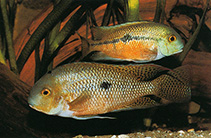
Classification / Noms Noms communs | Synonymes | Catalog of Fishes(Genre, Espèce) | ITIS | CoL | WoRMS | Cloffa
> Cichliformes (Cichlids, convict blennies) > Cichlidae (Cichlids) > Cichlasomatinae
Etymology: Hypsophrys: Greek, hypsi = high + Greek, ophrys = eyebrow (Ref. 45335).
More on author: Günther.
Etymology: Hypsophrys: Greek, hypsi = high + Greek, ophrys = eyebrow (Ref. 45335).
More on author: Günther.
Taxonomic Remarks
Species monograph by López (1974), well illustrated. Kullander & Hartel (1997) discussed the nomenclature of Hypsophrys unimaculatus. Reviewed by Bussing (1998: 354), with key, diagnosis, geographical distribution, and figures.
Environnement : milieu / zone climatique / profondeur / gamme de distribution Écologie
; eau douce benthopélagique; pH range: 7.0 - 8.0; dH range: 9 - 20. Tropical; 23°C - 36°C (Ref. 36880)
Distribution Territoires | Zones FAO | Écosystèmes | Occurrences | Carte par point | Introductions | Faunafri
Central America: Atlantic slope, from the San Juan drainage, including Lake Nicaragua, in Costa Rica and Nicaragua, to the Matina River drainage in Costa Rica.
Taille / Poids / Âge
Maturité: Lm ? range ? - ? cm
Max length : 16.5 cm SL mâle / non sexé; (Ref. 36377); 20.0 cm TL (female)
Max length : 16.5 cm SL mâle / non sexé; (Ref. 36377); 20.0 cm TL (female)
Description synthétique Clés d'identification | Morphologie | Morphométrie
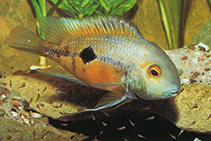
Épines dorsales (Total) : 18 - 19; Rayons mous dorsaux (Total) : 9 - 11; Épines anales: 7 - 8; Rayons mous anaux: 7 - 9. This species can be distinguished by the dark line running through the middle of the body and the large black blotch positioned midlength; head profile extremely curved with the mouth on the lower part of the head; in males, the scales have dark edges producing a reticulated pattern, their fins with many dark spots, and a red edge to the dorsal fin; both males with iridescent, greenish-blue head and with gold to copper-colored bodies (Ref. 44091).
Body shape (shape guide): fusiform / normal; Cross section: compressed.
Body shape (shape guide): fusiform / normal; Cross section: compressed.
Inhabit lakes and rivers with slow to moderate currents, between 5 to 200 m elevation (Ref. 36880). Juveniles feed on aquatic insects, while adults feed on bottom detritus, seeds and leaves. Also naturally feed on snails and other mollusks, but will accept a variety of food in captivity (Ref. 44091). Maximum length 25 cm TL (Ref. 2060).
Cycle de vie et comportement reproducteur Maturité | Reproduction | Frai | Œufs | Fécondité | Larves
Deposits eggs in sand depressions. Produces about 200-400 non adhesive eggs with females practicing communal care during the post spawning period (an unusual behavior referred to as "creching", Ref. 44091). A group of 3 or 4 females stand guard over their combined spawns, encircling the expanded group and do not allow any intruders or predators into the rearing arena.
Référence principale
Téléchargez vos références | Références | Coordinateur : Kullander, Sven O. | Collaborateurs
Kullander, S.O., 2003. Cichlidae (Cichlids). p. 605-654. In R.E. Reis, S.O. Kullander and C.J. Ferraris, Jr. (eds.) Checklist of the Freshwater Fishes of South and Central America. Porto Alegre: EDIPUCRS, Brasil. (Ref. 36377)
Statut dans la liste rouge de l'IUCN (Ref. 130435: Version 2025-2 (Global))
Préoccupation mineure (LC) ; Date assessed: 17 June 2019
CITES
Not Evaluated
Menace pour l'homme
Harmless
Utilisations par l'homme
Pêcheries: sans intérêt; Aquarium: Commercial
FAO - Publication: search | FishSource |
Plus d'informations
Écologie trophique
Aliments (proies)
Composition du régime alimentaire
Consommation alimentaire
Rations alimentaires
Prédateurs
Aliments (proies)
Composition du régime alimentaire
Consommation alimentaire
Rations alimentaires
Prédateurs
Dynamique des populations
Paramètres de croissance
Âges / tailles maximales
Longueur-poids rel.
Rel. longueur-longueur.
Fréquences de longueurs
Conversion de masse
Recrutement
Abondance
Paramètres de croissance
Âges / tailles maximales
Longueur-poids rel.
Rel. longueur-longueur.
Fréquences de longueurs
Conversion de masse
Recrutement
Abondance
Cycle de vie
Reproduction
Maturité
Maturité/épines rel.
Fécondité
Frai
Agrégats de frai
Œufs
Développement de l'œuf
Larves
Dynamique des populations larvaires
Reproduction
Maturité
Maturité/épines rel.
Fécondité
Frai
Agrégats de frai
Œufs
Développement de l'œuf
Larves
Dynamique des populations larvaires
Anatomie
Surface branchiale
Cerveau
Otolithe
Surface branchiale
Cerveau
Otolithe
Physiologie
Composition corporelle
Nutriments
Consommation d'oxygène
Type de natation
Vitesse de nage
Pigments visuels
Son de poisson
Maladies et parasites
Toxicité (CL50)
Composition corporelle
Nutriments
Consommation d'oxygène
Type de natation
Vitesse de nage
Pigments visuels
Son de poisson
Maladies et parasites
Toxicité (CL50)
Génétique
génôme
Génétique
Hétérozygotie
Héritabilité
Diversité génétique
génôme
Génétique
Hétérozygotie
Héritabilité
Diversité génétique
Liées à l'homme
Systèmes d'aquaculture
Profils d'aquaculture
Souches
Cas de ciguatera
Timbres, pièces de monnaie, divers
Systèmes d'aquaculture
Profils d'aquaculture
Souches
Cas de ciguatera
Timbres, pièces de monnaie, divers
Outils
Quiz bio | E-book | Guide de terrain | Clés d'identification | Générateur de fréquences de longueur | Outil de dynamique de population | Carte par point |
Capture-MSY |
Articles particuliers
Télécharger en XML
Sources Internet
AFORO (otoliths) | Alien/Invasive Species database | Aquatic Commons | BHL | Cloffa | Websites from users | FishWatcher | CISTI | Catalog of Fishes: Genre, Espèce | DiscoverLife | ECOTOX | FAO - Publication: search | Faunafri | Fishipedia | Fishtrace | GloBI | Google Books | Google Scholar | Google | IGFA World Record | OneZoom | Open Tree of Life | Otolith Atlas of Taiwan Fishes | Aquariums publics | PubMed | Reef Life Survey | Socotra Atlas | TreeBase | Arbre de Vie | Wikipedia: aller à, chercher | World Records Freshwater Fishing | Zoological Record
Estimations basées sur des modèles
Indice de diversité phylogénétique (Réf. 82804): PD50 = 0.7500 [Uniqueness, from 0.5 = low to 2.0 = high].
Bayesian length-weight: a=0.02188 (0.01025 - 0.04670), b=3.05 (2.87 - 3.23), in cm total length, based on LWR estimates for this (Sub)family-body shape (Ref. 93245).
Niveau trophique (Réf. 69278): 2.7 ±0.34 se; based on food items.
Résilience (Réf. 120179): Haut, temps minimum de doublement de population inférieur à 15 mois (Preliminary K or Fecundity.).