


Forsterygion lapillum Hardy, 1989
Common triplefin
Waarneming toevoegen in Fish Watcher
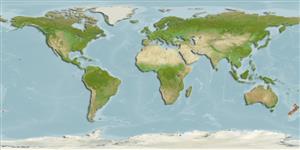
| Native range | All suitable habitat | Point map | Year 2050 |
|
| This map was computer-generated and has not yet been reviewed. |
| Forsterygion lapillum AquaMaps Data sources: GBIF OBIS |
Uploaden van uw Foto's en video's
Afbeeldingen | Google afbeelding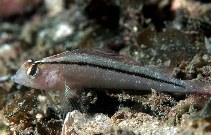 Forsterygion lapillum
Afbeelding van Clements, K.
Afbeeldingen | Google afbeelding
Afbeelding van Clements, K.
Classificatie / Namen Lokale namen | Synoniemen | Catalog of Fishes(Genus, Soort(en)) | ITIS | CoL | WoRMS | Cloffa
Milieu: milieu / Klimaatzone / Diepte / verspreidingsgebied Ecologie
marien benthopelagisch; diepte 0 - 20 m (Ref. 13227). Temperate
Verspreiding Gebieden | FAO regio's | Ecosystemen | Voorkomen | Verspreidingskaart | Introducties | Faunafri
Southwest Pacific: throughout New Zealand. Records from Chatham Islands are unconfirmed (Ref. 9003).
Grootte / Gewicht / Leeftijd
Maturiteit: Lm ? range ? - ? cm
Max length : 6.7 cm SL mannelijk / geslacht onbekend; (Ref. 13227); max. gerapporteerde leeftijd: 3.00 Jaren (Ref. 13227)
Max length : 6.7 cm SL mannelijk / geslacht onbekend; (Ref. 13227); max. gerapporteerde leeftijd: 3.00 Jaren (Ref. 13227)
Korte beschrijving Determinatiesleutels | Morfologie | Morfometrie
Dorsale stekels (totaal) : 24 - 31; Dorsale zachte stralen (totaal) : 11 - 14; Anale stekels: 2; Anale zachte stralen: 23 - 27; Wervels: 40 - 45. First dorsal fin spines V-VIII; second dorsal fin spines XIX-XXIII; third dorsal fin rays 11-14.
Discontinuous lateral line tubular scales 19-24, notched scales 14-24. Total vertebral number 43-45. Snout profile steep (70-75°). Preoperculo-mandibular canal with 7 pores, 3 at lower corner of preopercular, 3 at tip of upper jaw and 1 at lower jaw symphysis. Scale rows between anterior end of second dorsal fin and lateral line, 5-6. Scales between second and third dorsal fins, 4. Scales around caudal peduncle 12-13. Radii in scales from area below lateral line and under pectoral fin, 8-11. Long ctenii in scales from above and below lateral line in caudal peduncle area. Lateral line canal constricted with W-shaped anterior and posterior openings. Short denticles on interradial circuli. Post-temporal partially exposed. Pterygiophore supporting first segmented ray of third dorsal fin anterior to 24th vertebra. Dorsal fin formula V-0N-0-1-0-1. Ventral edge of lower caudal plate straight. Short neural spine of second preural vertebra. Epurals of different length. Soft rays in caudal fin, 14; 2 unbranched and 5 branched (non multibranched) rays in upper and lower caudal lobes. Procurrent rays in upper caudal lobe, 10; eight in lower lobe, 8; in upper lobe, 2 procurrent rays between upper lobe and posterior epural, 4 rays opposite epurals , 1 between neural spine of second preural vertebra and neural spine of third vertebra, 1 opposite neural spine of third preural vertebra and 2 anterior to neural spine of third vertebra; in lower lobe, one procurrent ray between lower lobe
and haemal spine of second preural vertebra, 5 rays opposite haemal spine of second preural vertebra, 1 between haemal spines of second and third preural vertebrae, 1 ray opposite neural spine of third preural vertebra. Rounded posterior end. Short, pointed rostrum. Broad antristrum. Excisura shallow (Ref. 84085).
Body shape (shape guide): elongated.
Body shape (shape guide): elongated.
Facultative air-breathing in the genus (Ref. 126274); Adults are most common in shallow water (0-5m), although recorded from depths of 30 m (Ref. 84085). They are commonly found in intertidal rock pools, particularly those with adequate rocky or algal shelter. They feed mainly on amphipods, isopods, and polychaetes (Ref. 13227). Eggs are hemispherical and covered with numerous sticky threads that anchor them in the algae on the nesting sites (Ref. 240). Larvae are planktonic which occur primarily in shallow, nearshore waters (Ref. 94114).
Levenscyclus en paargedrag Maturiteit | Voortplanting | Paaien | Eieren | Fecunditeit | Larven
Hoofdreferentie
Upload uw referenties | Referenties | Coördinator : Fricke, Ronald | Medewerkers
Fricke, R., 1994. Tripterygiid fishes of Australia, New Zealand and the southwest Pacific Ocean (Teleostei). Theses Zool. 24:1-585. (Ref. 13227)
Status op de Rode Lijst van het IUCN (Ref. 130435: Version 2025-2 (Global))
Niet bedreigd (LC) ; Date assessed: 04 May 2010
CITES
Not Evaluated
Gevaar voor de mens
Harmless
Gebruik door de mens
Visserij: van geen belang
FAO - Publication: search | FishSource |
Meer informatie
Trofische ecologie
Voedsel (prooien)
Dieetsamenstelling
Voedselconsumptie
Voedselrantsoenen
Predatoren
Voedsel (prooien)
Dieetsamenstelling
Voedselconsumptie
Voedselrantsoenen
Predatoren
Populatiedynamica
Groeiparameters
Max. leeftijden / maten
Lengte-gewicht rel.
Lengte-lengte rel.
Lengtefrequenties
Massaconversie
Rekrutering
Abundantie
Groeiparameters
Max. leeftijden / maten
Lengte-gewicht rel.
Lengte-lengte rel.
Lengtefrequenties
Massaconversie
Rekrutering
Abundantie
Anatomie
Kieuwoppervlak
Hersenen
Otoliet
Kieuwoppervlak
Hersenen
Otoliet
Fysiologie
Lichaamssamenstelling
Voedingsstoffen
Zuurstofverbruik
Type zwemmen
Zwemsnelheid
Visuele pigmenten
Vis geluid
Ziekten en parasieten
Toxiciteit (LC50)
Lichaamssamenstelling
Voedingsstoffen
Zuurstofverbruik
Type zwemmen
Zwemsnelheid
Visuele pigmenten
Vis geluid
Ziekten en parasieten
Toxiciteit (LC50)
Genetica
genoom
Genetica
Heterozygositeit
Erfelijkheid
Genetische diversiteit
genoom
Genetica
Heterozygositeit
Erfelijkheid
Genetische diversiteit
Menselijk gerelateerd
Aquacultuursystemen
Aquacultuurprofielen
Kweeklijnen
Ciguatera gevallen
Postzegels, munten, diversen.
Aquacultuursystemen
Aquacultuurprofielen
Kweeklijnen
Ciguatera gevallen
Postzegels, munten, diversen.
Tools
Biologische quiz | E-boek | Veldgids | Lengtefrequentie Tool | Levenscyclus tool | Verspreidingskaart |
Vangst-MSY |
Speciale rapporten
Bekijk gegevens voor het houden in een aquarium | Bekijk Fact Sheets voor de soort | Bekijk Aquacultuur Fact Sheets
Download XML
Internetbronnen
AFORO (otoliths) | Aquatic Commons | BHL | Cloffa | Websites from users | Bekijk FishWatcher | CISTI | Catalog of Fishes: Genus, Soort(en) | DiscoverLife | ECOTOX | FAO - Publication: search | Faunafri | Fishipedia | Fishtrace | GloBI | Google Books | Google Scholar | Google | IGFA World Record | OneZoom | Open Tree of Life | Otolith Atlas of Taiwan Fishes | PubMed | Reef Life Survey | Socotra Atlas | TreeBase | Tree of Life | Wikipedia: ga naar, zoek | World Records Freshwater Fishing | Zoobank | Zoological Record
Schattingen op basis van modellen
Gewenste temperatuur (Ref. 123201): 10.4 - 18.5, mean 14.9 °C (based on 161 cells).
Fylogenetische diversiteitsindex (Ref. 82804): PD50 = 0.5039 [Uniqueness, from 0.5 = low to 2.0 = high].
Bayesian length-weight: a=0.00631 (0.00356 - 0.01119), b=3.07 (2.91 - 3.23), in cm total length, based on LWR estimates for this species & (Sub)family-body (Ref. 93245).
Trofisch niveau (Ref. 69278): 3.2 ±0.45 se; based on food items.
Generation time: 0.9 ( na - na) years. Estimated as median ln(3)/K based on 1 growth studies.
Weerstandsvermogen (Ref. 120179): Hoog, minimale populatieverdubbelingstijd minder dan 15 maanden (K=1.20; tmax=3).
Voedingsstoffen (Ref. 124155): Calcium = 130 [65, 298] mg/100g; Iron = 0.491 [0.264, 0.997] mg/100g; Protein = 17.2 [16.0, 18.3] %; Omega3 = 0.422 [0.172, 0.977] g/100g; Selenium = 9.31 [3.45, 25.01] μg/100g; VitaminA = 35.9 [7.7, 169.3] μg/100g; Zinc = 1.32 [0.84, 2.00] mg/100g (wet weight);