


Forsterygion lapillum Hardy, 1989
Common triplefin
Ajouter votre observation dans Fish Watcher
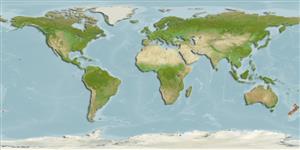
| Native range | All suitable habitat | Point map | Year 2050 |
|
| This map was computer-generated and has not yet been reviewed. |
| Forsterygion lapillum AquaMaps Data sources: GBIF OBIS |
Envoyez vos Photos et vidéos
Images | Images Google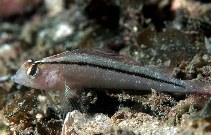 Forsterygion lapillum
Photo de Clements, K.
Images | Images Google
Photo de Clements, K.
Classification / Noms Noms communs | Synonymes | Catalog of Fishes(Genre, Espèce) | ITIS | CoL | WoRMS | Cloffa
Environnement : milieu / zone climatique / profondeur / gamme de distribution Écologie
marin benthopélagique; profondeur 0 - 20 m (Ref. 13227). Temperate
Distribution Territoires | Zones FAO | Écosystèmes | Occurrences | Carte par point | Introductions | Faunafri
Southwest Pacific: throughout New Zealand. Records from Chatham Islands are unconfirmed (Ref. 9003).
Taille / Poids / Âge
Maturité: Lm ? range ? - ? cm
Max length : 6.7 cm SL mâle / non sexé; (Ref. 13227); âge max. reporté: 3.00 années (Ref. 13227)
Max length : 6.7 cm SL mâle / non sexé; (Ref. 13227); âge max. reporté: 3.00 années (Ref. 13227)
Description synthétique Clés d'identification | Morphologie | Morphométrie
Épines dorsales (Total) : 24 - 31; Rayons mous dorsaux (Total) : 11 - 14; Épines anales: 2; Rayons mous anaux: 23 - 27; Vertèbres: 40 - 45. First dorsal fin spines V-VIII; second dorsal fin spines XIX-XXIII; third dorsal fin rays 11-14.
Discontinuous lateral line tubular scales 19-24, notched scales 14-24. Total vertebral number 43-45. Snout profile steep (70-75°). Preoperculo-mandibular canal with 7 pores, 3 at lower corner of preopercular, 3 at tip of upper jaw and 1 at lower jaw symphysis. Scale rows between anterior end of second dorsal fin and lateral line, 5-6. Scales between second and third dorsal fins, 4. Scales around caudal peduncle 12-13. Radii in scales from area below lateral line and under pectoral fin, 8-11. Long ctenii in scales from above and below lateral line in caudal peduncle area. Lateral line canal constricted with W-shaped anterior and posterior openings. Short denticles on interradial circuli. Post-temporal partially exposed. Pterygiophore supporting first segmented ray of third dorsal fin anterior to 24th vertebra. Dorsal fin formula V-0N-0-1-0-1. Ventral edge of lower caudal plate straight. Short neural spine of second preural vertebra. Epurals of different length. Soft rays in caudal fin, 14; 2 unbranched and 5 branched (non multibranched) rays in upper and lower caudal lobes. Procurrent rays in upper caudal lobe, 10; eight in lower lobe, 8; in upper lobe, 2 procurrent rays between upper lobe and posterior epural, 4 rays opposite epurals , 1 between neural spine of second preural vertebra and neural spine of third vertebra, 1 opposite neural spine of third preural vertebra and 2 anterior to neural spine of third vertebra; in lower lobe, one procurrent ray between lower lobe
and haemal spine of second preural vertebra, 5 rays opposite haemal spine of second preural vertebra, 1 between haemal spines of second and third preural vertebrae, 1 ray opposite neural spine of third preural vertebra. Rounded posterior end. Short, pointed rostrum. Broad antristrum. Excisura shallow (Ref. 84085).
Body shape (shape guide): elongated.
Body shape (shape guide): elongated.
Facultative air-breathing in the genus (Ref. 126274); Adults are most common in shallow water (0-5m), although recorded from depths of 30 m (Ref. 84085). They are commonly found in intertidal rock pools, particularly those with adequate rocky or algal shelter. They feed mainly on amphipods, isopods, and polychaetes (Ref. 13227). Eggs are hemispherical and covered with numerous sticky threads that anchor them in the algae on the nesting sites (Ref. 240). Larvae are planktonic which occur primarily in shallow, nearshore waters (Ref. 94114).
Cycle de vie et comportement reproducteur Maturité | Reproduction | Frai | Œufs | Fécondité | Larves
Référence principale
Téléchargez vos références | Références | Coordinateur : Fricke, Ronald | Collaborateurs
Fricke, R., 1994. Tripterygiid fishes of Australia, New Zealand and the southwest Pacific Ocean (Teleostei). Theses Zool. 24:1-585. (Ref. 13227)
Statut dans la liste rouge de l'IUCN (Ref. 130435: Version 2025-2 (Global))
Préoccupation mineure (LC) ; Date assessed: 04 May 2010
CITES
Not Evaluated
Menace pour l'homme
Harmless
Utilisations par l'homme
Pêcheries: sans intérêt
FAO - Publication: search | FishSource |
Plus d'informations
Écologie trophique
Aliments (proies)
Composition du régime alimentaire
Consommation alimentaire
Rations alimentaires
Prédateurs
Aliments (proies)
Composition du régime alimentaire
Consommation alimentaire
Rations alimentaires
Prédateurs
Dynamique des populations
Paramètres de croissance
Âges / tailles maximales
Longueur-poids rel.
Rel. longueur-longueur.
Fréquences de longueurs
Conversion de masse
Recrutement
Abondance
Paramètres de croissance
Âges / tailles maximales
Longueur-poids rel.
Rel. longueur-longueur.
Fréquences de longueurs
Conversion de masse
Recrutement
Abondance
Anatomie
Surface branchiale
Cerveau
Otolithe
Surface branchiale
Cerveau
Otolithe
Physiologie
Composition corporelle
Nutriments
Consommation d'oxygène
Type de natation
Vitesse de nage
Pigments visuels
Son de poisson
Maladies et parasites
Toxicité (CL50)
Composition corporelle
Nutriments
Consommation d'oxygène
Type de natation
Vitesse de nage
Pigments visuels
Son de poisson
Maladies et parasites
Toxicité (CL50)
Génétique
génôme
Génétique
Hétérozygotie
Héritabilité
Diversité génétique
génôme
Génétique
Hétérozygotie
Héritabilité
Diversité génétique
Liées à l'homme
Systèmes d'aquaculture
Profils d'aquaculture
Souches
Cas de ciguatera
Timbres, pièces de monnaie, divers
Systèmes d'aquaculture
Profils d'aquaculture
Souches
Cas de ciguatera
Timbres, pièces de monnaie, divers
Outils
Quiz bio | E-book | Guide de terrain | Générateur de fréquences de longueur | Outil de dynamique de population | Carte par point |
Capture-MSY |
Articles particuliers
Télécharger en XML
Sources Internet
AFORO (otoliths) | Aquatic Commons | BHL | Cloffa | Websites from users | FishWatcher | CISTI | Catalog of Fishes: Genre, Espèce | DiscoverLife | ECOTOX | FAO - Publication: search | Faunafri | Fishipedia | Fishtrace | GloBI | Google Books | Google Scholar | Google | IGFA World Record | OneZoom | Open Tree of Life | Otolith Atlas of Taiwan Fishes | PubMed | Reef Life Survey | Socotra Atlas | TreeBase | Arbre de Vie | Wikipedia: aller à, chercher | World Records Freshwater Fishing | Zoobank | Zoological Record
Estimations basées sur des modèles
Température préférée (Réf. 123201): 10.4 - 18.5, mean 14.9 °C (based on 161 cells).
Indice de diversité phylogénétique (Réf. 82804): PD50 = 0.5039 [Uniqueness, from 0.5 = low to 2.0 = high].
Bayesian length-weight: a=0.00631 (0.00356 - 0.01119), b=3.07 (2.91 - 3.23), in cm total length, based on LWR estimates for this species & (Sub)family-body (Ref. 93245).
Niveau trophique (Réf. 69278): 3.2 ±0.45 se; based on food items.
Generation time: 0.9 ( na - na) years. Estimated as median ln(3)/K based on 1 growth studies.
Résilience (Réf. 120179): Haut, temps minimum de doublement de population inférieur à 15 mois (K=1.20; tmax=3).
Nutriments (Ref. 124155): Calcium = 130 [65, 298] mg/100g; Iron = 0.491 [0.264, 0.997] mg/100g; Protein = 17.2 [16.0, 18.3] %; Omega3 = 0.422 [0.172, 0.977] g/100g; Selenium = 9.31 [3.45, 25.01] μg/100g; VitaminA = 35.9 [7.7, 169.3] μg/100g; Zinc = 1.32 [0.84, 2.00] mg/100g (wet weight);