


Oreochromis macrochir (Boulenger, 1912)
Longfin tilapia
上傳你的 相片 和 影像
照片 | Google 影像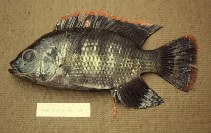 Oreochromis macrochir
拍攝者 de Vos, L.
照片 | Google 影像
拍攝者 de Vos, L.
分類 / 名稱 俗名 | 同種異名 | Catalog of Fishes(屬, 種) | ITIS | CoL | WoRMS | Cloffa
Teleostei > Cichliformes (Cichlids, convict blennies) 鱸形目 (Cichlids, convict blennies) > Cichlidae (Cichlids) 慈鯛科魚類 (Cichlids) > Pseudocrenilabrinae
Etymology: Oreochromis: Latin, aurum = gold + Greek, chromis = a fish, perhaps a perch (Ref. 45335); macrochir: From the Greek "macros" = big and the Greek "cheir" = hand, or pectoral fin in fishes, referring to the large pectoral fin (Ref. 52307).
More on author: Boulenger.
Etymology: Oreochromis: Latin, aurum = gold + Greek, chromis = a fish, perhaps a perch (Ref. 45335); macrochir: From the Greek "macros" = big and the Greek "cheir" = hand, or pectoral fin in fishes, referring to the large pectoral fin (Ref. 52307).
More on author: Boulenger.
Taxonomic Remarks
Status of and differences between O. macrochir and O. mweruensis are not clear; the latter is possibly restricted to Luapula/Lake Mweru/Congo basin and builds a star-shaped nest, in contrast to the more widespread O. macrochir which builds a volcano-shaped nest; origin (and identification) of introduced specimens is also unclear, but they mainly originate from Lake Mweru/Luapula (Ref. 88). See also Ref. 2, 33478, 55074.
環境: 環境 / 氣候帶 / 深度上下限 / 配送範圍 生態學
; 淡水 底中水層性; 非遷移的 (Ref. 126106); 深度上下限 5 - 14 m (Ref. 58302). 熱帶; 18°C - 35°C (Ref. 54042); 5°N - 25°S
分布 領土 | FAO區域 | 生態系 | 發現紀錄 | 分布圖 | 簡介 | Faunafri
Africa: Kafue, upper Zambezi, and Congo River systems, introduced elsewhere in Africa and in Hawaiian Islands. Also in the Okavango and Ngami region, Cunene basin, Chambezi and Bangweulu region (Ref. 5166).
非洲: Kafue ,尚比西河上游與剛果河流域; 在奧塔萬戈河與 Ngami 區域,庫內內河流域, Chambezi 與 Bangweulu 區域中也在非洲與夏威夷群島引入了其他地方。 (參考文獻 5166) 至少一個國家報告引入後的不利的生態衝擊。
非洲: Kafue ,尚比西河上游與剛果河流域; 在奧塔萬戈河與 Ngami 區域,庫內內河流域, Chambezi 與 Bangweulu 區域中也在非洲與夏威夷群島引入了其他地方。 (參考文獻 5166) 至少一個國家報告引入後的不利的生態衝擊。
初熟時的長度 / 大小 / 重量 / 年齡
簡短描述 檢索表 | 型態特徵 | 形態測量圖
背棘 (總數) : 15 - 17; 背的軟條 (總數) : 11 - 14; 臀棘: 3; 臀鰭軟條: 9 - 12; 脊椎骨: 29 - 32. Diagnosis: head profile steep (Ref. 2, 7248, 12524, 13337, 33478, 52193, 54167) and rounded (Ref. 315, 12524). Toothed area of lower pharyngeal bone with broadly rounded lobes; scales on cheek in 2-3 rows; caudal scales variable, not on the inter-radial membranes except at the base, and never stiffening the fin (Ref. 2). Adults with black (Ref. 2, 12524) or dark brown flecks in the temporal region, on the gill-cover (Ref. 2, 11970) and below the eye, mostly associated with openings of the lateral line system (Ref. 2). Adults without conspicuous mid-lateral blotches (Ref. 2).
Body shape (shape guide): fusiform / normal; Cross section: compressed.
在 2-3 列中的在頰上的鱗片。 尾部的鱗片可變的, 不在動脈之間的薄膜上除了在基底之外; 沒有硬挺的鰭。 生殖乳突大而長有小瘤或有荷葉邊的, 在繁殖期的雄性中流蘇了通常顏色淡或深橄欖綠色的。 繁殖期的雄魚彩虹色的深綠色的到藍黑色的在頭部,身體與垂直的鰭上; 對背鰭與尾鰭鰭的紅色邊緣。 色彩呈綠色的在頭側上有深色的斑紋.(參考文獻 4967)
Body shape (shape guide): fusiform / normal; Cross section: compressed.
在 2-3 列中的在頰上的鱗片。 尾部的鱗片可變的, 不在動脈之間的薄膜上除了在基底之外; 沒有硬挺的鰭。 生殖乳突大而長有小瘤或有荷葉邊的, 在繁殖期的雄性中流蘇了通常顏色淡或深橄欖綠色的。 繁殖期的雄魚彩虹色的深綠色的到藍黑色的在頭部,身體與垂直的鰭上; 對背鰭與尾鰭鰭的紅色邊緣。 色彩呈綠色的在頭側上有深色的斑紋.(參考文獻 4967)
Adults prefer quiet, deep water associated with aquatic vegetation, but has been collected in other habitats as well (Ref. 12524, 13337). Found at temperatures between 18 and 35°C (Ref. 54042). Has a very low salinity tolerance (Ref. 2, 58). They occasionally form schools, are mainly diurnal (Ref. 2). They feed mostly on detritus (Ref. 87, 7248, 44661, 52193, 52307, 56192), (blue-green) algae (Ref. 12524, 13337, 44661) and diatoms (Ref. 246, 7248, 12524, 13337, 52193). Juveniles also accept small invertebrates and zooplankton (Ref. 7248, 52193, 52307), but lose this tendency with age (Ref. 52307). Maternal mouthbrooders (Ref. 87, 246, 314, 5214, 7248, 8600, 12524, 13337, 36094, 52193, 54042). Mating territory having a central volcano-shaped mound (Ref. 2, 246, 314, 5214, 12524, 55074) with a flat or slightly concave top, surrounded by a ditch and vallum, in contrast to O. mweruensis (Ref. 2). Flesh excellent (Ref. 5214).
有一個中央的火山的交配領土-形狀的堆 (參考文獻 2,246,314,5214,12524,55074) 具有一個被一個溝渠與壁壘包圍的平坦或些微凹的頂端, 與 O. mweruensis相反.(參考文獻 2) 偏愛安靜, 深水域伴隨著.水生植物, 但是已經也在其他的棲息地被收集.(參考文獻 12524,13337) 發現在在 18 與 35 °C 之間的溫度.。 (參考文獻 54042) 有一個非常低的鹽度包容。 (參考文獻 2,58) 偶然地形成魚群, 主要日行性.(參考文獻 2) 大部份捕食碎屑 (參考文獻 87,7248,44661,52193,52307,56192) (藍綠色),藻類 (參考文獻 12524,13337,44661) 與矽藻。 (參考文獻 246,7248,12524,13337,52193) 稚魚也接受小型無脊椎動物與浮游動物 (參考文獻 7248,52193,52307), 但是失去這趨向隨著年齡.(參考文獻 52307) 母親的口孵者.(參考文獻 87,246,314,5214,7248,8600,12524,13337,36094,52193,54042) 肉優良的.(參考文獻 5214)
有一個中央的火山的交配領土-形狀的堆 (參考文獻 2,246,314,5214,12524,55074) 具有一個被一個溝渠與壁壘包圍的平坦或些微凹的頂端, 與 O. mweruensis相反.(參考文獻 2) 偏愛安靜, 深水域伴隨著.水生植物, 但是已經也在其他的棲息地被收集.(參考文獻 12524,13337) 發現在在 18 與 35 °C 之間的溫度.。 (參考文獻 54042) 有一個非常低的鹽度包容。 (參考文獻 2,58) 偶然地形成魚群, 主要日行性.(參考文獻 2) 大部份捕食碎屑 (參考文獻 87,7248,44661,52193,52307,56192) (藍綠色),藻類 (參考文獻 12524,13337,44661) 與矽藻。 (參考文獻 246,7248,12524,13337,52193) 稚魚也接受小型無脊椎動物與浮游動物 (參考文獻 7248,52193,52307), 但是失去這趨向隨著年齡.(參考文獻 52307) 母親的口孵者.(參考文獻 87,246,314,5214,7248,8600,12524,13337,36094,52193,54042) 肉優良的.(參考文獻 5214)
生命週期和交配行為 成熟度 | 繁殖 | 產卵場 | 卵 | 孕卵數 | 仔魚
Breeds in summer (Ref. 2, 7248, 52193). The reproductive season lasts from September to March in the southern regions of the species distribution (Ref. 52307). Males construct (Ref. 2, 13337) and defend (Ref. 2) a nest in shallowish waters (Ref. 2, 13337), which is a central volcano-shaped mound (Ref. 2, 314, 364, 5214, 13337, 55074) with a flat or slightly concave top which is the mating platform, surrounded by a ditch and vallum (groove and boundary wall) (Ref. 2). The cone is higher than the boundary wall of the territory (Ref. 2). Spawns in waters up to 150 (Ref. 2) or 300 (Ref. 52307) cm deep, along banks of the lakes/river (Ref. 2). Males court several females in succession and females may mate with more than one male in a summer, so that large populations of young may build up (Ref. 5214, 52307). Several nests are often grouped into an arena (Ref. 5214, 7248, 36094, 52193). If a male can successfully attract a female to his pit, both fish will swim to the center of the nest; the female then deposits her eggs - about 10-50 per spawn - and the male, possessing tassel-like genital papilla approximately 25 mm in length, swims over the eggs; the female touches the male's tassels with her lips, stimulating him to fertilize the eggs; surely part of the sperm will fertilize the eggs in the female's mouth, but the majority of the fertilization takes place outside, in the crater of the nest; Wickler (1966) wrote that he observed a spermatophore-like structure in this species but Trewavas (1983) wrote that it was more likely a filament of the genital papilla, as she did not observe any spermatophores in this species under natural conditions; pair-bonding does not take place, as partners are only together during spawning; in the wlld, females have been observed spawning with one male and then seeking others out to continue spawning with, in the end brooding some eggs from each; depending on its size, a female can carry up to 1300 eggs in her mouth; eggs have a diameter of 3 mm and are greenish-brown in color; a female can raise multiple broods per season, at about 5·week intervals; brooding females prefer to hide in regions with thick vegetation and cover; fry may initially leave the mother's mouth even before yolk sack is totally absorbed, but remain close together and are reincubated by the mother at night or when threatened; after about 21 days, the babies (about
20 mm long) leave their mother; they spend their earliest days in the shallow waters near the banks, or in other regions that contain plenty of shelter; once they increase in size, they will begin to venture out into more open water (Ref. 52307).非洲: Kafue ,尚比西河上游與剛果河流域; 在奧塔萬戈河與 Ngami 區域,庫內內河流域, Chambezi 與 Bangweulu 區域中也在非洲與夏威夷群島引入了其他地方。 (參考文獻 5166) 至少一個國家報告引入後的不利的生態衝擊。
主要參考資料
上傳您的推薦信 | 參考文獻 | 合作者 : Kullander, Sven O. | 合作者
Trewavas, E., 1983. Tilapiine fishes of the genera Sarotherodon, Oreochromis and Danakilia. British Mus. Nat. Hist., London, UK. 583 p. (Ref. 2)
CITES
Not Evaluated
對人類具威脅
潛能有害之物
人類使用
漁業: 商業性; 養殖: 商業性; 游釣魚種: 是的
FAO - 水產養殖系統: 產生; ; Publication: search | FishSource |
更多資訊
工具
特別的報告
下載 XML
網路資源
AFORO (otoliths) | Alien/Invasive Species database | Aquatic Commons | BHL | Cloffa | Websites from users | 檢查 FishWatcher | CISTI | Catalog of Fishes: 屬, 種 | DiscoverLife | ECOTOX | FAO - 水產養殖系統: 產生; ; Publication: search | Faunafri | Fishipedia | Fishtrace | GloBI | Google Books | Google Scholar | Google | IGFA World Record | OneZoom | Open Tree of Life | Otolith Atlas of Taiwan Fishes | PubMed | Reef Life Survey | Socotra Atlas | TreeBase | 樹狀分類階層 | Wikipedia: 去, 搜尋 | World Records Freshwater Fishing | 動物學的記錄
基於模型的估計
系統發育多樣性指數 (參考文獻 82804): PD50 = 0.5000 [Uniqueness, from 0.5 = low to 2.0 = high].
Bayesian length-weight: a=0.01479 (0.00838 - 0.02612), b=3.01 (2.86 - 3.16), in cm total length, based on LWR estimates for this species & Genus-body shape (Ref. 93245).
營養階層 (參考文獻 69278): 2.1 ±0.0 se; based on diet studies.
Generation time: 2.6 (1.1 - 4.0) years. Estimated as median ln(3)/K based on 12 growth studies.
回復力 (參考文獻 120179): 高度, 族群倍增時間少於 15個月 (K=0.23-1.0; tm<1).
營養素 (Ref. 124155): Calcium = 15.1 [6.2, 80.0] mg/100g; Iron = 1.22 [0.57, 2.91] mg/100g; Protein = 18.1 [16.4, 19.9] %; Omega3 = 0.347 [0.123, 0.961] g/100g; Selenium = 66.1 [25.9, 145.8] μg/100g; VitaminA = 19.7 [4.5, 80.8] μg/100g; Zinc = 2.07 [1.15, 4.89] mg/100g (wet weight);