>
Cichliformes (Cichlids, convict blennies) >
Cichlidae (Cichlids) > Pseudocrenilabrinae
Etymology: Oreochromis: Latin, aurum = gold + Greek, chromis = a fish, perhaps a perch (Ref. 45335); macrochir: From the Greek "macros" = big and the Greek "cheir" = hand, or pectoral fin in fishes, referring to the large pectoral fin (Ref. 52307).
More on author: Boulenger.
Issue
Status of and differences between O. macrochir and O. mweruensis are not clear; the latter is possibly restricted to Luapula/Lake Mweru/Congo basin and builds a star-shaped nest, in contrast to the more widespread O. macrochir which builds a volcano-shaped nest; origin (and identification) of introduced specimens is also unclear, but they mainly originate from Lake Mweru/Luapula (Ref. 88). See also Ref. 2, 33478, 55074.
Meio ambiente: milieu / Zona climática / intervalo de profundidade / faixa de distribuição
Ecologia
; Água doce bentopelágico; intervalo de profundidade 5 - 14 m (Ref. 58302). Tropical; 18°C - 35°C (Ref. 54042); 5°N - 25°S
Africa: Kafue, upper Zambezi, and Congo River systems, introduced elsewhere in Africa and in Hawaiian Islands. Also in the Okavango and Ngami region, Cunene basin, Chambezi and Bangweulu region (Ref. 5166).
Comprimento de primeira maturação / Tamanho / Peso / Idade
Maturidade: Lm 15.6, range 18 - 18 cm
Max length : 43.0 cm TL macho/indeterminado; (Ref. 54097)
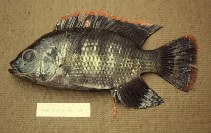
Espinhos dorsais (total) : 15 - 17; Raios dorsais (total) : 11 - 14; Espinhos anais: 3; Raios anais : 9 - 12; Vértebras: 29 - 32. Diagnosis: head profile steep (Ref. 2, 7248, 12524, 13337, 33478, 52193, 54167) and rounded (Ref. 315, 12524). Toothed area of lower pharyngeal bone with broadly rounded lobes; scales on cheek in 2-3 rows; caudal scales variable, not on the inter-radial membranes except at the base, and never stiffening the fin (Ref. 2). Adults with black (Ref. 2, 12524) or dark brown flecks in the temporal region, on the gill-cover (Ref. 2, 11970) and below the eye, mostly associated with openings of the lateral line system (Ref. 2). Adults without conspicuous mid-lateral blotches (Ref. 2).
Body shape (shape guide): fusiform / normal; Cross section: compressed.
Prefers quiet, deep water associated with aquatic vegetation, but has been collected in other habitats as well (Ref. 12524, 13337). Found at temperatures between 18 and 35°C (Ref. 54042). Has a very low salinity tolerance (Ref. 2, 58). Occasionally forms schools, is mainly diurnal (Ref. 2). Feeds mostly on detritus (Ref. 87, 7248, 44661, 52193, 52307, 56192), (blue-green) algae (Ref. 12524, 13337, 44661) and diatoms (Ref. 246, 7248, 12524, 13337, 52193). Juvenile also accepts small invertebrates and zooplankton (Ref. 7248, 52193, 52307), but lose this tendency with age (Ref. 52307). Maternal mouthbrooder (Ref. 87, 246, 314, 5214, 7248, 8600, 12524, 13337, 36094, 52193, 54042). Mating territory having a central volcano-shaped mound (Ref. 2, 246, 314, 5214, 12524, 55074) with a flat or slightly concave top, surrounded by a ditch and vallum, in contrast to O. mweruensis (Ref. 2). Flesh excellent (Ref. 5214).
Breeds in summer (Ref. 2, 7248, 52193). The reproductive season lasts from September to March in the southern regions of the species distribution (Ref. 52307). Males construct (Ref. 2, 13337) and defend (Ref. 2) a nest in shallowish waters (Ref. 2, 13337), which is a central volcano-shaped mound (Ref. 2, 314, 364, 5214, 13337, 55074) with a flat or slightly concave top which is the mating platform, surrounded by a ditch and vallum (groove and boundary wall) (Ref. 2). The cone is higher than the boundary wall of the territory (Ref. 2). Spawns in waters up to 150 (Ref. 2) or 300 (Ref. 52307) cm deep, along banks of the lakes/river (Ref. 2). Males court several females in succession and females may mate with more than one male in a summer, so that large populations of young may build up (Ref. 5214, 52307). Several nests are often grouped into an arena (Ref. 5214, 7248, 36094, 52193). If a male can successfully attract a female to his pit, both fish will swim to the center of the nest; the female then deposits her eggs - about 10-50 per spawn - and the male, possessing tassel-like genital papilla approximately 25 mm in length, swims over the eggs; the female touches the male's tassels with her lips, stimulating him to fertilize the eggs; surely part of the sperm will fertilize the eggs in the female's mouth, but the majority of the fertilization takes place outside, in the crater of the nest; Wickler (1966) wrote that he observed a spermatophore-like structure in this species but Trewavas (1983) wrote that it was more likely a filament of the genital papilla, as she did not observe any spermatophores in this species under natural conditions; pair-bonding does not take place, as partners are only together during spawning; in the wlld, females have been observed spawning with one male and then seeking others out to continue spawning with, in the end brooding some eggs from each; depending on its size, a female can carry up to 1300 eggs in her mouth; eggs have a diameter of 3 mm and are greenish-brown in color; a female can raise multiple broods per season, at about 5·week intervals; brooding females prefer to hide in regions with thick vegetation and cover; fry may initially leave the mother's mouth even before yolk sack is totally absorbed, but remain close together and are reincubated by the mother at night or when threatened; after about 21 days, the babies (about
20 mm long) leave their mother; they spend their earliest days in the shallow waters near the banks, or in other regions that contain plenty of shelter; once they increase in size, they will begin to venture out into more open water (Ref. 52307).
Trewavas, E., 1983. Tilapiine fishes of the genera Sarotherodon, Oreochromis and Danakilia. British Mus. Nat. Hist., London, UK. 583 p. (Ref. 2)
Status na Lista Vermelha da UICN (Ref. 130435: Version 2025-2)
Ameaça para os humanos
Harmless
Uso pelos humanos
Pescarias: espécies comerciais; Aquacultura: espécies comerciais; peixe esportivo: sim
Ferramentas
Relatórios especiais
Baixar XML
Fontes da internet
Estimativas baseadas em modelos
Índice de diversidade filogenética (Ref.
82804): PD
50 = 0.5000 [Uniqueness, from 0.5 = low to 2.0 = high].
Bayesian length-weight: a=0.01479 (0.00838 - 0.02612), b=3.01 (2.86 - 3.16), in cm total length, based on LWR estimates for this species & Genus-body shape (Ref.
93245).
Nível Trófico (Ref.
69278): 2.1 ±0.0 se; based on diet studies.
Generation time: 2.6 (1.1 - 4.0) years. Estimated as median ln(3)/K based on 12
growth studies.
Resiliência (Ref.
120179): Elevada, tempo mínimo de duplicação da população menor que 15 meses (K=0.23-1.0; tm<1).
Vulnerabilidade da pesca (Ref.
59153): Low to moderate vulnerability (35 of 100).
🛈
Nutrientes (Ref.
124155): Calcium = 15.1 [6.2, 80.0] mg/100g; Iron = 1.22 [0.57, 2.91] mg/100g; Protein = 18.1 [16.4, 19.9] %; Omega3 = 0.347 [0.123, 0.961] g/100g; Selenium = 66.1 [25.9, 145.8] μg/100g; VitaminA = 19.7 [4.5, 80.8] μg/100g; Zinc = 2.07 [1.15, 4.89] mg/100g (wet weight);