>
Cichliformes (Cichlids, convict blennies) >
Cichlidae (Cichlids) > Pseudocrenilabrinae
Etymology: Oreochromis: Latin, aurum = gold + Greek, chromis = a fish, perhaps a perch (Ref. 45335); leucostictus: From the Greek "leukostiktos" = with white spots, referring to the white spotted color pattern of this species (Ref. 55074).
More on author: Trewavas.
Issue
Species also referred to as Tilapia nigra x T. zillii (Ref. 5166).
Entorno: milieu / zona climática / rango de profundidad / gama de distribución
Ecología
; agua dulce bentopelágico; pH range: 7.0 - 9.0; dH range: 10 - ?; rango de profundidad 0 - 10 m (Ref. 34291). Tropical; 26°C - 28°C (Ref. 2060); 2°N - 2°S
Africa: Lakes Edward, George and Albert and affluent rivers and streams of these lakes and of the Semliki River (Ref. 5166). Also in tributaries of the Aswa River where it is not certain whether it occurs naturally or has been introduced (Ref. 5166, 34290). Introduced from Lake Albert to Lake Victoria and fish ponds in catchment (Ref. 1739, 4967); also introduced in Lake Kivu (Ref. 107916). Several countries report adverse ecological impact after introduction.
Longitud en la primera madurez / Tamaño / Peso / Edad
Madurez: Lm 19.5, range 6 - 22 cm
Max length : 36.3 cm SL macho / no sexado; (Ref. 56123)
Descripción breve
Claves de identificación | Morfología | Morfometría
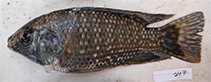
Espinas dorsales (total) : 15 - 18; Radios blandos dorsales (total) : 10 - 13; Espinas anales: 3 - 4; Radios blandos anales: 9 - 11; Vértebra: 27 - 29. Diagnosis: A small medium-sized tilapia, with a relatively deep, flattened body and small head and jaws (Ref. 118638). Lower jaw not longer than 34% of the head, preorbital depth not more than 23.2%; teeth of jaws and pharynx very small, those of the lower pharyngeal restricted to the posterior part of the pad; 27-29 vertebrae (Ref. 2). Scales on lateral line 28-30 (Ref. 2, 34290, 54836), rarely 31 or 32 (Ref. 2). Gill-rakers on lower part of first gill-arch 19-24 (Ref. 34290, 54836). Length/depth ratio of caudal peduncle 0.5-0.8 (Ref. 34290). Males are black with white spots on the flanks and fins; females are more olive coloured, with pale ventral regions, faint vertical barring and dark anal and tail fins (Ref. 2, 4903, 34290, 118638). Lower lip often bluish-white; 8 to 12 dark vertical stripes sometimes visible on flanks (Ref. 2, 4903, 34290). Dorsal, anal and caudal fins dark; soft dorsal, entire caudal and anal fins with well-defined bluish-white spots (Ref. 4903, 34290). Genital papilla intensely white in both sexes (Ref. 2). Ground color in breeding males changes to dark blue-black, whilst whitish spots on body and fins are intensified; eye outstanding with its bright amber iris crossed by a black bar (Ref. 2, 4903, 34290).
Body shape (shape guide): fusiform / normal; Cross section: compressed.
Occupies an inshore zone and is common in lagoons (Ref. 87). Occasionally forms schools (Ref. 2, 39939). Is mainly diurnal (Ref. 2). Can tolerate considerable deoxygenation (Ref. 2, 1739, 4903, 13046, 32297) and warm temperatures (Ref. 2060), known to occur at 38.0 °C (Ref. 2). Feeds on phytoplankton (Ref. 2, 21, 4903, 34291, 55486) and detritus (Ref. 34291, 55486, 56058). Ovophilic (Ref. 2060), a maternal mouthbrooder (Ref. 4903, 34291, 55074, 118638). Males dig simple pits in shallow water (Ref. 118638). Strongly prone to precocious maturity; this makes it an undesirable aquaculture species (Ref. 118638). Caught in large numbers by small-meshed nets in shallow swampy areas, where it has become established (Ref. 118638). When stocked along with Nile tilapia, probably will assist in filling all suitable niches and competitively excluding native species (Ref. 118638).
Breeds over shallow muddy bottoms in sheltered inlets and in the papyrus fringe (Ref. 56123). Ripe males are found near the bottom over particular nesting areas (Ref. 39939). Males establish territory and make a nest by mouth-digging (Ref. 2), actively preventing invasion by other fishes (Ref. 39939). Nests made in shallow water, 15-300cm deep (Ref. 2, 56123), 16-20cm in diameter and 1-4m apart, dug in coarse leaf-debris or on shallow muddy bottoms (Ref. 2, 39939). Brooding females from the lagoons are found in pools adjacent to the lagoons/nursery swamps (Ref. 2, 39939). Fry spent their early days in shallow, grassy (Ref. 2, 32297, 39939) and deoxygenated swamps (Ref. 56123), but move to deeper water as their length increases (Ref. 32297, 39939).
Trewavas, E., 1983. Tilapiine fishes of the genera Sarotherodon, Oreochromis and Danakilia. British Mus. Nat. Hist., London, UK. 583 p. (Ref. 2)
Situación en la Lista Roja de la UICN (Ref. 130435: Version 2025-2)
Amenaza para el ser humano
Potential pest (Ref. 13364)
Usos humanos
Acuicultura: experimental; Acuario: Comercial
Herramientas
Informes especiales
Descargar XML
Fuentes de Internet
Estimaciones basadas en modelos
Índice de diversidad filogenética (Referencia
82804): PD
50 = 0.5000 [Uniqueness, from 0.5 = low to 2.0 = high].
Bayesian length-weight: a=0.01318 (0.00717 - 0.02424), b=2.99 (2.84 - 3.14), in cm total length, based on LWR estimates for this species & Genus-body shape (Ref.
93245).
Nivel trófico (Referencia
69278): 2.3 ±0.14 se; based on food items.
Generation time: 1.8 ( na - na) years. Estimated as median ln(3)/K based on 1
growth studies.
Resiliencia (Referencia
120179): Medio, población duplicada en un tiempo mínimo de 1.4-4.4 años (K=0.63; assumed tmax>2).
Vulnerabilidad pesquera (Ref.
59153): Low vulnerability (25 of 100).
🛈