


Oncorhynchus kisutch (Walbaum, 1792)
Coho salmon
Masukkan pemerhatian anda di Fish Watcher
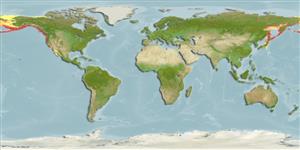
| Native range | All suitable habitat | Point map | Year 2050 |
|
| This map was computer-generated and has not yet been reviewed. |
| Oncorhynchus kisutch AquaMaps Data sources: GBIF OBIS |
muatnaik fotos/gambar dan video
Gambar | video | imej Google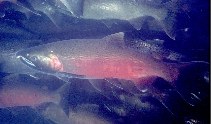 Oncorhynchus kisutch
Male foto/gambar oleh Keeley, E.R.
Gambar | video | imej Google
Male foto/gambar oleh Keeley, E.R.
klasifikasi / Nama Nama-nama umum | Sinonim (persamaan) | Catalog of Fishes(Marga, Jenis) | ITIS | CoL | WoRMS | Cloffa
> Salmoniformes (Salmons) > Salmonidae (Salmonids) > Salmoninae
Etymology: Oncorhynchus: Greek, onyx, -ychos = nail + Greek, rhyngchos = snout (Ref. 45335); kisutch: Most probably a typo in the emendada p720 for kisutch, which is the vernacular name of this fish in Kamtchatka (Ref. 1998).
More on author: Walbaum.
Etymology: Oncorhynchus: Greek, onyx, -ychos = nail + Greek, rhyngchos = snout (Ref. 45335); kisutch: Most probably a typo in the emendada p720 for kisutch, which is the vernacular name of this fish in Kamtchatka (Ref. 1998).
More on author: Walbaum.
Lingkungan: lingkungan / zona iklim / kisaran kedalaman / jangkauan distribusi Ekologi
laut; air tawar; payau pelagic-neritic; anadromus (ruaya dari laut ke air tawar) (Ref. 126106); kisaran kedalaman 0 - 250 m (Ref. 50550). Subtropical; 0°C - 25°C (Ref. 35682); 72°N - 22°N, 135°E - 111°W (Ref. 117423)
Penyebaran Wilayah | Daerah-daerah FAO | Ekosistem | Kemunculan | peta titik | Introduksi | Faunafri
North Pacific: distributed from the Anadyr River in Russia south towards Hokkaido, Japan, and from Point Hope in Alaska southwards to Chamalu Bay in Baja California, Mexico.
Ukuran / Berat / umur
Kematangan: Lm ? range ? - ? cm
Max length : 108 cm TL jantan/; (Ref. 40637); 65.5 cm (female); common length : 71.0 cm TL jantan/; (Ref. 593); common length :59.5 cm (female); Berat maksimum terpublikasi: 15.2 kg (Ref. 40637); Umur maksimum dilaporkan: 5 Tahun (Ref. 36794)
Max length : 108 cm TL jantan/; (Ref. 40637); 65.5 cm (female); common length : 71.0 cm TL jantan/; (Ref. 593); common length :59.5 cm (female); Berat maksimum terpublikasi: 15.2 kg (Ref. 40637); Umur maksimum dilaporkan: 5 Tahun (Ref. 36794)
deskripsi pendek Kunci identifiaksi (pengenalan) | Morfologi | Morfometrik
Duri punggung (Keseluruhan (total)) : 0; duri punggung lunak (Keseluruhan (total)) : 9 - 13; Duri dubur: 0; Sirip dubur lunak: 12 - 17; vertebrata, bertulang belakang: 61 - 69. Characterized by the presence of small black spots on the back and on the upper lobe of the caudal fin, and by the lack of dark pigment along the gum line of the lower jaw (Ref. 27547). The gill rakers are rough and widely spaced; the lateral line is nearly straight (Ref. 27547). The adipose fin is slender; the pelvic fins have an axillary extension (Ref. 27547). Fish in the sea are dark metallic blue or greenish on the back and upper sides, a brilliant silver color on middle and lower sides, and white below; small black spots are present on the back and upper sides and on the upper lobe of the caudal fin (Ref. 27547). During the spawning season fish turn dark to bright green on head and back, bright red on the sides, and often dark on the belly (Ref. 27547). Females are less brightly colored than males (Ref. 27547).
Body shape (shape guide): fusiform / normal.
Body shape (shape guide): fusiform / normal.
The fish occur in the ocean or in lakes; adults return to the rivers where they were born (Ref. 27547). The young fish emerge in springtime and they usually live in fresh water for 1-2 years (sometimes up to 4 years, Ref. 27547); later they migrate at night to freshwater lakes or to the sea (Ref. 1998). Epipelagic (Ref. 58426). The fish that stay more than two years in fresh water and become sexually ripe without ever going to sea, are called residuals; they never spawn (Ref. 27547). Young fish in lakes and rivers eat mainly insects; they stay almost entirely in deep parts of the river and soon become strongly territorial (Ref. 27547). Upon reaching the sea, the smolts remain close to the coast for a certain time, eating planktonic crustaceans (Ref. 27547). As they grow, they migrate farther out into the sea and hunt larger organisms (Ref. 27547) such as jellyfish, squids and fishes (Ref. 58426). They are hunted by various fishes, birds (mergansers, loons and kingfishers), mammals and lampreys (Ref. 1998). This kind is traded as fresh fish, dried or salted, smoked, canned, preserved and frozen (Ref. 9988). They are steamed, grilled, broiled, cooked in the microwave and baked (Ref. 9988).
Siklus hidup dan perilaku kawin Kematangan | Reproduksi, perkembang biakan | Pemijahan | telur-telur | Fekunditas | Larva
Adults migrate from the sea or lake, school at mouths of rivers, and move upstream when rains increase river flow (Ref. 1998). As a rule, the winter entries (December and January) occur in the southern part of the range, with appearance in fresh water becoming progressively earlier to the north (Ref. 30381, 30382, 30383). At the spawning area, the female finds a spot and digs a pitt. At this point she is aggressive toward other females. While digging, an attendant male courts her or is busy driving away other males. As soon as the pitt is completed, the female drops into it and is immediately followed by the male. The pair are side by side, they open their mouth, quiver and release egg and sperm (Ref. 27547). At this point, other males move in and release sperm into the nest (Ref. 1998). The female quickly moves to the upstream edge of the nest and starts digging a new pitt, covering the eggs. The whole process is repeated for several days until the female deposits all her eggs. The male then leaves and may seek another female. The spent female usually continues to dig, until she dies (Ref. 27547).
Reproductive strategy: synchronous ovarian organization, determinate fecundity (Ref. 51846).
rujukan utama
Unggah referensi Anda | Acuan | Koordinator | mitra
Page, L.M. and B.M. Burr, 2011. A field guide to freshwater fishes of North America north of Mexico. Boston : Houghton Mifflin Harcourt, 663p. (Ref. 86798)
Status IUCN Red List (Ref. 130435: Version 2025-2 (Global))
kurang bimbang (LC) ; Date assessed: 27 July 2020
CITES
Not Evaluated
ancaman kepada manusia
Harmless
penggunaan manusia
Perikanan: bernilai komersial tinggi; Budidaya air: komersial; Ikan buruan: ya
FAO - Sistem akuakultur: produksi, profail spesis; Perikanan: pendaratan, profail spesis; Publication: search | FishSource | Laut di Sekitar Kita
informasi lanjut
Dinamika populasi
Parameter pertumbuhan
Maks. usia / ukuran
Panjang-berat rel.
Panjang-panjang rel.
ukuran frekuensi
Konversi massa
pemulihan
Kelimpahan
Parameter pertumbuhan
Maks. usia / ukuran
Panjang-berat rel.
Panjang-panjang rel.
ukuran frekuensi
Konversi massa
pemulihan
Kelimpahan
Siklus hidup
Reproduksi, perkembang biakan
Kematangan
Kedewasaan / insang rel.
Fekunditas
Pemijahan
Agregasi pemijahan
telur-telur
pekembangan telor
Larva
Dinamika larva
Reproduksi, perkembang biakan
Kematangan
Kedewasaan / insang rel.
Fekunditas
Pemijahan
Agregasi pemijahan
telur-telur
pekembangan telor
Larva
Dinamika larva
Anatomi
Area insang
Otak
Otolith
Area insang
Otak
Otolith
Yang berhubungan dengan manusia
Sistem akuakultur
profil budidaya air
Strain
Kasus Ciguatera
Perangko, koin, dll.
Sistem akuakultur
profil budidaya air
Strain
Kasus Ciguatera
Perangko, koin, dll.
Alat, peralatan
Kuis organik | E-book | Penuntun lapangan | Kunci identifiaksi (pengenalan) | tanda freqkuenci panjang | peringkat sejarah hidup | peta titik |
Tangkap-MSY |
laporan khas
muat turun XML
Sumber internet
AFORO (otoliths) | Alien/Invasive Species database | Aquatic Commons | BHL | Cloffa | Websites from users | semak peneliti ikan | CISTI | Catalog of Fishes: Marga, Jenis | DiscoverLife | ECOTOX | FAO - Sistem akuakultur: produksi, profail spesis; Perikanan: pendaratan, profail spesis; Publication: search | Faunafri | Fishipedia | Fishtrace | GloBI | Google Books | Google Scholar | Google | IGFA World Record | Pangkalan data nasional | OceanAdapt | OneZoom | Open Tree of Life | Otolith Atlas of Taiwan Fishes | Akuarium publik | PubMed | Reef Life Survey | pengenalan RFE | Socotra Atlas | TreeBase | Tree of Life | Wikipedia: pergi, Cari | World Records Freshwater Fishing | Catatan Zoologi
Estimasi berdasarkan model
Suhu yang disukai (Acuan 123201): 1 - 8.9, mean 3.9 °C (based on 453 cells).
Indeks keanekaragaman filogenetik (Acuan 82804): PD50 = 0.5000 [Uniqueness, from 0.5 = low to 2.0 = high].
Bayesian length-weight: a=0.01047 (0.00488 - 0.02245), b=3.04 (2.87 - 3.21), in cm total length, based on LWR estimates for this Genus-body shape (Ref. 93245).
Tingkat Trofik (Acuan 69278): 4.2 ±0.70 se; based on food items.
Daya lenting (Acuan 120179): sedang, Waktu penggandaan populasi minimum 1.4 - 4.4 tahun (K=0.98(?); tm=2-4; Fec=1,400).
Prior r = 0.32, 95% CL = 0.21 - 0.48, Based on 2 full stock assessments.
Nutrisi (Ref. 124155): Calcium = 31.9 [13.0, 81.4] mg/100g; Iron = 1.24 [0.62, 2.64] mg/100g; Protein = 19.8 [18.6, 20.9] %; Omega3 = 1.13 [0.55, 2.34] g/100g; Selenium = 161 [50, 502] μg/100g; VitaminA = 12 [3, 42] μg/100g; Zinc = 0.543 [0.347, 1.065] mg/100g (wet weight); based on nutrient studies.