


Oncorhynchus kisutch (Walbaum, 1792)
Coho salmon
Ajouter votre observation dans Fish Watcher
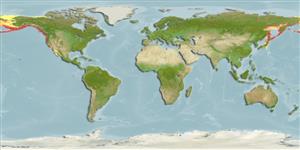
| Native range | All suitable habitat | Point map | Year 2050 |
|
| This map was computer-generated and has not yet been reviewed. |
| Oncorhynchus kisutch AquaMaps Data sources: GBIF OBIS |
Envoyez vos Photos et vidéos
Images | vidéos | Images Google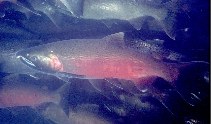 Oncorhynchus kisutch
Male Photo de Keeley, E.R.
Images | vidéos | Images Google
Male Photo de Keeley, E.R.
Classification / Noms Noms communs | Synonymes | Catalog of Fishes(Genre, Espèce) | ITIS | CoL | WoRMS | Cloffa
> Salmoniformes (Salmons) > Salmonidae (Salmonids) > Salmoninae
Etymology: Oncorhynchus: Greek, onyx, -ychos = nail + Greek, rhyngchos = snout (Ref. 45335); kisutch: Most probably a typo in the emendada p720 for kisutch, which is the vernacular name of this fish in Kamtchatka (Ref. 1998).
More on author: Walbaum.
Etymology: Oncorhynchus: Greek, onyx, -ychos = nail + Greek, rhyngchos = snout (Ref. 45335); kisutch: Most probably a typo in the emendada p720 for kisutch, which is the vernacular name of this fish in Kamtchatka (Ref. 1998).
More on author: Walbaum.
Environnement : milieu / zone climatique / profondeur / gamme de distribution Écologie
marin; eau douce; saumâtre pelagic-neritic; anadrome (Ref. 126106); profondeur 0 - 250 m (Ref. 50550). Subtropical; 0°C - 25°C (Ref. 35682); 72°N - 22°N, 135°E - 111°W (Ref. 117423)
Distribution Territoires | Zones FAO | Écosystèmes | Occurrences | Carte par point | Introductions | Faunafri
North Pacific: distributed from the Anadyr River in Russia south towards Hokkaido, Japan, and from Point Hope in Alaska southwards to Chamalu Bay in Baja California, Mexico.
Taille / Poids / Âge
Maturité: Lm ? range ? - ? cm
Max length : 108 cm TL mâle / non sexé; (Ref. 40637); 65.5 cm (female); common length : 71.0 cm TL mâle / non sexé; (Ref. 593); common length :59.5 cm (female); poids max. publié: 15.2 kg (Ref. 40637); âge max. reporté: 5 années (Ref. 36794)
Max length : 108 cm TL mâle / non sexé; (Ref. 40637); 65.5 cm (female); common length : 71.0 cm TL mâle / non sexé; (Ref. 593); common length :59.5 cm (female); poids max. publié: 15.2 kg (Ref. 40637); âge max. reporté: 5 années (Ref. 36794)
Description synthétique Clés d'identification | Morphologie | Morphométrie
Épines dorsales (Total) : 0; Rayons mous dorsaux (Total) : 9 - 13; Épines anales: 0; Rayons mous anaux: 12 - 17; Vertèbres: 61 - 69. Characterized by the presence of small black spots on the back and on the upper lobe of the caudal fin, and by the lack of dark pigment along the gum line of the lower jaw (Ref. 27547). The gill rakers are rough and widely spaced; the lateral line is nearly straight (Ref. 27547). The adipose fin is slender; the pelvic fins have an axillary extension (Ref. 27547). Fish in the sea are dark metallic blue or greenish on the back and upper sides, a brilliant silver color on middle and lower sides, and white below; small black spots are present on the back and upper sides and on the upper lobe of the caudal fin (Ref. 27547). During the spawning season fish turn dark to bright green on head and back, bright red on the sides, and often dark on the belly (Ref. 27547). Females are less brightly colored than males (Ref. 27547).
Body shape (shape guide): fusiform / normal.
Body shape (shape guide): fusiform / normal.
The fish occur in the ocean or in lakes; adults return to the rivers where they were born (Ref. 27547). The young fish emerge in springtime and they usually live in fresh water for 1-2 years (sometimes up to 4 years, Ref. 27547); later they migrate at night to freshwater lakes or to the sea (Ref. 1998). Epipelagic (Ref. 58426). The fish that stay more than two years in fresh water and become sexually ripe without ever going to sea, are called residuals; they never spawn (Ref. 27547). Young fish in lakes and rivers eat mainly insects; they stay almost entirely in deep parts of the river and soon become strongly territorial (Ref. 27547). Upon reaching the sea, the smolts remain close to the coast for a certain time, eating planktonic crustaceans (Ref. 27547). As they grow, they migrate farther out into the sea and hunt larger organisms (Ref. 27547) such as jellyfish, squids and fishes (Ref. 58426). They are hunted by various fishes, birds (mergansers, loons and kingfishers), mammals and lampreys (Ref. 1998). This kind is traded as fresh fish, dried or salted, smoked, canned, preserved and frozen (Ref. 9988). They are steamed, grilled, broiled, cooked in the microwave and baked (Ref. 9988).
Cycle de vie et comportement reproducteur Maturité | Reproduction | Frai | Œufs | Fécondité | Larves
Adults migrate from the sea or lake, school at mouths of rivers, and move upstream when rains increase river flow (Ref. 1998). As a rule, the winter entries (December and January) occur in the southern part of the range, with appearance in fresh water becoming progressively earlier to the north (Ref. 30381, 30382, 30383). At the spawning area, the female finds a spot and digs a pitt. At this point she is aggressive toward other females. While digging, an attendant male courts her or is busy driving away other males. As soon as the pitt is completed, the female drops into it and is immediately followed by the male. The pair are side by side, they open their mouth, quiver and release egg and sperm (Ref. 27547). At this point, other males move in and release sperm into the nest (Ref. 1998). The female quickly moves to the upstream edge of the nest and starts digging a new pitt, covering the eggs. The whole process is repeated for several days until the female deposits all her eggs. The male then leaves and may seek another female. The spent female usually continues to dig, until she dies (Ref. 27547).
Reproductive strategy: synchronous ovarian organization, determinate fecundity (Ref. 51846).
Référence principale
Téléchargez vos références | Références | Coordinateur | Collaborateurs
Page, L.M. and B.M. Burr, 2011. A field guide to freshwater fishes of North America north of Mexico. Boston : Houghton Mifflin Harcourt, 663p. (Ref. 86798)
Statut dans la liste rouge de l'IUCN (Ref. 130435: Version 2025-2 (Global))
Préoccupation mineure (LC) ; Date assessed: 27 July 2020
CITES
Not Evaluated
Menace pour l'homme
Harmless
Utilisations par l'homme
Pêcheries: hautement commercial; Aquaculture: commercial; pêche sportive: oui
FAO - Systèmes d'aquaculture: production, Résumé espèce; pêcheries: débarquements, Résumé espèce; Publication: search | FishSource | Sea Around Us
Plus d'informations
Écologie trophique
Aliments (proies)
Composition du régime alimentaire
Consommation alimentaire
Rations alimentaires
Prédateurs
Aliments (proies)
Composition du régime alimentaire
Consommation alimentaire
Rations alimentaires
Prédateurs
Dynamique des populations
Paramètres de croissance
Âges / tailles maximales
Longueur-poids rel.
Rel. longueur-longueur.
Fréquences de longueurs
Conversion de masse
Recrutement
Abondance
Paramètres de croissance
Âges / tailles maximales
Longueur-poids rel.
Rel. longueur-longueur.
Fréquences de longueurs
Conversion de masse
Recrutement
Abondance
Anatomie
Surface branchiale
Cerveau
Otolithe
Surface branchiale
Cerveau
Otolithe
Liées à l'homme
Systèmes d'aquaculture
Profils d'aquaculture
Souches
Cas de ciguatera
Timbres, pièces de monnaie, divers
Systèmes d'aquaculture
Profils d'aquaculture
Souches
Cas de ciguatera
Timbres, pièces de monnaie, divers
Outils
Quiz bio | E-book | Guide de terrain | Clés d'identification | Générateur de fréquences de longueur | Outil de dynamique de population | Carte par point |
Capture-MSY |
Articles particuliers
Télécharger en XML
Sources Internet
AFORO (otoliths) | Alien/Invasive Species database | Aquatic Commons | BHL | Cloffa | Websites from users | FishWatcher | CISTI | Catalog of Fishes: Genre, Espèce | DiscoverLife | ECOTOX | FAO - Systèmes d'aquaculture: production, Résumé espèce; pêcheries: débarquements, Résumé espèce; Publication: search | Faunafri | Fishipedia | Fishtrace | GloBI | Google Books | Google Scholar | Google | IGFA World Record | Bases de données nationales | OceanAdapt | OneZoom | Open Tree of Life | Otolith Atlas of Taiwan Fishes | Aquariums publics | PubMed | Reef Life Survey | Identification RFE | Socotra Atlas | TreeBase | Arbre de Vie | Wikipedia: aller à, chercher | World Records Freshwater Fishing | Zoological Record
Estimations basées sur des modèles
Température préférée (Réf. 123201): 1 - 8.9, mean 3.9 °C (based on 453 cells).
Indice de diversité phylogénétique (Réf. 82804): PD50 = 0.5000 [Uniqueness, from 0.5 = low to 2.0 = high].
Bayesian length-weight: a=0.01047 (0.00488 - 0.02245), b=3.04 (2.87 - 3.21), in cm total length, based on LWR estimates for this Genus-body shape (Ref. 93245).
Niveau trophique (Réf. 69278): 4.2 ±0.70 se; based on food items.
Résilience (Réf. 120179): Milieu, temps minimum de doublement de population : 1,4 à 4,4 années (K=0.98(?); tm=2-4; Fec=1,400).
Prior r = 0.32, 95% CL = 0.21 - 0.48, Based on 2 full stock assessments.
Nutriments (Ref. 124155): Calcium = 31.9 [13.0, 81.4] mg/100g; Iron = 1.24 [0.62, 2.64] mg/100g; Protein = 19.8 [18.6, 20.9] %; Omega3 = 1.13 [0.55, 2.34] g/100g; Selenium = 161 [50, 502] μg/100g; VitaminA = 12 [3, 42] μg/100g; Zinc = 0.543 [0.347, 1.065] mg/100g (wet weight); based on nutrient studies.