


Coptodon guineensis (Günther, 1862)
Guinean tilapia
Ajouter votre observation dans Fish Watcher
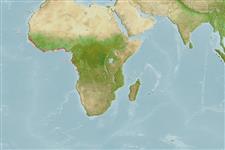
| Native range | All suitable habitat | Point map | Year 2050 |
|
| This map was computer-generated and has not yet been reviewed. |
| Coptodon guineensis AquaMaps Data sources: GBIF OBIS |
Envoyez vos Photos et vidéos
Images | Images Google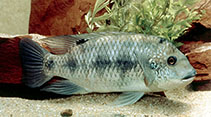 Coptodon guineensis
Photo de Muséum-Aquarium de Nancy/D. Terver
Images | Images Google
Photo de Muséum-Aquarium de Nancy/D. Terver
Classification / Noms Noms communs | Synonymes | Catalog of Fishes(Genre, Espèce) | ITIS | CoL | WoRMS | Cloffa
> Cichliformes (Cichlids, convict blennies) > Cichlidae (Cichlids) > Pseudocrenilabrinae
More on author: Günther.
More on author: Günther.
Environnement : milieu / zone climatique / profondeur / gamme de distribution Écologie
marin; eau douce; saumâtre benthopélagique. Tropical; 22°C - 26°C (Ref. 2059); 36°N - 12°S, 18°W - 16°E
Distribution Territoires | Zones FAO | Écosystèmes | Occurrences | Carte par point | Introductions | Faunafri
Africa: coastal basins, fresh waters, brackish and marine waters from Moulay Bousselham (Canal de Nador), Morocco to mouth of the Cuanza River (Angola) (Ref. 81260), sometimes ascending far up rivers.
Longueur à la première maturité / Taille / Poids / Âge
Description synthétique Clés d'identification | Morphologie | Morphométrie
Épines dorsales (Total) : 14 - 16; Rayons mous dorsaux (Total) : 12 - 13; Épines anales: 3; Rayons mous anaux: 8 - 10. Diagnosis: upper profile of head strongly convex; lower pharyngeal bone about as long as broad, and with anterior lamella shorter than toothed area (Ref. 53405). 10 or fewer rakers on lower limb of first arch; unpaired fins not predominantly red-brown; mouth terminal; 29-30 scales on lateral line; outer row teeth robust (Ref. 81260). Dorsal fin with 14-16 spines and 12-13 soft rays (total rays 27-29) (Ref. 53405, 81260). Anal fin with 3 spines and 8-10 soft rays; caudal fin weakly covered with scales at base or entirely membranous (Ref. 81260). Caudal without spots, grey on upper lobe, yellow on lower; large vertical stripes weakly pronounced on flanks; flank scales with a blackish mark at base (Ref. 53405, 81260). No bifurcated dark vertical bars on flanks; dorsal and anal without orange-red upper margin (Ref. 53405). Length of caudal peduncle 10.5-12.9% of standard length (Ref. 81260).
Body shape (shape guide): fusiform / normal.
Body shape (shape guide): fusiform / normal.
Very tolerant of elevated salinities, found in pure seawater, even reproduction in these highly saline environments is possible (Ref. 52307). Feeds on shrimps, bivalves, plankton (Ref. 28587), detritus (Ref. 28587, 52307), higher plants, algae, aufwuchs and small crustaceans (Ref. 52307). Oviparous (Ref. 205). Very prolific, spawning up to every 3 weeks (Ref. 52307). Pair bonding, open (Ref. 52307) substrate brooder/spawner (Ref. 52307, 81260) with both parents guarding the brood (Ref. 52307).
Cycle de vie et comportement reproducteur Maturité | Reproduction | Frai | Œufs | Fécondité | Larves
Oviparous (Ref. 205). Subtrate guarding of eggs as a form of parental care is done by both male and female (Ref. 50828).
Référence principale
Téléchargez vos références | Références | Coordinateur : Kullander, Sven O. | Collaborateurs
Dunz, A.R. and U.K. Schliewen, 2013. Molecular phylogeny and revised classification of the haplotilapiine cichlid fishes formerly referred to as "Tilapia". Mol. Phylogenet. Evol. 68(1):64-80. (Ref. 93285)
Statut dans la liste rouge de l'IUCN (Ref. 130435: Version 2025-2 (Global))
Préoccupation mineure (LC) ; Date assessed: 21 April 2019
CITES
Not Evaluated
Menace pour l'homme
Harmless
Utilisations par l'homme
Pêcheries: commercial; Aquaculture: commercial
FAO - Publication: search | FishSource |
Plus d'informations
Écologie trophique
Aliments (proies)
Composition du régime alimentaire
Consommation alimentaire
Rations alimentaires
Prédateurs
Aliments (proies)
Composition du régime alimentaire
Consommation alimentaire
Rations alimentaires
Prédateurs
Dynamique des populations
Paramètres de croissance
Âges / tailles maximales
Longueur-poids rel.
Rel. longueur-longueur.
Fréquences de longueurs
Conversion de masse
Recrutement
Abondance
Paramètres de croissance
Âges / tailles maximales
Longueur-poids rel.
Rel. longueur-longueur.
Fréquences de longueurs
Conversion de masse
Recrutement
Abondance
Cycle de vie
Reproduction
Maturité
Maturité/épines rel.
Fécondité
Frai
Agrégats de frai
Œufs
Développement de l'œuf
Larves
Dynamique des populations larvaires
Reproduction
Maturité
Maturité/épines rel.
Fécondité
Frai
Agrégats de frai
Œufs
Développement de l'œuf
Larves
Dynamique des populations larvaires
Anatomie
Surface branchiale
Cerveau
Otolithe
Surface branchiale
Cerveau
Otolithe
Physiologie
Composition corporelle
Nutriments
Consommation d'oxygène
Type de natation
Vitesse de nage
Pigments visuels
Son de poisson
Maladies et parasites
Toxicité (CL50)
Composition corporelle
Nutriments
Consommation d'oxygène
Type de natation
Vitesse de nage
Pigments visuels
Son de poisson
Maladies et parasites
Toxicité (CL50)
Liées à l'homme
Systèmes d'aquaculture
Profils d'aquaculture
Souches
Cas de ciguatera
Timbres, pièces de monnaie, divers
Systèmes d'aquaculture
Profils d'aquaculture
Souches
Cas de ciguatera
Timbres, pièces de monnaie, divers
Outils
Quiz bio | E-book | Guide de terrain | Clés d'identification | Générateur de fréquences de longueur | Outil de dynamique de population | Carte par point |
Capture-MSY |
Articles particuliers
Télécharger en XML
Sources Internet
AFORO (otoliths) | Alien/Invasive Species database | Aquatic Commons | BHL | Cloffa | Websites from users | FishWatcher | CISTI | Catalog of Fishes: Genre, Espèce | DiscoverLife | ECOTOX | FAO - Publication: search | Faunafri | Fishipedia | Fishtrace | GloBI | Google Books | Google Scholar | Google | IGFA World Record | OneZoom | Open Tree of Life | Otolith Atlas of Taiwan Fishes | PubMed | Reef Life Survey | Socotra Atlas | TreeBase | Arbre de Vie | Wikipedia: aller à, chercher | World Records Freshwater Fishing | Zoological Record
Estimations basées sur des modèles
Température préférée (Réf. 123201): 25.5 - 28, mean 27.4 °C (based on 152 cells).
Indice de diversité phylogénétique (Réf. 82804): PD50 = 0.5000 [Uniqueness, from 0.5 = low to 2.0 = high].
Bayesian length-weight: a=0.01479 (0.01258 - 0.01738), b=2.98 (2.94 - 3.02), in cm total length, based on LWR estimates for this species (Ref. 93245).
Niveau trophique (Réf. 69278): 2.8 ±0.33 se; based on food items.
Generation time: 0.8 (0.5 - 1.3) years. Estimated as median ln(3)/K based on 10 growth studies.
Résilience (Réf. 120179): Haut, temps minimum de doublement de population inférieur à 15 mois (K=0.47; Fec < 1,000).