分類 / Names
共通名の | 類義語 | Catalog of Fishes(部類, 種) | ITIS | CoL | WoRMS | Cloffa
Environment: milieu / climate zone / 深さの範囲 / distribution range
生態学
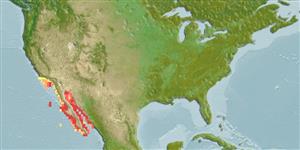
海 関連する礁; 深さの範囲 1 - 200 m (Ref. 37955), usually 1 - 22 m (Ref. 12951). Subtropical; 37°N - 20°N, 125°W - 108°W (Ref. 114953)
Eastern Pacific: California, USA to Mexico, records to Peru probably misidentifications.
Length at first maturity / サイズ / 重さ / 年齢
成熟: Lm 68.0, range 57 - 77 cm
Max length : 83.0 cm オス/雌雄の選別がない; (Ref. 48844); 97.0 cm (female)
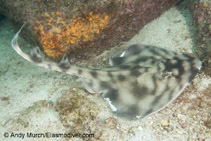
脊つい: 149 - 150. Spiral valve count: 8-10. Broad disc is about as wide as it is long; dorsal surface covered with numerous, small to large, scattered, stellate prickles; a single median row of enlarged thorns running along the mid-back; a broad, short snout; small, blunt, pebble like teeth; a dorsal fin that originates closer to the pelvic fin bases than to the caudal fin origin; a thick tail and a moderately large, rounded caudal fin without a distinct lower lobe. Tooth count: 60-75/60-75.
Coloration: The dorsal surface is sandy brown to dark gray, with several prominent black bars, and lighter below with dark spots on the posterior edge of the pectoral fins.
Body shape (shape guide): other.
Generally in rocky areas mainly shallower than 10 m, moves offshore onto soft bottoms in autumn and winter; but may also be found on sandy bottoms (Ref. 37955, Ref. 114953). Reported from tide pools (Ref. 12951). Relatively docile, harmless rays that are easily approached by divers (Ref. 48844). Feeds mainly on mollusks and crustaceans (Ref. 37955). Ovoviviparous (Ref. 50449), with 4 to 11 pups in a litter (Ref. 51576). Maturity size of males at 64-70 cm TL, females at 57-77 cm TL; birth size at 15-18 cm TL (Ref. 114953). Seldom buries itself in sand. This species is a commercially important part of artisanal fisheries (Ref. 114953).
Etymology: The genus name comes from the Greek za, meaning intensive, and pteryx, meaning fin, in reference to the vertical fins being larger than those of skates. The species name comes from Latin, meaning made rough, in reference to the numerous stellate prickles on its back. (Ref. 48844).
Life cycle and mating behavior
成熟 | 繁殖 | 放精 | 卵 | 生産力 | 幼生
Exhibit ovoviparity (aplacental viviparity), with embryos feeding initially on yolk, then receiving additional nourishment from the mother by indirect absorption of uterine fluid enriched with mucus, fat or protein through specialised structures (Ref. 50449).
During breeding season, male and female adult schools congregate in shallow areas of bays and lagoons (Ref. 51576). Parturition takes place three to four months after mating, with litters of 4 to 11 pups (Ref. 48844).
Compagno, L.J.V., 1999. Checklist of living elasmobranchs. p. 471-498. In W.C. Hamlett (ed.) Sharks, skates, and rays: the biology of elasmobranch fishes. Johns Hopkins University Press, Maryland. (Ref. 35766)
IUCNのレッドリストの状況は (Ref. 130435: Version 2025-1)
Human uses
水産業: 少数商業の
用具
特記事項
XMLをダウンロードして下さい
インターネットの情報源
Estimates based on models
Preferred temperature (参照
123201): 18.1 - 28.5, mean 23.1 °C (based on 64 cells).
Phylogenetic diversity index (参照
82804): PD
50 = 0.6289 [Uniqueness, from 0.5 = low to 2.0 = high].
Bayesian length-weight: a=0.00724 (0.00267 - 0.01964), b=3.00 (2.77 - 3.23), in cm total length, based on LWR estimates for this (Sub)family-body shape (Ref.
93245).
栄養段階 (参照
69278): 3.6 ±0.53 se; based on food items.
Generation time: 7.8 ( na - na) years. Estimated as median ln(3)/K based on 2
growth studies.
回復力 (参照
120179): 非常に低い, 14年以上の倍増期間の最小個体群 (Fec = 4).
Fishing Vulnerability (Ref.
59153): High vulnerability (63 of 100).
🛈
Nutrients (Ref.
124155): Calcium = 9.41 [1.30, 36.16] mg/100g; Iron = 0.385 [0.093, 1.046] mg/100g; Protein = 19.9 [17.7, 21.9] %; Omega3 = 0.146 [0.062, 0.340] g/100g; Selenium = 16.5 [4.8, 49.0] μg/100g; VitaminA = 34.4 [11.2, 110.6] μg/100g; Zinc = 0.605 [0.292, 1.289] mg/100g (wet weight);