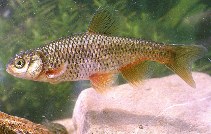
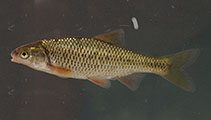
>
Cypriniformes (Carps) >
Leuciscidae (Minnows) > Leuciscinae
Etymology: Sarmarutilus: Derived from the Sarmatic Sea, or Lago Mare, an ancient central European inner freshwater sea where this monotypic genus probably has its evolutionary roots.
More on author: Bonaparte.
Environment: milieu / Zona climática / intervalo de profundidade / distribution range
Ecologia
; Água doce bentopelágico; pH range: 7.0 - ? ; dH range: 20 - ?. Subtropical; 10°C - 27°C (Ref. 2059); 47°N - 38°N, 7°E - 22°E
Europe: Tyrrhenian slope from Magra to Bussento drainages, Adriatic slope from Chienti to Trigno drainages and Ofanto drainage in Italy. Introduced in southern Italy and Sicily; part of range on Adriatic slope and southernmost localities on Tyrrhenian slope possibly results from introductions.
Tamanho / Peso / Idade
Maturidade: Lm ? range ? - ? cm
Max length : 18.0 cm SL macho/indeterminado; (Ref. 59043); idade máx. registrada: 6 anos (Ref. 96829)
Descrição suscinta
Chaves de identificação | Morfologia | Morfometria
Raios dorsais (total) : 11; Raios anais : 12. Formerly placed under Rutilus and cannot be treated under Rutilus and Lecos by the following diagnostic characters: pharyngeal teeth formulae, 5-5; presence of prominent tubercles at the center of each scale of the body and on the head in breeding males; lateral stripe masked by heavy pigmentation on flanks formed by well marked crescent triangular spot on scales; and shape not found in all species of Rutilus and Lecos (Ref. 96829).
Body shape (shape guide): fusiform / normal.
Inhabits streams with moderate current, shallow, sand or gravel bottom, and limited aquatic vegetation (Ref. 59043). Prefers running waters and is not well adapted in still waters (Ref. 96829). Occurs in groups. Feeds on small molluscs and crustaceans, insects and algae. Spawns in clear, shallow water, on gravel and aquatic vegetation on sunny days (Ref. 59043). Attains a maximum size of about 18 cm SL (Ref. 59043), but reported not to exceed 16 cm SL (Ref. 96829). Threatened due to the introduction of other species and habitat destruction. Can colonize lakes in the absence of specialized lacustrine species (Ref. 26100).
A single female usually spawns with 2-5 males (Ref. 59043). Multiple spawner (Ref. 59043).
Bianco, P.G. and V. Ketmaier, 2014. A revision of the Rutilus complex from Mediterranean Europe with description of a new genus, Sarmarutilus, and a new species, Rutilus stoumboudae (Teleostei: Cyprinidae). Zootaxa 3481(3):379-402. (Ref. 96829)
Status na Lista Vermelha da UICN (Ref. 130435: Version 2025-1)
Ameaça para os humanos
Harmless
Uso pelos humanos
Peixe esportivo: sim
Ferramentas
Relatórios especiais
Baixar XML
Fontes da internet
Estimates based on models
Índice de diversidade filogenética (Ref.
82804): PD
50 = 1.0000 [Uniqueness, from 0.5 = low to 2.0 = high].
Bayesian length-weight: a=0.00912 (0.00599 - 0.01390), b=3.22 (3.10 - 3.34), in cm total length, based on LWR estimates for this species & (Sub)family-body (Ref.
93245).
Nível Trófico (Ref.
69278): 2.8 ±0.43 se; based on food items.
Resiliência (Ref.
120179): médio(a), tempo mínimo de duplicação da população 1,4 - 4,4 anos (tmax=9; K=0.12; tm=2).
Fishing Vulnerability (Ref.
59153): Low vulnerability (12 of 100).
🛈