Environment: milieu / climate zone / Tiefenbereich / distribution range
Ökologie
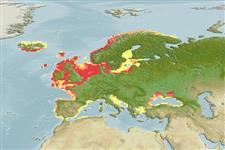
seewasser; brackwasser demersal; tiefenbereich 1 - 96 m (Ref. 57178). Temperate; 72°N - 36°N, 23°W - 42°E
Northeast Atlantic: Murmansk to Spain, including Iceland and the Baltic (Ref. 4674). Reports from the Mediterraneanare misidentications (Ref. 125963). Two distinct but often sympatric spawning groups exist in the area but have not been given subspecies status although spawning groups differ in mean vertebral number (autumn higher than spring), otolith structure, and probably habitats.
Length at first maturity / Size / Gewicht / Alter
Geschlechtsreife: Lm 13.0, range 11 - 15 cm
Max length : 20.0 cm SL Männchen/unbestimmt; (Ref. 3397); max. veröff. Alter: 7 Jahre (Ref. 729)
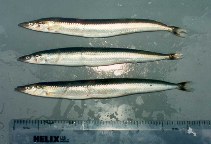
Rückenflossenstacheln (insgesamt) : 0; Rückenflossenweichstrahlen (insgesamt) : 49 - 58; Afterflossenweichstrahlen: 24 - 32; Wirbelzahl: 60 - 68. Scales present in the midline anterior to dorsal fin and over the musculature at base of caudal fin. Belly scales in tight chevron. Margins of dorsal and anal fins straight with rays of equal length. Lateral line pores linearly arranged along the un branched canals. Back typically sandy brown.
Body shape (shape guide): elongated; Cross section: circular.
Territorial; found in inshore waters, especially sandy bays and beaches, including the inter-tidal zone and estuaries; rarely offshore. Alternate between lying buried in the sandy substrate and swimming in schools in the water mass. Adults feed on zooplankton and some large diatoms (Ref. 3397). They hibernate in winter buried in sand at depths of 20-50 cm (Ref. 35388).
Bauchot, M.-L., 1987. Poissons osseux. p. 891-1421. In W. Fischer, M.L. Bauchot and M. Schneider (eds.) Fiches FAO d'identification pour les besoins de la pêche. (rev. 1). Méditerranée et mer Noire. Zone de pêche 37. Vol. II. Commission des Communautés Européennes and FAO, Rome. (Ref. 3397)
IUCN Rote Liste Status (Ref. 130435: Version 2025-1)
Bedrohung für Menschen
Harmless
Nutzung durch Menschen
Fischereien: hoch kommerziell; Köder: usually
Tools
Zusatzinformationen
Download XML
Internet Quellen
Estimates based on models
Preferred temperature (Ref.
123201): 7.3 - 13.5, mean 10.2 °C (based on 738 cells).
Phylogenetic diversity index (Ref.
82804): PD
50 = 0.5078 [Uniqueness, from 0.5 = low to 2.0 = high].
Bayesian length-weight: a=0.00240 (0.00187 - 0.00308), b=3.02 (2.96 - 3.08), in cm total length, based on LWR estimates for this species (Ref.
93245).
Trophic level (Ref.
69278): 3.1 ±0.1 se; based on diet studies.
Generation time: 1.8 (1.4 - 2.6) years. Estimated as median ln(3)/K based on 10
growth studies.
Widerstandsfähigkeit (Ref.
120179): mittel, Verdopplung der Population dauert 1,4 - 4,4 Jahre. (K=0.45-0.77; tm=1-3; tmax=7).
Prior r = 1.02, 95% CL = 0.67 - 1.53, Based on 6 full stock assessments.
Fishing Vulnerability (Ref.
59153): Low vulnerability (23 of 100).
🛈
Nutrients (Ref.
124155): Calcium = 80.7 [45.2, 182.6] mg/100g; Iron = 0.528 [0.273, 0.948] mg/100g; Protein = 19.2 [17.7, 20.6] %; Omega3 = 0.459 [0.238, 0.845] g/100g; Selenium = 12.4 [5.5, 29.2] μg/100g; VitaminA = 20.7 [6.7, 66.3] μg/100g; Zinc = 0.857 [0.585, 1.270] mg/100g (wet weight); based on
nutrient studies.