


Chloroscombrus chrysurus (Linnaeus, 1766)
Atlantic bumper
Waarneming toevoegen in Fish Watcher
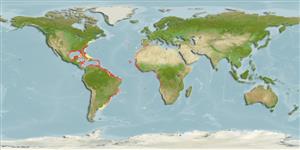
| Native range | All suitable habitat | Point map | Year 2050 |
|
| This map was computer-generated and has not yet been reviewed. |
| Chloroscombrus chrysurus AquaMaps Data sources: GBIF OBIS |
Uploaden van uw Foto's en video's
Afbeeldingen | Geluiden | Google afbeelding Chloroscombrus chrysurus
Afbeelding van Cox, C.D.
Afbeeldingen | Geluiden | Google afbeelding
Afbeelding van Cox, C.D.
Classificatie / Namen Lokale namen | Synoniemen | Catalog of Fishes(Genus, Soort(en)) | ITIS | CoL | WoRMS | Cloffa
> Carangiformes (Jacks) > Carangidae (Jacks and pompanos) > Caranginae
Etymology: Chloroscombrus: Greek, chloros = green + Greek, skombros = the name of several fishes, a mackerel (Ref. 45335).
More on author: Linnaeus.
Etymology: Chloroscombrus: Greek, chloros = green + Greek, skombros = the name of several fishes, a mackerel (Ref. 45335).
More on author: Linnaeus.
Milieu: milieu / Klimaatzone / Diepte / verspreidingsgebied Ecologie
marien; brak water pelagic-neritic; diepte 0 - 110 m (Ref. 114025). Subtropical; 42°N - 41°S, 98°W - 14°E
Verspreiding Gebieden | FAO regio's | Ecosystemen | Voorkomen | Verspreidingskaart | Introducties | Faunafri
Western Atlantic: Massachusetts to Florida, USA and Bermuda to Uruguay; throughout Caribbean Sea and Gulf of Mexico (Ref. 9626); Bahamas, Antilles, along Central and South American coasts to Uruguay (Ref. 26938). Eastern Atlantic: Spain to Angola (Ref. 57392). First recorded from the Mediterranean Sea (Ref. 128468).
Replaced by Chloroscombrus orqueta in eastern Pacific. These two species have not been adequately studied and may prove to be conspecific.
Lengte bij maturiteit / Grootte / Gewicht / Leeftijd
Maturiteit: Lm 12.4, range 10 - ? cm
Max length : 65.0 cm TL mannelijk / geslacht onbekend; (Ref. 57392); common length : 25.0 cm TL mannelijk / geslacht onbekend; (Ref. 5217); max. gepubliceerd gewicht: 121.00 g (Ref. 128468)
Max length : 65.0 cm TL mannelijk / geslacht onbekend; (Ref. 57392); common length : 25.0 cm TL mannelijk / geslacht onbekend; (Ref. 5217); max. gepubliceerd gewicht: 121.00 g (Ref. 128468)
Korte beschrijving Determinatiesleutels | Morfologie | Morfometrie
Dorsale stekels (totaal) : 9; Dorsale zachte stralen (totaal) : 25 - 28; Anale stekels: 3; Anale zachte stralen: 25 - 28. Diagnosis: body compressed and deep (depth comprised from 2.3 to 2.8 times in fork length) (Ref. 57392), its ventral profile distinctly more convex than the dorsal (Ref. 26938, 57392). Snout very short, its tip blunt, upper jaw extending almost to behind level of anterior eye margin; 2 dorsal fins, the first with 8 spines, the second with 1 spine and 25-28 soft rays; anal fin with 2 detached spines, followed by 1 spine and 25-28 soft rays; upper lobe of caudal fin longer than the lower; small, cycloid scales covering most of body, including chest; 5-15 weak scutes on posterior part of lateral line, at level of caudal peduncle, the latter without bilateral keels (Ref. 57392). Metallic blue above, silvery below; caudal peduncle with black saddle spot (Ref. 3197).
Coloration: back greenish or bluish, sides silvery-white; a dark, saddle-shaped blotch on caudal peduncle just before caudal fin, and another at upper angle of gill cover (Ref. 57392).
Body shape (shape guide): fusiform / normal.
Body shape (shape guide): fusiform / normal.
Adults are found over soft bottoms of the continental shelf; sometimes forming schools near the surface (Ref. 5217). Marine pelagic species very common in coastal lagoons and estuaries (Ref. 57392). They feed on fish, cephalopods, zooplankton and detritus (Ref. 28587). Juveniles common in brackish estuaries and often associated with jellyfish (Ref. 5217). Marketed fresh and salted.
Levenscyclus en paargedrag Maturiteit | Voortplanting | Paaien | Eieren | Fecunditeit | Larven
Hoofdreferentie
Upload uw referenties | Referenties | Coördinator : Smith-Vaniz, William F. | Medewerkers
Smith-Vaniz, W.F., J.-C. Quéro and M. Desoutter, 1990. Carangidae. p. 729-755. In J.C. Quero, J.C. Hureau, C. Karrer, A. Post and L. Saldanha (eds.) Check-list of the fishes of the eastern tropical Atlantic (CLOFETA). JNICT, Lisbon; SEI, Paris; and UNESCO, Paris. Vol. 2. (Ref. 7097)
Status op de Rode Lijst van het IUCN (Ref. 130435: Version 2025-2 (Global))
Niet bedreigd (LC) ; Date assessed: 20 August 2012
CITES
Not Evaluated
Gevaar voor de mens
Harmless
Gebruik door de mens
Visserij: commercieel
FAO - visserij: aanvoer; Publication: search | FishSource | Sea Around Us
Meer informatie
Trofische ecologie
Voedsel (prooien)
Dieetsamenstelling
Voedselconsumptie
Voedselrantsoenen
Predatoren
Voedsel (prooien)
Dieetsamenstelling
Voedselconsumptie
Voedselrantsoenen
Predatoren
Populatiedynamica
Groeiparameters
Max. leeftijden / maten
Lengte-gewicht rel.
Lengte-lengte rel.
Lengtefrequenties
Massaconversie
Rekrutering
Abundantie
Groeiparameters
Max. leeftijden / maten
Lengte-gewicht rel.
Lengte-lengte rel.
Lengtefrequenties
Massaconversie
Rekrutering
Abundantie
Levenscyclus
Voortplanting
Maturiteit
Rijpheid/kieuwen rel.
Fecunditeit
Paaien
Paaibestanden
Eieren
Ontwikkeling van de eieren
Larven
Larvale populatiedynamiek
Voortplanting
Maturiteit
Rijpheid/kieuwen rel.
Fecunditeit
Paaien
Paaibestanden
Eieren
Ontwikkeling van de eieren
Larven
Larvale populatiedynamiek
Anatomie
Kieuwoppervlak
Hersenen
Otoliet
Kieuwoppervlak
Hersenen
Otoliet
Fysiologie
Lichaamssamenstelling
Voedingsstoffen
Zuurstofverbruik
Type zwemmen
Zwemsnelheid
Visuele pigmenten
Vis geluid
Ziekten en parasieten
Toxiciteit (LC50)
Lichaamssamenstelling
Voedingsstoffen
Zuurstofverbruik
Type zwemmen
Zwemsnelheid
Visuele pigmenten
Vis geluid
Ziekten en parasieten
Toxiciteit (LC50)
Menselijk gerelateerd
Aquacultuursystemen
Aquacultuurprofielen
Kweeklijnen
Ciguatera gevallen
Postzegels, munten, diversen.
Aquacultuursystemen
Aquacultuurprofielen
Kweeklijnen
Ciguatera gevallen
Postzegels, munten, diversen.
Tools
E-boek | Veldgids | Determinatiesleutels | Lengtefrequentie Tool | Levenscyclus tool | Verspreidingskaart |
Vangst-MSY |
Speciale rapporten
Bekijk gegevens voor het houden in een aquarium | Bekijk Fact Sheets voor de soort | Bekijk Aquacultuur Fact Sheets
Download XML
Internetbronnen
AFORO (otoliths) | Aquatic Commons | BHL | Cloffa | Websites from users | Bekijk FishWatcher | CISTI | Catalog of Fishes: Genus, Soort(en) | DiscoverLife | ECOTOX | FAO - visserij: aanvoer; Publication: search | Faunafri | Fishipedia | Fishtrace | GloBI | GoMexSI (interaction data) | Google Books | Google Scholar | Google | IGFA World Record | Nationale databanken | OceanAdapt | OneZoom | Open Tree of Life | Otolith Atlas of Taiwan Fishes | PubMed | Reef Life Survey | Socotra Atlas | TreeBase | Tree of Life | Wikipedia: ga naar, zoek | World Records Freshwater Fishing | Zoological Record
Schattingen op basis van modellen
Gewenste temperatuur (Ref. 123201): 23.2 - 28, mean 26.2 °C (based on 552 cells).
Fylogenetische diversiteitsindex (Ref. 82804): PD50 = 0.7500 [Uniqueness, from 0.5 = low to 2.0 = high].
Bayesian length-weight: a=0.01202 (0.01068 - 0.01353), b=2.94 (2.91 - 2.97), in cm total length, based on LWR estimates for this species (Ref. 93245).
Trofisch niveau (Ref. 69278): 3.5 ±0.2 se; based on diet studies.
Generation time: 5.0 ( na - na) years. Estimated as median ln(3)/K based on 2 growth studies.
Weerstandsvermogen (Ref. 120179): Gemiddeld, minimale populatieverdubbelingstijd 1,4-4,4 jaar (K=0.22-0.56; assumed tm=1-2).
Prior r = 0.57, 95% CL = 0.37 - 0.85, Based on 3 data-limited stock assessments.
Voedingsstoffen (Ref. 124155): Calcium = 90.6 [51.1, 199.0] mg/100g; Iron = 1.79 [1.02, 3.33] mg/100g; Protein = 20.3 [19.1, 21.5] %; Omega3 = 0.442 [0.268, 0.757] g/100g; Selenium = 26.1 [13.5, 51.0] μg/100g; VitaminA = 6.02 [1.87, 18.28] μg/100g; Zinc = 0.834 [0.576, 1.190] mg/100g (wet weight);