Environment: milieu / climate zone / intervalo de profundidade / distribution range
Ecologia
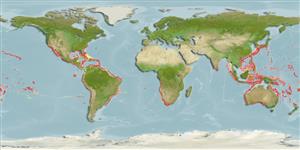
marinhas bentopelágico; intervalo de profundidade 150 - 400 m (Ref. 6181). Tropical; 37°N - 37°S, 180°W - 180°E (Ref. 6181)
Atlantic Ocean: Walvis Ridge, off Puerto Rico and Uruguay. Indian Ocean: off western Australia. Pacific Ocean: off New Guinea, southern Japan, Midway Island, California, Nazca and Sala y Gomez Ridge.
Tamanho / Peso / Idade
Maturidade: Lm ? range ? - ? cm
Max length : 250 cm SL macho/indeterminado; (Ref. 9351); common length : 200 cm SL macho/indeterminado; (Ref. 9351)
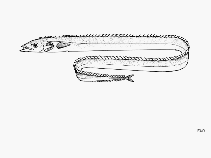
Raios dorsais moles (total) : 116 - 123; Espinhos anais: 2; Raios anais moles: 74 - 87; Vértebras: 125 - 129. Body very elongate and compressed. Head profile straight or scarcely convex, with sagittal crest strongly elevated. Both jaws have a short dermal process; the lower jaw longer than the upper jaw. The dorsal fin has a few weak anterior spines that hardly differ from the soft rays. Body color silvery, dorsal fin membrane black before the third to the fourth soft ray.
Body shape (shape guide): eel-like; Cross section: compressed.
Probably benthopelagic from 150 to 400 m, juveniles epipelagic or mesopelagic. Feeds on fishes (including Engraulis mordax and Merluccius productus off California) and squids. Occasionally hooked, captured in nets, or found washed ashore. No special fishery.
Life cycle and mating behavior
Maturidade | Reprodução | Desova | Ovos | Fecundidade | Larvas
Nakamura, I. and N.V. Parin, 1993. FAO Species Catalogue. Vol. 15. Snake mackerels and cutlassfishes of the world (families Gempylidae and Trichiuridae). An annotated and illustrated catalogue of the snake mackerels, snoeks, escolars, gemfishes, sackfishes, domine, oilfish, cutlassfishes,. scabbardfishes, hairtails, and frostfishes known to date. FAO Fish. Synop. 125(15):136 p. (Ref. 6181)
Categoria na Lista Vermelha da IUCN (Ref. 130435: Version 2025-1)
Ameaça para o homem
Harmless
Utilização humana
Pescarias: pescarias de subsistência
Ferramentas
Relatórios especiais
Descarregue XML
Fontes da internet
Estimates based on models
Preferred temperature (Ref.
123201): 10 - 20.6, mean 14.7 °C (based on 279 cells).
Phylogenetic diversity index (Ref.
82804): PD
50 = 1.0000 [Uniqueness, from 0.5 = low to 2.0 = high].
Bayesian length-weight: a=0.00052 (0.00021 - 0.00129), b=3.13 (2.92 - 3.34), in cm total length, based on LWR estimates for this (Sub)family-body shape (Ref.
93245).
Nível Trófico (Ref.
69278): 4.5 ±0.69 se; based on food items.
Resiliência (Ref.
120179): Baixo, tempo mínimo de duplicação da população 4,5 - 14 anos (Preliminary K or Fecundity.).
Fishing Vulnerability (Ref.
59153): Very high vulnerability (90 of 100).
🛈
Nutrients (Ref.
124155): Calcium = 38.5 [17.7, 76.0] mg/100g; Iron = 0.632 [0.313, 1.202] mg/100g; Protein = 17.7 [16.1, 19.3] %; Omega3 = 0.147 [0.071, 0.331] g/100g; Selenium = 142 [65, 340] μg/100g; VitaminA = 15 [4, 53] μg/100g; Zinc = 0.578 [0.385, 0.925] mg/100g (wet weight);