


Waarneming toevoegen in Fish Watcher
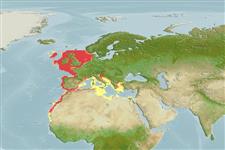
| Native range | All suitable habitat | Point map | Year 2050 |
|
| This map was computer-generated and has not yet been reviewed. |
| Leucoraja naevus AquaMaps Data sources: GBIF OBIS |
Uploaden van uw Foto's en video's
Afbeeldingen | Google afbeelding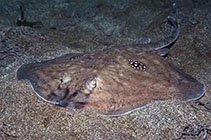 Leucoraja naevus
Afbeelding van Greenfield, J.
Afbeeldingen | Google afbeelding
Afbeelding van Greenfield, J.
Classificatie / Namen Lokale namen | Synoniemen | Catalog of Fishes(Genus, Soort(en)) | ITIS | CoL | WoRMS | Cloffa
Elasmobranchii (haaien en roggen) (sharks and rays) > Rajiformes (Skates and rays) > Rajidae (Skates)
Etymology: Leucoraja: Greek, leykos = white + Latin, raja = a fish, Raja sp. (Ref. 45335).
More on authors: Müller & Henle.
Etymology: Leucoraja: Greek, leykos = white + Latin, raja = a fish, Raja sp. (Ref. 45335).
More on authors: Müller & Henle.
Milieu: milieu / Klimaatzone / Diepte / verspreidingsgebied Ecologie
marien demersaal; diepte 12 - 900 m (Ref. 106604), usually 20 - 250 m (Ref. 11284). Subtropical; 63°N - 15°N, 18°W - 36°E
Verspreiding Gebieden | FAO regio's | Ecosystemen | Voorkomen | Verspreidingskaart | Introducties | Faunafri
Eastern Atlantic: Kattegat (Ref. 3167) and North Sea, around Great Britain, Ireland and the Mediterranean to Morocco and Senegal.
Lengte bij maturiteit / Grootte / Gewicht / Leeftijd
Maturiteit: Lm 57.5, range 45 - 71.8 cm
Max length : 81.0 cm TL mannelijk / geslacht onbekend; (Ref. 106604); 68.0 cm TL (female); common length : 40.0 cm TL mannelijk / geslacht onbekend; (Ref. 3261)
Max length : 81.0 cm TL mannelijk / geslacht onbekend; (Ref. 106604); 68.0 cm TL (female); common length : 40.0 cm TL mannelijk / geslacht onbekend; (Ref. 3261)
Korte beschrijving Determinatiesleutels | Morfologie | Morfometrie
Dorsale stekels (totaal) : 0; Anale stekels: 0. Snout short; upper surface entirely spinulose, but centre of pectoral fins more or less bare in adults, underside smooth except for prickly front edges; generally 9-13 thorns in a complete row around inner margin of eye, and a large triangle of thorns on nape or shoulder region; two parallel rows of strong thorns on each side of midline along tail; upper surface ochre to light greyish-brown with a large roundish black eye-spot in middle of each pectoral fin, underside white (Ref. 3167)
Body shape (shape guide): other; Cross section: flattened.
Body shape (shape guide): other; Cross section: flattened.
Feed on all kinds of bottom animals (Ref. 3167). Maximum sizes of up to 106 cm, that are occasionally reported for specimens from the North Sea are probably erroneous (Ref. 131089). Oviparous. Distinct pairing with embrace. Young may tend to follow large objects, such as their mother (Ref. 205). Eggs are oblong capsules with stiff pointed horns at the corners deposited in sandy or muddy flats (Ref. 205). Egg capsules are 5.0-7.0 cm long and 3.1-3.9 cm wide (Ref. 41250). Around 70-150 eggs are laid per individual annually (Ref. 41250).
Levenscyclus en paargedrag Maturiteit | Voortplanting | Paaien | Eieren | Fecunditeit | Larven
Oviparous, paired eggs are laid. Embryos feed solely on yolk (Ref. 50449). Distinct pairing with embrace. Young may tend to follow large objects, such as their mother (Ref. 205).
Hoofdreferentie
Upload uw referenties | Referenties | Coördinator : McEachran, John | Medewerkers
McEachran, J.D. and K.A. Dunn, 1998. Phylogenetic analysis of skates, a morphologically conservative clade of elasmobranchs (Chondrichthyes: Rajidae). Copeia 1998(2):271-290. (Ref. 27314)
Status op de Rode Lijst van het IUCN (Ref. 130435: Version 2025-2 (Global))
Gevoelig (NT) (A2bd); Date assessed: 20 February 2024
CITES
Not Evaluated
Gevaar voor de mens
Harmless
Gebruik door de mens
Visserij: van minder commercieel belang; Aquarium: Publieke aquaria
FAO - visserij: aanvoer; Publication: search | FishSource | Sea Around Us
Meer informatie
Trofische ecologie
Voedsel (prooien)
Dieetsamenstelling
Voedselconsumptie
Voedselrantsoenen
Predatoren
Voedsel (prooien)
Dieetsamenstelling
Voedselconsumptie
Voedselrantsoenen
Predatoren
Populatiedynamica
Groeiparameters
Max. leeftijden / maten
Lengte-gewicht rel.
Lengte-lengte rel.
Lengtefrequenties
Massaconversie
Rekrutering
Abundantie
Groeiparameters
Max. leeftijden / maten
Lengte-gewicht rel.
Lengte-lengte rel.
Lengtefrequenties
Massaconversie
Rekrutering
Abundantie
Levenscyclus
Voortplanting
Maturiteit
Rijpheid/kieuwen rel.
Fecunditeit
Paaien
Paaibestanden
Eieren
Ontwikkeling van de eieren
Larven
Larvale populatiedynamiek
Voortplanting
Maturiteit
Rijpheid/kieuwen rel.
Fecunditeit
Paaien
Paaibestanden
Eieren
Ontwikkeling van de eieren
Larven
Larvale populatiedynamiek
Fysiologie
Lichaamssamenstelling
Voedingsstoffen
Zuurstofverbruik
Type zwemmen
Zwemsnelheid
Visuele pigmenten
Vis geluid
Ziekten en parasieten
Toxiciteit (LC50)
Lichaamssamenstelling
Voedingsstoffen
Zuurstofverbruik
Type zwemmen
Zwemsnelheid
Visuele pigmenten
Vis geluid
Ziekten en parasieten
Toxiciteit (LC50)
Menselijk gerelateerd
Aquacultuursystemen
Aquacultuurprofielen
Kweeklijnen
Ciguatera gevallen
Postzegels, munten, diversen.
Aquacultuursystemen
Aquacultuurprofielen
Kweeklijnen
Ciguatera gevallen
Postzegels, munten, diversen.
Tools
E-boek | Veldgids | Determinatiesleutels | Lengtefrequentie Tool | Levenscyclus tool | Verspreidingskaart |
Vangst-MSY |
Speciale rapporten
Bekijk gegevens voor het houden in een aquarium | Bekijk Fact Sheets voor de soort | Bekijk Aquacultuur Fact Sheets
Download XML
Internetbronnen
AFORO (otoliths) | Aquatic Commons | BHL | Cloffa | Websites from users | Bekijk FishWatcher | CISTI | Catalog of Fishes: Genus, Soort(en) | DiscoverLife | ECOTOX | FAO - visserij: aanvoer; Publication: search | Faunafri | Fishipedia | Fishtrace | GloBI | Google Books | Google Scholar | Google | IGFA World Record | Nationale databanken | OneZoom | Open Tree of Life | Otolith Atlas of Taiwan Fishes | Publieke aquaria | PubMed | Reef Life Survey | Socotra Atlas | TreeBase | Tree of Life | Wikipedia: ga naar, zoek | World Records Freshwater Fishing | Zoological Record
Schattingen op basis van modellen
Gewenste temperatuur (Ref. 123201): 7.2 - 16.7, mean 10.5 °C (based on 1278 cells).
Fylogenetische diversiteitsindex (Ref. 82804): PD50 = 0.5000 [Uniqueness, from 0.5 = low to 2.0 = high].
Bayesian length-weight: a=0.00245 (0.00211 - 0.00286), b=3.22 (3.18 - 3.26), in cm total length, based on LWR estimates for this species (Ref. 93245).
Trofisch niveau (Ref. 69278): 4.2 ±0.3 se; based on diet studies.
Weerstandsvermogen (Ref. 120179): laag, minimale populatieverdubbelingstijd 4,5-14 jaar (K=0.11-0.16; tm=8-9; tmax=28; Fec<100).
Prior r = 0.41, 95% CL = 0.27 - 0.61, Based on 1 full stock assessment.
Voedingsstoffen (Ref. 124155): Calcium = 14 [2, 254] mg/100g; Iron = 0.805 [0.076, 9.895] mg/100g; Protein = 16.4 [14.4, 18.5] %; Omega3 = 0.488 [0.206, 1.165] g/100g; Selenium = 28.6 [5.5, 148.2] μg/100g; VitaminA = 8.99 [0.73, 103.53] μg/100g; Zinc = 0.415 [0.024, 4.858] mg/100g (wet weight);