


Ajouter votre observation dans Fish Watcher
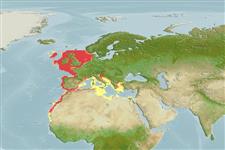
| Native range | All suitable habitat | Point map | Year 2050 |
|
| This map was computer-generated and has not yet been reviewed. |
| Leucoraja naevus AquaMaps Data sources: GBIF OBIS |
Envoyez vos Photos et vidéos
Images | Images Google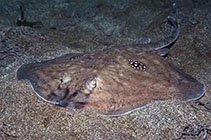 Leucoraja naevus
Photo de Greenfield, J.
Images | Images Google
Photo de Greenfield, J.
Classification / Noms Noms communs | Synonymes | Catalog of Fishes(Genre, Espèce) | ITIS | CoL | WoRMS | Cloffa
Élasmobranches (requins et raies) (sharks and rays) > Rajiformes (Skates and rays) > Rajidae (Skates)
Etymology: Leucoraja: Greek, leykos = white + Latin, raja = a fish, Raja sp. (Ref. 45335).
More on authors: Müller & Henle.
Etymology: Leucoraja: Greek, leykos = white + Latin, raja = a fish, Raja sp. (Ref. 45335).
More on authors: Müller & Henle.
Environnement : milieu / zone climatique / profondeur / gamme de distribution Écologie
marin démersal; profondeur 12 - 900 m (Ref. 106604), usually 20 - 250 m (Ref. 11284). Subtropical; 63°N - 15°N, 18°W - 36°E
Distribution Territoires | Zones FAO | Écosystèmes | Occurrences | Carte par point | Introductions | Faunafri
Eastern Atlantic: Kattegat (Ref. 3167) and North Sea, around Great Britain, Ireland and the Mediterranean to Morocco and Senegal.
Longueur à la première maturité / Taille / Poids / Âge
Maturité: Lm 57.5, range 45 - 71.8 cm
Max length : 81.0 cm TL mâle / non sexé; (Ref. 106604); 68.0 cm TL (female); common length : 40.0 cm TL mâle / non sexé; (Ref. 3261)
Max length : 81.0 cm TL mâle / non sexé; (Ref. 106604); 68.0 cm TL (female); common length : 40.0 cm TL mâle / non sexé; (Ref. 3261)
Description synthétique Clés d'identification | Morphologie | Morphométrie
Épines dorsales (Total) : 0; Épines anales: 0. Snout short; upper surface entirely spinulose, but centre of pectoral fins more or less bare in adults, underside smooth except for prickly front edges; generally 9-13 thorns in a complete row around inner margin of eye, and a large triangle of thorns on nape or shoulder region; two parallel rows of strong thorns on each side of midline along tail; upper surface ochre to light greyish-brown with a large roundish black eye-spot in middle of each pectoral fin, underside white (Ref. 3167)
Body shape (shape guide): other; Cross section: flattened.
Body shape (shape guide): other; Cross section: flattened.
Feed on all kinds of bottom animals (Ref. 3167). Maximum sizes of up to 106 cm, that are occasionally reported for specimens from the North Sea are probably erroneous (Ref. 131089). Oviparous. Distinct pairing with embrace. Young may tend to follow large objects, such as their mother (Ref. 205). Eggs are oblong capsules with stiff pointed horns at the corners deposited in sandy or muddy flats (Ref. 205). Egg capsules are 5.0-7.0 cm long and 3.1-3.9 cm wide (Ref. 41250). Around 70-150 eggs are laid per individual annually (Ref. 41250).
Cycle de vie et comportement reproducteur Maturité | Reproduction | Frai | Œufs | Fécondité | Larves
Oviparous, paired eggs are laid. Embryos feed solely on yolk (Ref. 50449). Distinct pairing with embrace. Young may tend to follow large objects, such as their mother (Ref. 205).
Référence principale
Téléchargez vos références | Références | Coordinateur : McEachran, John | Collaborateurs
McEachran, J.D. and K.A. Dunn, 1998. Phylogenetic analysis of skates, a morphologically conservative clade of elasmobranchs (Chondrichthyes: Rajidae). Copeia 1998(2):271-290. (Ref. 27314)
Statut dans la liste rouge de l'IUCN (Ref. 130435: Version 2025-2 (Global))
Quasi-menacé (NT) (A2bd); Date assessed: 20 February 2024
CITES
Not Evaluated
Menace pour l'homme
Harmless
Utilisations par l'homme
Pêcheries: intérêt commercial mineur; Aquarium: Aquariums publics
FAO - pêcheries: débarquements; Publication: search | FishSource | Sea Around Us
Plus d'informations
Écologie trophique
Aliments (proies)
Composition du régime alimentaire
Consommation alimentaire
Rations alimentaires
Prédateurs
Aliments (proies)
Composition du régime alimentaire
Consommation alimentaire
Rations alimentaires
Prédateurs
Dynamique des populations
Paramètres de croissance
Âges / tailles maximales
Longueur-poids rel.
Rel. longueur-longueur.
Fréquences de longueurs
Conversion de masse
Recrutement
Abondance
Paramètres de croissance
Âges / tailles maximales
Longueur-poids rel.
Rel. longueur-longueur.
Fréquences de longueurs
Conversion de masse
Recrutement
Abondance
Cycle de vie
Reproduction
Maturité
Maturité/épines rel.
Fécondité
Frai
Agrégats de frai
Œufs
Développement de l'œuf
Larves
Dynamique des populations larvaires
Reproduction
Maturité
Maturité/épines rel.
Fécondité
Frai
Agrégats de frai
Œufs
Développement de l'œuf
Larves
Dynamique des populations larvaires
Physiologie
Composition corporelle
Nutriments
Consommation d'oxygène
Type de natation
Vitesse de nage
Pigments visuels
Son de poisson
Maladies et parasites
Toxicité (CL50)
Composition corporelle
Nutriments
Consommation d'oxygène
Type de natation
Vitesse de nage
Pigments visuels
Son de poisson
Maladies et parasites
Toxicité (CL50)
Liées à l'homme
Systèmes d'aquaculture
Profils d'aquaculture
Souches
Cas de ciguatera
Timbres, pièces de monnaie, divers
Systèmes d'aquaculture
Profils d'aquaculture
Souches
Cas de ciguatera
Timbres, pièces de monnaie, divers
Outils
E-book | Guide de terrain | Clés d'identification | Générateur de fréquences de longueur | Outil de dynamique de population | Carte par point |
Capture-MSY |
Articles particuliers
Télécharger en XML
Sources Internet
AFORO (otoliths) | Aquatic Commons | BHL | Cloffa | Websites from users | FishWatcher | CISTI | Catalog of Fishes: Genre, Espèce | DiscoverLife | ECOTOX | FAO - pêcheries: débarquements; Publication: search | Faunafri | Fishipedia | Fishtrace | GloBI | Google Books | Google Scholar | Google | IGFA World Record | Bases de données nationales | OneZoom | Open Tree of Life | Otolith Atlas of Taiwan Fishes | Aquariums publics | PubMed | Reef Life Survey | Socotra Atlas | TreeBase | Arbre de Vie | Wikipedia: aller à, chercher | World Records Freshwater Fishing | Zoological Record
Estimations basées sur des modèles
Température préférée (Réf. 123201): 7.2 - 16.7, mean 10.5 °C (based on 1278 cells).
Indice de diversité phylogénétique (Réf. 82804): PD50 = 0.5000 [Uniqueness, from 0.5 = low to 2.0 = high].
Bayesian length-weight: a=0.00245 (0.00211 - 0.00286), b=3.22 (3.18 - 3.26), in cm total length, based on LWR estimates for this species (Ref. 93245).
Niveau trophique (Réf. 69278): 4.2 ±0.3 se; based on diet studies.
Résilience (Réf. 120179): Faible, temps minimum de doublement de population : 4,5 à 14 années (K=0.11-0.16; tm=8-9; tmax=28; Fec<100).
Prior r = 0.41, 95% CL = 0.27 - 0.61, Based on 1 full stock assessment.
Nutriments (Ref. 124155): Calcium = 14 [2, 254] mg/100g; Iron = 0.805 [0.076, 9.895] mg/100g; Protein = 16.4 [14.4, 18.5] %; Omega3 = 0.488 [0.206, 1.165] g/100g; Selenium = 28.6 [5.5, 148.2] μg/100g; VitaminA = 8.99 [0.73, 103.53] μg/100g; Zinc = 0.415 [0.024, 4.858] mg/100g (wet weight);