>
Eupercaria/misc (Various families in series Eupercaria) >
Nemipteridae (Threadfin breams, Whiptail breams)
Etymology: Nemipterus: Greek, nema, -atos = filament + Greek, pteron = wing, fin (Ref. 45335).
More on author: Snyder.
Environment: milieu / climate zone / Tiefenbereich / distribution range
Ökologie
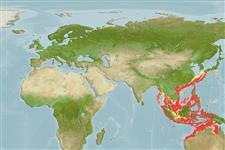
seewasser demersal; tiefenbereich 35 - 300 m (Ref. 9785). Tropical; 34°N - 23°S, 90°E - 141°E (Ref. 3810)
Western Pacific: southern Japan to Indonesia and northwestern Australia.
Length at first maturity / Size / Gewicht / Alter
Geschlechtsreife: Lm 11.9 range ? - ? cm
Max length : 24.0 cm SL Männchen/unbestimmt; (Ref. 108763); common length : 16.0 cm SL Männchen/unbestimmt; (Ref. 3810); max. veröff. Alter: 10 Jahre (Ref. 52946)
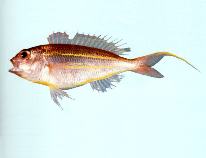
Rückenflossenstacheln (insgesamt) : 10; Rückenflossenweichstrahlen (insgesamt) : 9; Afterflossenstacheln: 3; Afterflossenweichstrahlen: 7. Suborbital spine absent. Preopercle with 3 transverse scale rows. Pectoral fins long, reaching almost to level of origin of anal fin. Pelvic fins moderately long, reaching beyond anus. A line drawn upwards from the posterior edge of suborbital reaching the dorsal profile in front of origin of dorsal fin. Upper lobe of caudal fin falcate and yellow, usually ribbon-like in adults. Axillary scale present. Color: Upper body pinkish, silvery below.
Body shape (shape guide): fusiform / normal; Cross section: oval.
Found on sand or mud bottoms. Abundant in depths between 45 and 90 m, but larger fish generally occur in depths greater than 110 m. Larger fish feed mainly on crustaceans, fish and cephalopods. Young fish (< 12 cm) eat copepods, ostracods and amphipods.
This species is a rudimentary hermaphrodite, in which males have functional testes but also with rudimentary ovarian portions that remain throughout their life.
Russell, B.C., 1990. FAO Species Catalogue. Vol. 12. Nemipterid fishes of the world. (Threadfin breams, whiptail breams, monocle breams, dwarf monocle breams, and coral breams). Family Nemipteridae. An annotated and illustrated catalogue of nemipterid species known to date. FAO Fish. Synop. 125(12):149p. Rome: FAO. (Ref. 3810)
IUCN Rote Liste Status (Ref. 130435: Version 2025-1)
Bedrohung für Menschen
Harmless
Nutzung durch Menschen
Fischereien: kommerziell
Tools
Zusatzinformationen
Download XML
Internet Quellen
Estimates based on models
Preferred temperature (Ref.
123201): 18.2 - 27.8, mean 23.9 °C (based on 515 cells).
Phylogenetic diversity index (Ref.
82804): PD
50 = 0.5000 [Uniqueness, from 0.5 = low to 2.0 = high].
Bayesian length-weight: a=0.01349 (0.01122 - 0.01622), b=2.96 (2.92 - 3.00), in cm total length, based on LWR estimates for this species (Ref.
93245).
Trophic level (Ref.
69278): 4.0 ±0.55 se; based on food items.
Widerstandsfähigkeit (Ref.
120179): mittel, Verdopplung der Population dauert 1,4 - 4,4 Jahre. (tmax=8-10).
Fishing Vulnerability (Ref.
59153): Low to moderate vulnerability (30 of 100).
🛈