Priacanthus tayenus, Purple-spotted bigeye : fisheries

You can sponsor this page

Priacanthus tayenus Richardson, 1846

Purple-spotted bigeye
Add your observation in Fish Watcher
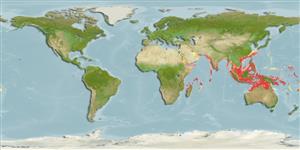
Native range | All suitable habitat | Point map | Year 2050
This map was computer-generated and has not yet been reviewed.
Priacanthus tayenus   AquaMaps   Data sources: GBIF OBIS
Upload your photos and videos
तस्वीरे | Google image
Image of Priacanthus tayenus (Purple-spotted bigeye)
Priacanthus tayenus
Picture by CSIRO

Classification / Names आम नाम | उपशब्द | Catalog of Fishes(वर्ग, प्रजाति) | ITIS | CoL | WoRMS | Cloffa

> Eupercaria/misc (Various families in series Eupercaria) > Priacanthidae (Bigeyes or catalufas)
Etymology: Priacanthus: Greek, prion = saw + Greek, akantha = thorn (Ref. 45335).
More on author: Richardson.

Environment: milieu / climate zone / गहराई सीमा / distribution range पारिस्थितिकी

समुद्री प्रवाल-भित्ति संयुक्त; गहराई सीमा 20 - 200 m (Ref. 11441). Tropical; 30°N - 19°S

वितरण देश | ऐफ ऐ ओ क्षेत्र | Ecosystems | संयोग | बिन्दु नक्शा | भूमिका | Faunafri

Indo-West Pacific: Persian Gulf to the western coast of India, eastward to the Pacific, where it occurs from Taiwan southward to the Arafura Sea (Ref. 9819) and northern Queensland, Australia (Ref. 3414).

Length at first maturity / आकार / वज़न / Age

परिपक्व अवधि: Lm 21.1  range ? - ? cm
Max length : 35.0 cm TL पुल्लिंग / अलिंग; (Ref. 11441); common length : 25.0 cm TL पुल्लिंग / अलिंग; (Ref. 3483)

Short description पहचान कुंजी | आकृति विज्ञान | मौरफोमैटरिक्स


Body shape (shape guide): fusiform / normal.

जीवविज्ञान     शब्द संग्रह (उदाहरणार्थ epibenthic)

Inhabits coral or rocky areas. Sometimes forms aggregations. Feeds on a wide variety of benthic animals. Smaller fish are mostly found inshore. Marketed mostly fresh, whole or dried-salted.

Life cycle and mating behavior परिपक्व अवधि | पुनरुत्पत्ति | मछलीऔ का अंडे देना | अंडे | Fecundity | लार्वा

Main reference Upload your references | संदर्भ | संयोजक | सहयोगीयो

Starnes, W.C., 1988. Revision, phylogeny and biogeographic comments on the circumtropical marine percoid fish family Priacanthidae. Bull. Mar. Sci. 43(2):117-203. (Ref. 5403)

IUCN Red List Status (Ref. 130435: Version 2025-1)

  Least Concern (LC) ; Date assessed: 10 March 2015

CITES

Not Evaluated

CMS (Ref. 116361)

Not Evaluated

Threat to humans

  Harmless


Human uses

मात्स्यिकी: लघु वाणिज्य
FAO - Publication: search | FishSource |

अधिक जानकारी

Trophic ecology
Food items (preys)
संघटक आहार
आहार खपत
Food rations
परभक्षी
पारिस्थितिकी
पारिस्थितिकी
Home ranges
Life cycle
पुनरुत्पत्ति
परिपक्व अवधि
Maturity/Gills rel.
Fecundity
मछलीऔ का अंडे देना
Spawning aggregations
अंडे
Egg development
लार्वा
लारवल गतिकी
वितरण
देश
ऐफ ऐ ओ क्षेत्र
Ecosystems
संयोग
भूमिका
BRUVS - Videos
Anatomy
गिल क्षेत्र
Brain
Otolith
Physiology
Body composition
Nutrients
Oxygen consumption
Swimming type
Swimming speed
Visual pigments
Fish sound
Diseases & Parasites
Toxicity (LC50s)
आनुवंशिकी
Genome
आनुवंशिकी
Heterozygosity
हैरेटिबिलटी
Human related
Aquaculture systems
जलीयकृषि रूपरेखाऐ
खींच
Ciguatera cases
Stamps, coins, misc.
संदर्भ
संदर्भ

साधन

Special reports

Download XML

इंटरनेट स्रोत

Estimates based on models

Preferred temperature (संदर्भ 123201): 21.9 - 28.3, mean 26.8 °C (based on 847 cells).
Phylogenetic diversity index (संदर्भ 82804):  PD50 = 0.5002   [Uniqueness, from 0.5 = low to 2.0 = high].
Bayesian length-weight: a=0.02138 (0.01572 - 0.02907), b=2.89 (2.81 - 2.97), in cm total length, based on LWR estimates for this species (Ref. 93245).
Trophic level (संदर्भ 69278):  3.8   ±0.3 se; based on diet studies.
Generation time: 1.6 (1.2 - 1.8) years. Estimated as median ln(3)/K based on 12 growth studies.
लौटाव (संदर्भ 120179):  ऊंचा, न्यूनतम जनसंख्या दुगनी समय अवलागत 15 महीने। (K=0.55-1.23; tm=0.75; Fec=123,500).
Fishing Vulnerability (Ref. 59153):  Low vulnerability (23 of 100). 🛈
Price category (Ref. 80766):   High.
Nutrients (Ref. 124155):  Calcium = 53.2 [33.9, 86.8] mg/100g; Iron = 0.65 [0.42, 1.03] mg/100g; Protein = 19.3 [18.3, 20.3] %; Omega3 = 0.176 [0.124, 0.251] g/100g; Selenium = 45.4 [28.3, 74.4] μg/100g; VitaminA = 61.3 [25.2, 151.0] μg/100g; Zinc = 1.08 [0.80, 1.46] mg/100g (wet weight);