


Nothobranchius guentheri (Pfeffer, 1893)
Redtail notho
Adicionar o seu Fotografias e vídeos
Fotografias | Selos, moedas, diversos. | Imagem do Google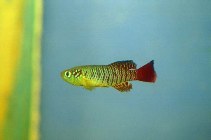 Nothobranchius guentheri
Fotografia de JJPhoto
Fotografias | Selos, moedas, diversos. | Imagem do Google
Fotografia de JJPhoto
Classificação / Nomes Nomes comuns | Sinónimos | Catalog of Fishes(Género, Espécies) | ITIS | CoL | WoRMS | Cloffa
> Cyprinodontiformes (Rivulines, killifishes and live bearers) > Nothobranchiidae (African rivulines)
Etymology: Nothobranchius: Greek, nothos = false + Greek, brangchia = gill (Ref. 45335).
Eponymy: Dr Albert Karl Ludwig Gotthilf Günther (1830–1914) was a German-born British zoologist, ichthyologist and herpetologist. [...] (Ref. 128868), visit book page.
Etymology: Nothobranchius: Greek, nothos = false + Greek, brangchia = gill (Ref. 45335).
Eponymy: Dr Albert Karl Ludwig Gotthilf Günther (1830–1914) was a German-born British zoologist, ichthyologist and herpetologist. [...] (Ref. 128868), visit book page.
Ambiente: milieu / zona climática / intervalo de profundidade / gama de distribuição Ecologia
; Água doce bentopelágico; pH range: 6.0 - 7.0; dH range: 4 - 10; não migratória (Ref. 126106). Tropical; 22°C - 25°C (Ref. 1672)
Distribuição Territórios | Áreas FAO | Ecossistemas | Ocorrências | Mapa dos pontos | Introduções | Faunafri
Africa: endemic to Unguja Island, Zanzibar archipelago, eastern Tanzania (Ref. 122075).
Tamanho / Peso / Idade
Maturidade: Lm ? range ? - ? cm
Max length : 3.5 cm SL macho/indeterminado; (Ref. 122075); 3.2 cm SL (female)
Max length : 3.5 cm SL macho/indeterminado; (Ref. 122075); 3.2 cm SL (female)
Descrição breve Chaves de identificação | Morfologia | Morfometria
Espinhos dorsais (total) : 0; Raios dorsais moles (total) : 15 - 16; Espinhos anais: 0; Raios anais moles: 15 - 16; Vértebras: 28. Diagnosis: It is distinguished from all congeners by the combination of the following character states: caudal fin red with black posterior margin in males; flank and fins without dark spots in females; pre-dorsal length in males 57.5-61.4% of standard length; 3 + 12-14 gill-rakers on first branchial arch; 27-28 scales in longitudinal series; 14 series of scales around caudal peduncle; single longitudinal row of scales between anterior supraorbital series of neuromasts; anterior supraorbital series of neuromasts arranged in two sections, anterior section with one well-developed neuromast, posterior with two; three neuromasts in posterior supraorbital series; 26-27 caudal-fin rays; 28 vertebrae; second proximal radial of dorsal fin between neural spines of 10th and 12th vertebrae (Ref. 122075).
Body shape (shape guide): fusiform / normal; Cross section: compressed.
Body shape (shape guide): fusiform / normal; Cross section: compressed.
Found in temporary pools, swamps, ditches and small streams (Ref. 3788). Used for biological control of mosquitos (Ref. 3788). One of the so called 'annual fishes' which has eggs that can withstand seasonal droughts (Ref. 1739). A bottom spawner, 3-4 months incubation. Quite popular with aquarists; difficult to maintain in an aquarium (Ref. 27139).
Ciclo de vida e comportamento de acasalamento Maturidade | Reprodução | Desova | Ovos | Fecundidade | Larvas
Thrives in seasonal rainwater pools. Spawns throughout the short breeding period until the pool dries up and all fish die except their drought-resistant eggs. Eggs go through a dry period of many weeks. When rain comes and pool fills, most of the eggs begin to develop and hatch within hours. Fry grow very fast. In only 6 to 8 weeks they are sexually mature and start breeding (Ref. 7062). In aquaria, males showed aggressive behavior toward each other. Females were being pushed down to the substratum by the males as a prelude to spawning.
Referência principal
Carregar as suas referências | Referências | Coordenador | Colaboradores
Huber, J.H., 1996. Killi-Data 1996. Updated checklist of taxonomic names, collecting localities and bibliographic references of oviparous Cyprinodont fishes (Atherinomorpha, Pisces). Société Française d'Ichtyologie, Muséum National d'Histoire Naturelle, Paris, France, 399 p. (Ref. 27139)
Categoria na Lista Vermelha da IUCN (Ref. 130435: Version 2025-2 (Global))
Ameaçada (EN) (B1ab(iii,iv)+2ab(iii,iv)); Date assessed: 09 December 2018
CITES
Not Evaluated
Ameaça para o homem
Harmless
Utilização humana
Pescarias: sem interesse; Aquário: Espécies comerciais
FAO - Publication: search | FishSource |
Mais informação
Ecologia Trófica
Produtos alimentares (presas)
Composição da dieta
Consumo alimentar
Rações alimentares
Predadores
Produtos alimentares (presas)
Composição da dieta
Consumo alimentar
Rações alimentares
Predadores
Dinâmica das populações
Parâmetros de crescimento
Idades / tamanhos máximos
Comprimento-peso rel.
Comprimento-comprimento rel.
Frequência de comprimento
Conversão de massa
Recrutamento
Abundância
Parâmetros de crescimento
Idades / tamanhos máximos
Comprimento-peso rel.
Comprimento-comprimento rel.
Frequência de comprimento
Conversão de massa
Recrutamento
Abundância
Ciclo de vida
Reprodução
Maturidade
Maturidade/Rel. das guelras
Fecundidade
Desova
Agregações de desova
Ovos
Desenvolvimento dos ovos
Larvas
Dinâmica larvar
Reprodução
Maturidade
Maturidade/Rel. das guelras
Fecundidade
Desova
Agregações de desova
Ovos
Desenvolvimento dos ovos
Larvas
Dinâmica larvar
Anatomia
Área branquial
Cérebro
Otólitos
Área branquial
Cérebro
Otólitos
Fisiologia
Composição corporal
Nutrientes
Consumo de oxigénio
Tipo de natação
Velocidade de natação
Pigmentos visuais
Som de peixe
Doenças e Parasitas
Toxicidade (LC50s)
Composição corporal
Nutrientes
Consumo de oxigénio
Tipo de natação
Velocidade de natação
Pigmentos visuais
Som de peixe
Doenças e Parasitas
Toxicidade (LC50s)
Relacionado com o ser humano
Sistemas de aquacultura
Perfis para aquacultura
Estirpes
Casos de Ciguatera
Selos, moedas, diversos.
Sistemas de aquacultura
Perfis para aquacultura
Estirpes
Casos de Ciguatera
Selos, moedas, diversos.
Ferramentas
E-book | Guia de campo | Ferramenta auxiliar de frequências de comprimento | Ferramenta sobre a história de vida | Mapa dos pontos |
Captura-MSY |
Relatórios especiais
Descarregue XML
Fontes da internet
AFORO (otoliths) | Alien/Invasive Species database | Aquatic Commons | BHL | Cloffa | Websites from users | Consultar FishWatcher | CISTI | Catalog of Fishes: Género, Espécies | DiscoverLife | ECOTOX | FAO - Publication: search | Faunafri | Fishipedia | Fishtrace | GloBI | Google Books | Google Scholar | Google | IGFA World Record | OneZoom | Open Tree of Life | Otolith Atlas of Taiwan Fishes | PubMed | Reef Life Survey | Socotra Atlas | TreeBase | Árvore da vida | Wikipedia: ir para, procurar | World Records Freshwater Fishing | Registo zoológico
Estimativas baseadas em modelos
Índice de diversidade filogenética (Ref. 82804): PD50 = 0.5000 [Uniqueness, from 0.5 = low to 2.0 = high].
Bayesian length-weight: a=0.01096 (0.00461 - 0.02608), b=2.94 (2.74 - 3.14), in cm total length, based on LWR estimates for this (Sub)family-body shape (Ref. 93245).
Nível Trófico (Ref. 69278): 3.2 ±0.4 se; based on size and trophs of closest relatives
Resiliência (Ref. 120179): Elevada, tempo mínimo de duplicação da população menor que 15 meses (tm= 0.12-0.15; tmax < 1 yr).